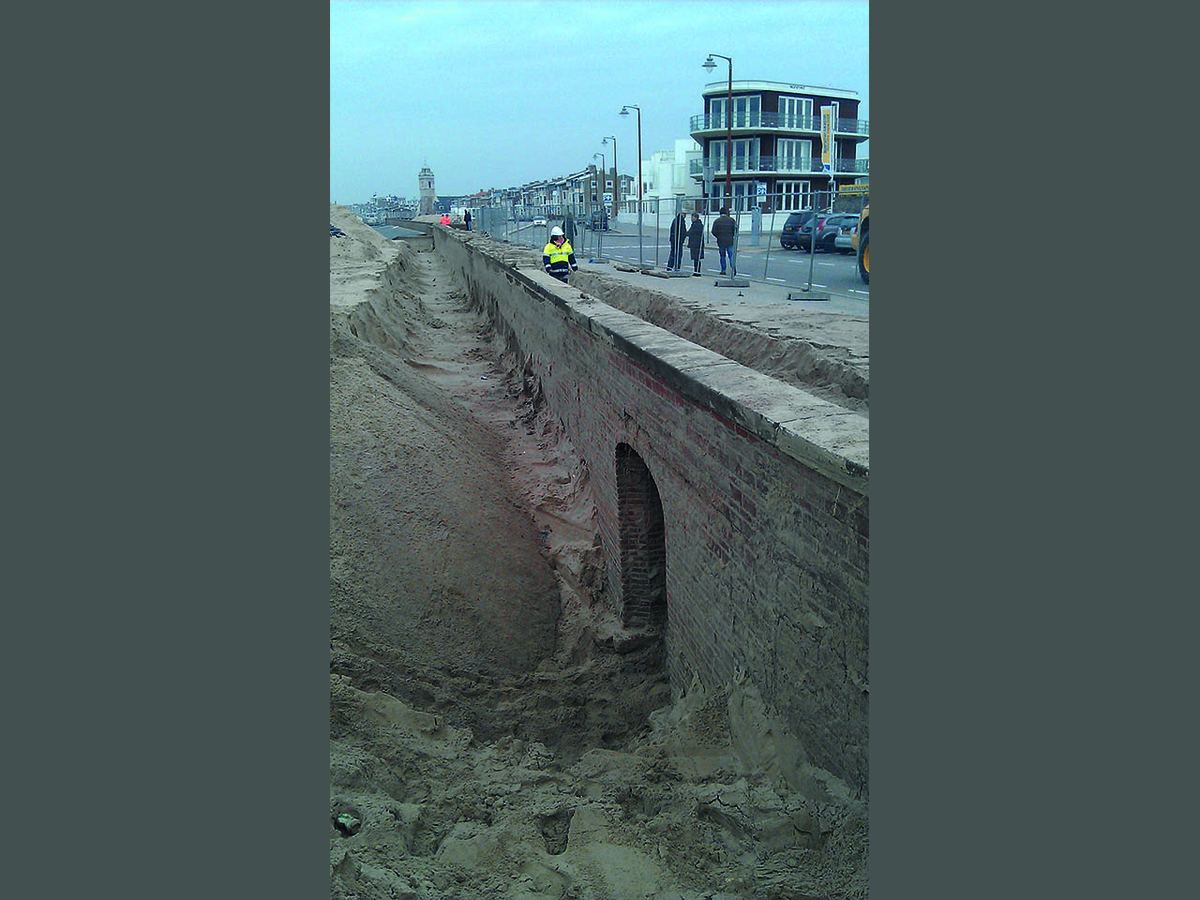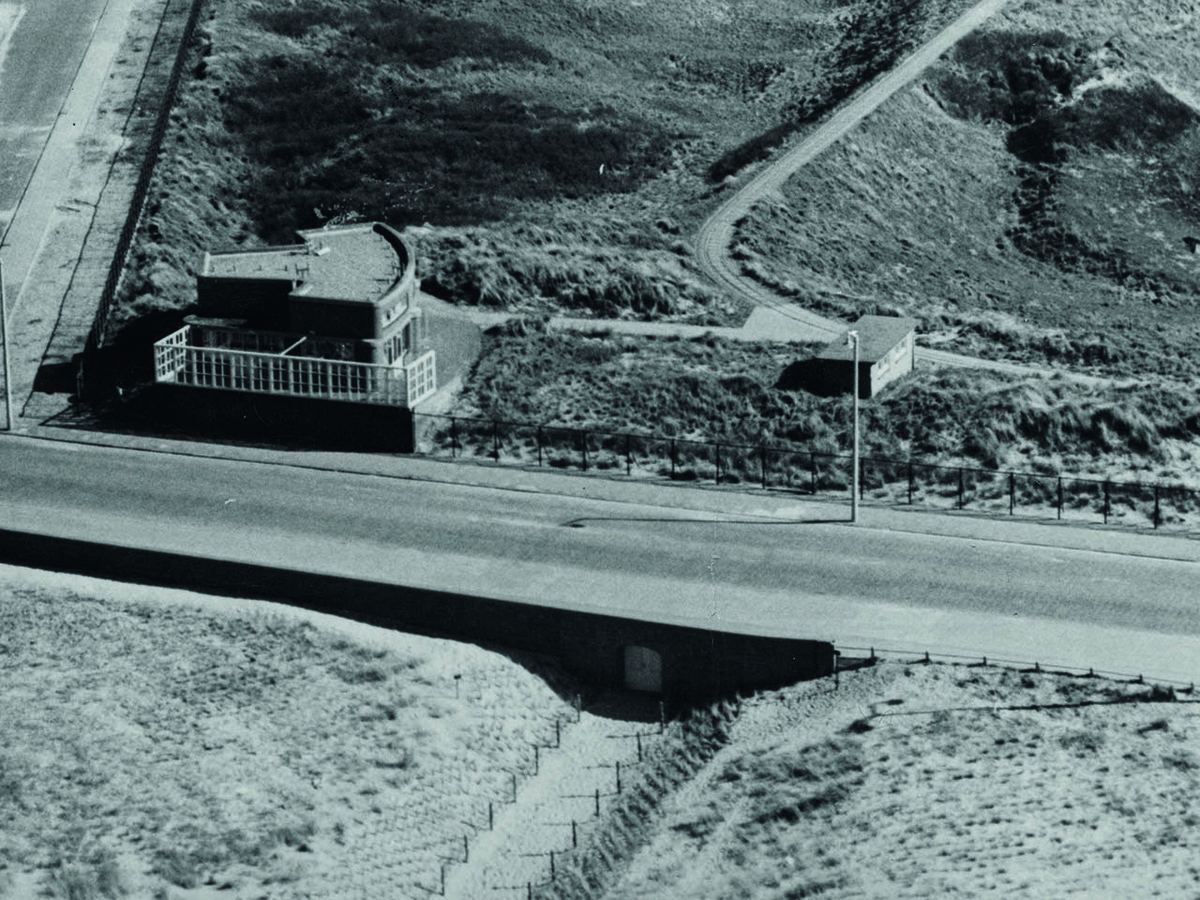
In the autumn of 1941 Alex Wiesinger, together with Freddy Berlage and Lex da Costa, tried to escape to England through the ‘zeehostunneltje’, the little tunnel at the children’s seaside hospital in Katwijk. His account gives a vivid picture of what went on in that narrow passage beneath the promenade.
I saw many advantages in crossing the North Sea directly: self-reliance in planning and execution, independence and speed. I thought of a folding canoe, but knew too little about the type. By chance my path crossed with those of two students, Adri Oosters and Hans Kerkhoff. Both had suddenly vanished and, according to a girlfriend, were already ‘on the other side’. I could hardly believe my ears and was instantly, wildly jealous. So these two had simply slipped across on a calm night! Someone who lived in her house said he had received word that Oosters and Kerkhoff had arrived.
In March I bought a folding canoe from under the nose of someone who had telephoned about it from The Hague. Freddy Berlage was willing to contribute up to 250 guilders. Freddy had already inspected the launching place, to which we had an introduction: a passage beneath the promenade at Katwijk, leading out of a children’s sanatorium. Oosters and Kerkhoff had set off from this tunnel. A month later it turned out that they had never reached England, nor had they fallen into German hands; most probably they had drowned. Yet this news did not shake me from my plan, because I judged the conditions under which those boys had left far less favourable than the ones we intended to set out in. They had left on a freezing February night in an open boat in which you cannot move, so they ran a serious risk of exposure. They had no experience of folding canoes and divided the work quite differently. The man in front could only keep a lookout, while the man behind had to hold the course and at the same time operate and adjust the engine and refuel it every half hour. That was an unnecessary burden, but perhaps more serious was the position of the compass: in front of the rear man, with the engine mounted beside him, so that it must have suffered a severe deviation that could hardly be corrected. All in all, I believed we were in a far better position: thorough training, summer night temperatures and a better division of labour.
‘On top of the dune beside the tunnel stood a machine gun’
I spent my holidays looking for a new launching place. We cycled along the coast: Noordwijk, where we had our eye on a house that seemed ideal to rent; Katwijk, where, however, a machine gun stood on top of the dune beside the tunnel; Scheveningen, Maassluis, Hoek van Holland, Ter Heide, ’s-Gravenzande, Wijk aan Zee, Den Briel, Castricum… We also still had to solve the transport problem and run in the engine. At Abcoude we made a trial run on the Gein. It turned into hours of fiddling about: the engine would start, but I kept choking it. I pulled myself silly, and only after fitting a new spark plug did it work. We went up and down the Gein a few times. Speed: about 17 km an hour. At sea I reckoned on making 10 to 12, and on covering the 200 km to Lowestoft within 20 hours. Over the following days we painted the boat grey and fitted dual steering.
My cousin Bob Crone came with me on the train as far as Haarlem; we travelled first class so that we could talk undisturbed. The next morning he was to visit my mother and hand her a letter from me together with the key to my desk. I had removed from it everything that might enlighten anyone investigating me. Many letters I was fond of had to go up in smoke, as did my account book. Over a year I had saved 750 guilders from my salary, 600 of which had been swallowed up by the plans. The rest I left in my cousin’s keeping. If I was not back by Christmas, he was to give part of it to my mother and keep the rest as a present.
Lex was waiting for me in Leiden, and together we began the last leg: the tram to Katwijk. We arrived as dusk fell. Freddy was waiting at the tram stop. At the dress rehearsal in Amsterdam we had had two helpers; now two Leiden students, Bart Hofdijk and Hans Buning, had offered to assist us so that they could learn. They planned to leave from the same spot in a folding canoe shortly and wanted to see how a launch worked in practice.
We all settled into a hollow in the dunes, fairly close to the sanatorium, where, as arranged, the vehicle carrying my boat would pull up. Meanwhile our third helper, a man called Van Dorp, told me he had already helped seven folding canoes out to sea, of which one was certain to have arrived. It had been the most slovenly and amateurishly equipped of them all, crewed by two dreamers, and had set off on the longest night of the year, right under the eyes of the machine-gun post!
The boat was delivered that evening at about ten o’clock. The lorry stopped in front of the sanatorium. The carrier pointed out that petrol was leaking from one of the cases. By now it was eleven, and, heavily laden, we began the slow, stealthy trek through the night to the tunnel 100 metres further on. The late delivery had already put me badly behind schedule. Under normal circumstances I could have the boat completely ready to launch in an hour and a half. But since I now had only torchlight to work by, I had to allow two to three hours. The moon would rise at around four, which we did not expect to matter once we were at sea. By first light we would already be sixty kilometres out, hopefully beyond the patrol zone of the German E-boats. Still, everyone knew the story of a naval officer who had been picked up by an E-boat in a folding canoe within sight of the English coast, which cost him two years in prison.
‘We put out our lamps and stood stock-still for ten minutes in the dark of the tunnel’
It was half past eleven by the time we had taken up our position in the tunnel. The grounds lay right up against the promenade, separated from it by a high fence. The tunnel itself ran directly beneath the promenade. On the seaward side it was closed by a door, but on the landward side it was completely open, so we had to rely on our torches for light. Any sound would be clearly audible on the promenade above the tunnel, so we set up a lookout post behind a bush on the other side of the fence to keep watch on the promenade. A rope connected this post to the tunnel entrance. If a patrol approached, the lookout would tug the rope, and the man at the entrance would then flash a light signal into the tunnel. Assembling the boat was my department, and Freddy held the light for me.
We had barely opened the luggage when the first alarm came. We put out our lamps and stood stock-still. But when nothing could be heard outside for quite a while, we began to feel rather uneasy. After ten minutes standing in the dark, word came from the man behind the bush: he had mistaken a post for a man and raised the alarm to be on the safe side. After that I set to work feverishly on the assembly, which was no easy matter on the sandy floor and in the poor light. The batteries also ran down far sooner than the supplier had led us to believe. From then on the alarm was raised every half hour, and some time later we heard a patrol passing over our heads, so the work had to stop again. It was quite a sensation to hear the enemy walking a metre away, but we soon got used to it. Above all, our sense of being a team kept our spirits up. Once a motorcycle went by, and the noise thundered through the tunnel.
I had been working without a break for three hours and was sweating heavily. To my alarm I realised it was already three o’clock. Outside the surf boomed monotonously; the torches grew ever dimmer. It felt as if I had been crawling around this dark hole for a whole day and night. The petrol fumes stung our eyes and noses. A 5-litre can had been punctured, but Van Dorp was able to find us a new one, which he dug up from somewhere in the sand. We had only an hour left before the moon rose, so there was no question of any finishing touches. On Freddy’s suggestion I left everything that could still be done at sea, such as refuelling. The supplies were quickly stowed wherever there was room. We felt as though it was almost morning. We put on inflatable lifebelts, sou’westers and jumpers, and rolled up our trouser legs, since we would have to wade in above our knees. Going barefoot was too risky because of injuries, so we wore tennis shoes, which we would swap for a dry pair once in the boat.
At about a quarter past three Van Dorp opened the door to the beach. We said goodbye to our helpers. I gave Lex my ration coupons, and Freddy tucked the last newspaper into his inside pocket. The cool night air streamed in, and the boom and hiss of the surf drowned out everything else. No footsteps could be heard. Now came the great gamble. Besides the patrols marching along the promenade, there were also beach patrols, which we could not see from the grounds. So the moment we opened the gate, one of those patrols might be passing.
‘It was like being born, and the sight of the sea was overwhelming’
It is hard to imagine that Van Dorp was now taking this gamble for the seventh time. The moment never failed to make a deep impression on him, he told us, once he had checked the surroundings. It was like being born, and the sight of the sea was overwhelming. The surf, forty metres away, was a single band of light; this phosphorescence was a magnificent natural spectacle.
Then the four of us lifted the boat. The Leiden students stayed in the grounds. It was a crushing load, and in the soft sand we had to stop once and change places, since the engine end was the heaviest. The boat slid into the water, and it was as if a fountain of gold washed over the bow. Around our ankles, too, everything splashed gold, and when we had taken our seats and made the first strokes with the paddles, they too sprayed golden water. It was indescribably beautiful, and for a moment I no longer felt tired.
Our companions had disappeared, and every sound was drowned by the surf. In front of me I saw Freddy paddling, while I, having climbed in last, was not yet sitting properly with my legs on the bottom. The surf was not especially rough. We had made about ten strokes when, for no reason I could explain, I suddenly felt the boat slide away from under me. We went under, but luckily we did not stay caught in the boat; we dropped out of it like ripe apples. Fortunately I could touch the bottom, but my left arm had come out of its socket, a chronic complaint of mine. A quick shake put it back, but meanwhile we watched the boat drift away northwards as if on a fast current. Afterwards we concluded that the treacherous current of a ground swell had capsized us.
With our paddles over our shoulders we waded ashore, utterly dumbfounded and sobered. Water sloshed in my shoes, which I kicked off on Freddy’s advice. We had only one thought: to get ourselves to safety. Reluctantly, but as quick as lightning, our minds, which had been entirely set on the crossing, switched to ‘full speed astern’. Luckily no patrol passed, and we knocked cautiously on the tunnel door… Would they open it, or had they gone? Would they think we were Germans and make themselves scarce? Van Dorp opened up, and the others heard with dismay what had happened to us. Yet the situation was so comical that we all broke into a relieved laugh. But when they heard that the boat had been washed away, the mood sank. After a brief discussion it seemed unwise to try to salvage the boat, which was bound to wash ashore before long. Every trace had to be removed from the tunnel, and then we would see.
Freddy and I went on ahead and rested by the sanatorium. We were wet and felt wretched as we made our way back barefoot through the dunes, pricked by thorns and stubbing our feet on stones. We waited for the others in a small hollow and revived ourselves with cognac. Twenty minutes later we were all together; the paddles had been pushed into a rabbit hole and everything else hidden in Van Dorp’s house. Surely the boat had already washed ashore and been found by a patrol. A little earlier my subconscious had reminded me that the New Testament lying in the boat bore my name. This night seemed set to turn out badly for me. In a kind of vision I saw my life taking an entirely different course because of it. At the same time I was overcome by gratitude that I was still completely free. There was nothing for it but to accept Van Dorp’s hospitality and change out of our wettest clothes.
Then the six of us sat down around the table with a pack of cards, ready to pretend we were playing bridge if the house was searched. Six men at four in the morning! We talked the situation over at length, and for the first time I saw the faces of my Leiden helpers. They were keen to disappear at once, until the telephone suddenly rang shrilly. Van Dorp’s mother, in her dressing gown, picked up the receiver. It was the stoker, who lived in a house by the entrance to the sanatorium. He said that a German officer and a soldier had asked for the key to the tunnel, and shortly afterwards he came to collect it. In the meantime it seemed better to make out that the whole household was asleep and that we were simply staying the night, so we all crept into various beds. All night we expected the house to be raided at any moment, but when nothing had happened by seven o’clock, daylight seemed to have chased away our unlucky star.
Word came that the German officer had concluded from the smell of petrol in the tunnel that a boat had left that night; the boat, however, had been found and people had been arrested. The Leiden students decided to leave at once on their bicycles. A few minutes later, dressed in Van Dorp’s clothes, Freddy and I took the same road on his parents’ tandem, and Lex followed shortly after. As we cycled past the sanatorium, everything looking bright and cheerful in the daylight, a few windows opened above us and the nurses called the big news to one another: ‘Have you heard? A boat left for England from here last night.’
Only once the village was behind us did we feel completely safe. For part of the way we rode alongside a farmer, with whom we made unremarkable conversation. Van Dorp later told us that ten minutes after we left, a German guard was posted at the gate to their grounds and the site was searched thoroughly. Parts of a folding canoe were found there, belonging to someone who, without Van Dorp’s knowledge, had wanted to launch from the same place. Van Dorp himself was not under suspicion, and fortunately the family suffered no further trouble. On German orders, however, the matron of the seaside hospital had to warn the staff not to get involved in illegal activities. The tunnel also had to be bricked up, which was done soon afterwards.
Meanwhile I set course for The Hague. Freddy mourned his lost tin of Chesterfields, while I begrudged the Germans my ten bars of chocolate, all full milk, of a kind I had not tasted myself for a year.
Alexander Friedrich Carl Wiesinger’s account was given to us, at the request of George Makowski, by his daughter Judith Wiesinger in Canada. Jos Teunissen edited it.