Anyone who reads the former De Schakel, the magazine of the Genootschap Engelandvaarders, or the ‘London interrogations’ of a number of “Engelandvaarders” regularly comes across the name Davids. Davids ‘tirelessly toured the prisons and, by bribing guards, got countless “Engelandvaarders” released’, wrote Agnes Dessing. Who was this man, mentioned without exception in glowing terms?
Joachim Cesar Davids was born in Rotterdam on 10 September 1909; his father was a toy wholesaler. After his military service he trained in the toy trade, but the economic crisis of the 1920s led him to move to Paris in 1927, where he specialised in barter transactions for a French firm.
During the Dutch mobilisation of 1939 he served with the 22nd Infantry Regiment, and he was discharged in May 1940. He then returned to France, where his firm sent him to Spain to buy supplies for the French steel industry.
The war in France and the subsequent demarcation line between occupied France and so-called ‘free France’ (Vichy France) made his life very unsettled. He travelled to Madrid, back to France (Vichy, Ax-les-Thermes, Perpignan) and then back to Spain again, where he reported to the Dutch legation and consulate in Madrid. There he was taken on by the legation to help Dutch refugees.
In that role he would prove enormously valuable. He visited all kinds of prisons and camps where he knew Dutch nationals were held. When he could not secure their immediate release, he would, for example, arrange food for the Dutch prisoners, as rations in those places left a great deal to be desired.
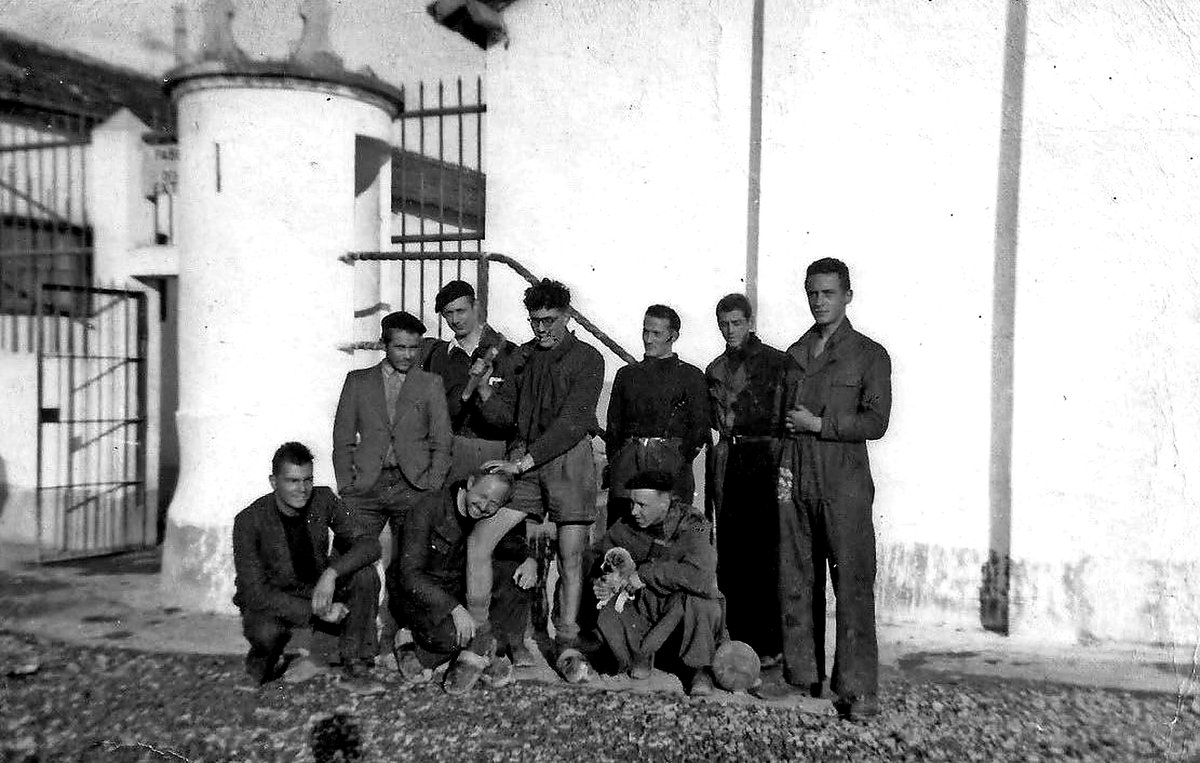
Many “Engelandvaarders” in Spain ended up in the camp at Miranda de Ebro. The Spanish government had originally set it up to hold Spaniards captured during the civil war (opponents of Franco). Miranda was not comparable to the German concentration camps; rather, as one Dutchman put it, it was ‘an overcrowded open-air waiting room’, with just a few water taps and a latrine where dysentery bacteria ran riot.
As the war went on, the wait for release grew shorter. Miranda was crowded with prisoners from many European countries: British, French, Belgian and many Dutch. “Engelandvaarder” Timmers Verhoeven wrote about Davids in De Schakel: ‘Mr Davids regularly appeared at the gate of Miranda, where, armed with an impressive box of cigars and an equally fat wallet, he asked for an interview with El Coronel Jefe del Campo de la Capitania General de la sexta región militar.’
That was how Davids bribed the guards. ‘Davids usually succeeded, and you could tell from his ear-to-ear grin as he left.’ It was his standard method, at other camps and prisons too.
Davids also arranged decent lodgings, far better than a primitive local cell. “Engelandvaarder” Herman van Nouhuys wrote: ‘Arrived in Spain on 27 October (1943) in a hamlet called Ochagavía. Reported to the police at Ochagavía on 28 October. Transferred to Pamplona on 29 October, where Mr Davids got him out of prison the same day.’ Via Madrid, Van Nouhuys reached Lisbon, and from there he arrived in Glasgow on 7 March 1944.
“Engelandvaarder” Willebeek le Mair was arrested after arriving in Spain and taken to Pamplona: ‘there they put us in a holding cell. Hundreds of names of British, Dutch, Americans and so on were written on the walls. One by one we were searched again. Suddenly Mr Davids walked in. All honour to this man. After some talk they gave us a slip of paper and we were allowed into town with Davids. He took us to an excellent hotel.’ The next day Davids bought Willebeek le Mair new clothes and shoes at the consulate’s expense, as his old gear was completely worn out. There are many more examples of Davids helping Dutch “Engelandvaarders”.
After the war it was calculated that Davids had secured the release of roughly 300 Dutch “Engelandvaarders”, so that they reached England much sooner and could join the fight against the Nazis.
After the German surrender Davids stayed on at the legation in Madrid until mid-1947, now employed by the Ministry of Economic Affairs. He then went back to working for himself, handling barter transactions in Madrid for various firms. His attempts to obtain a permanent post at the Dutch legation in Madrid or Paris failed, probably because he was not thought to fit in with the other legation staff. One Dutch official wrote: ‘…there is no exceptionally great enthusiasm for this, either from Paris or on my part…’
Until 1970 Davids did reasonably well as a self-employed trader, but after that his (financial) fortunes declined. He ended up in rather straitened circumstances, which led the Social Committee of the Genootschap Engelandvaarders to set up a Davids Fund. In 1993 De Schakel called on those Davids had helped to contribute, so that he could receive a little monthly pocket money on top of his meagre state pension, as he had been refused a special war pension. About 50 people from some eight countries responded, and their contributions made his life somewhat more comfortable.
Also in 1993, a decision finally allowed Davids to be granted a special pension after all (his first application dated from 1978!). Sadly, he did not enjoy it for long. In May 1994 he was admitted to hospital in Amersfoort with various medical problems. After his discharge he was cared for at the Sinai Centre in Amersfoort, an institution for people suffering from, among other things, war trauma. He died there on 10 September 1994, aged 85. ‘José Davids is no more, but in our memories he will live on as the support and mainstay of many “Engelandvaarders” stranded in Spain’, wrote the editor of De Schakel.
Davids’ report on freeing prisoners from Miranda (in Dutch)
Selected sources
De Schakel, magazine of the Genootschap Engelandvaarders
A. Dessing, Tulpen voor Wilhelmina, Amsterdam 2004.
Ruud Yap, En verder hoorden we niets, on Dutch internees in the Spanish concentration camp at Miranda de Ebro 1940-1944, master’s thesis, VU Amsterdam 2004.
Idem, in: De Schakel no. 107, October 2005, pp. 14-21.
José Angel Fernandez Lopez, Historia del Campo de Concentracion de Miranda de Ebro 1937-1947, Miranda de Ebro 2003.
Matilde Eiron and Concha Pallares, “Incertain Fates: Allied Soldiers at the Miranda de Ebro Concentration camp”, in: The Historian 2014.
J. Davids, report, Madrid 4-1-1944.
Foreign Affairs London 3487, letters from Davids.
H. van Nouhuys, MvJL 12139.
S.G. Timmers Verhoeven, De Schakel.
M. Willebeek le Mair, MvJL 12264.
W.K. Brederode, on the Miranda de Ebro concentration camp and the care of Dutch nationals in Madrid, Lisbon 8-6-1943, in MvOL 2511.
G. Hazelzet, Abraham and Joseph Citroen, 1943, in MvOL 204-88.