On 17 January 2027 a monument will be unveiled at the end of Scheveningen’s northern boulevard in memory of the men and women who prepared the secret operations of Erik Hazelhoff Roelfzema and Peter Tazelaar on the beach. Some were “Engelandvaarders”, others their helpers. They paid a high price for this perilous resistance work.
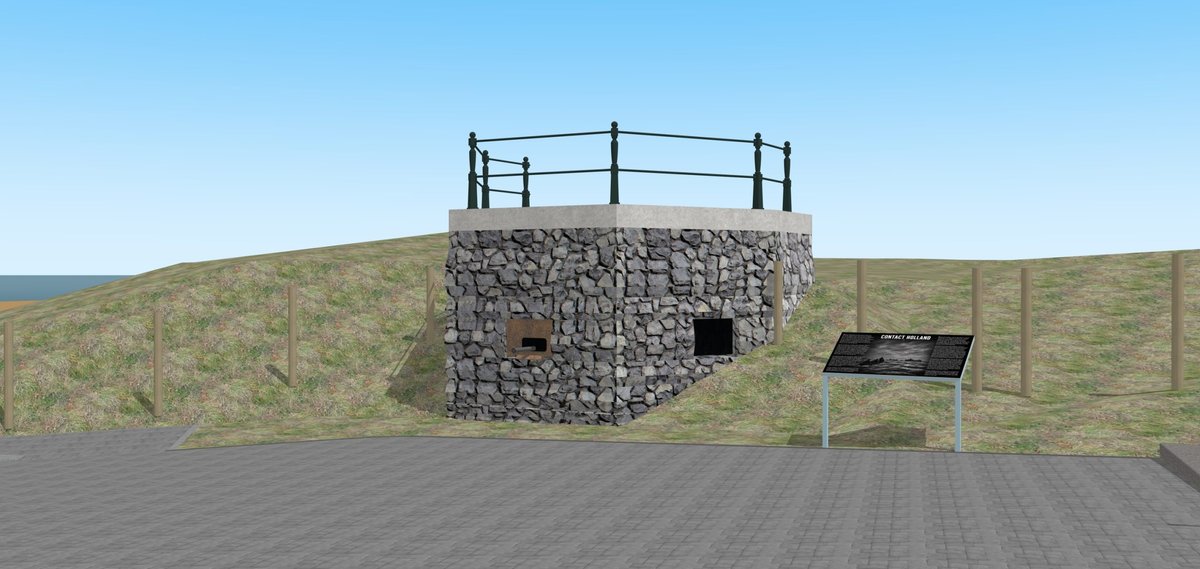
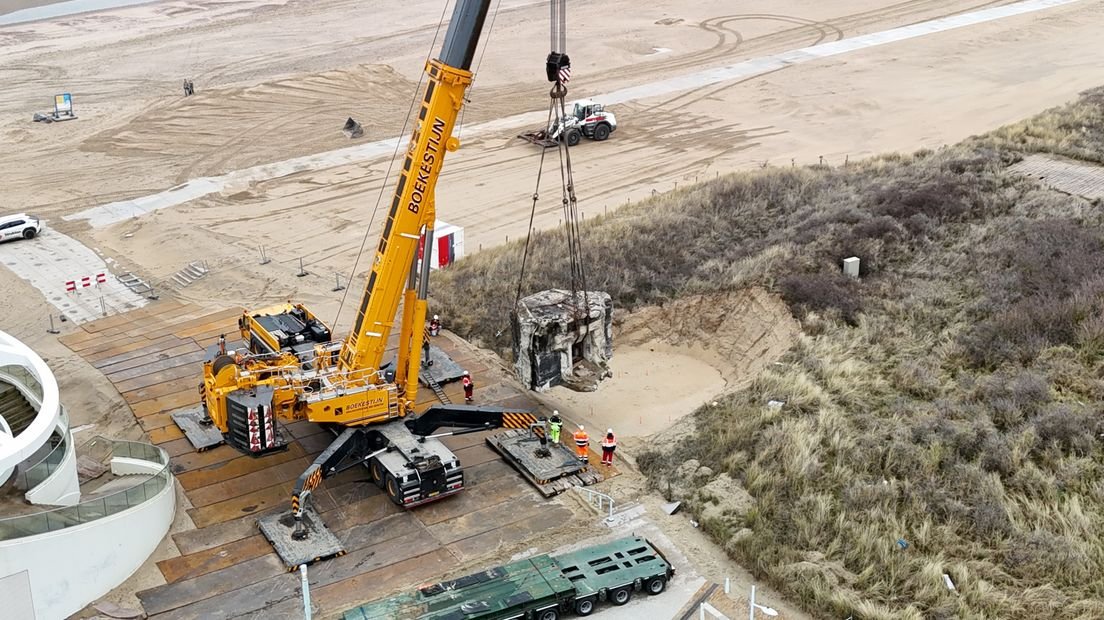
The monument is a Dutch casemate, built shortly before the Second World War to defend the coast against an enemy attack. During the renovation of the northern boulevard in 2018, the little bunker was removed from the sea wall and “parked” beside the Scheveningen pier. On 20 February the casemate was moved to a new spot at the foot of a dune at the end of the boulevard. The structure is being restored to its original state and will be officially opened to public view in January.
Between November 1941 and mid-January 1942, secret operations took place on this beach under the code name Contact Holland, aimed at linking resistance groups in occupied Holland with the Dutch government in exile in London. To that end, Erik Hazelhoff Roelfzema, Chris Krediet and the British secret service landed agents and radio equipment on the beach from England. The casemate and the nearby breakwater are the only silent witnesses.
On 21 November 1941 Hazelhoff Roelfzema brought “Engelandvaarder” Peter Tazelaar, wearing a dinner jacket, to the beach in a motor gun boat so that he could organise the operations from occupied Holland. Tazelaar set up a network of people who contributed directly or indirectly to the secret operations. Some of them, including Gerard Dogger, Eddy Latuperisa, Johan de Jonge Melly, Cor Knulst, Chris Navis, Johan Scheepmaker and Willem Pasdeloup, belonged to the Orde Dienst (OD), a resistance group of former servicemen. They reconnoitred the beach and the boulevard to prepare the operations.
In the streets around Scheveningen, the sisters Dora and Titia Gorter (Snelliusstraat 82), Eva Roeper Bosch and Helena Rens (Leuvensestraat 70), Else Comfurius (Middelburgsestraat 21), Tazelaar’s girlfriend Sabine Zuur (Emantsstraat 1) and the Hague policeman Adriën Moonen (Suezkade 141) provided safe houses and support. In Wassenaar, Gerard Vinkesteijn’s small farm (Van Brienenlaan) and the home of the doctor Gerrit Krediet (Zijdeweg 4) offered shelter.
‘Heraus! Es wird geschossen!’
The operations took a dramatic turn. On the night of 17 to 18 January 1942, at Queen Wilhelmina’s request, Hazelhoff Roelfzema was to collect Herman Wiardi Beckman from the beach in a motor gun boat from England. Wiardi Beckman, a politician who played a leading role in Dutch social democracy, was to strengthen the government in London. Frans Goedhart, one of the founders of the resistance paper Het Parool, was to go with him. They did not know that the plan had already been betrayed to the German police by the Dutch informer George Ridderhof.
On the evening of Saturday 17 January, Wiardi Beckman walked from his hiding place on the Van Hogenhoucklaan to Groningsestraat 24, Scheepmaker’s home, which served as the base that night. At about half past three, Moonen and Comfurius were the first to set off for the beach. On the boulevard they played a courting couple while watching out for German patrols. Well behind them came Tazelaar, Dogger, Wiardi Beckman, Goedhart and their escort Pasdeloup.
It was fourteen degrees below freezing and Scheveningen was pitch dark. At the bottom of the slope from the boulevard to the beach, they took a roll call. Tazelaar and Dogger pointed the men to a Dutch “bunker under the boulevard”, where they could shelter from the cold and stay out of sight of German patrols. Some sources point to the casemate now placed there, which the Germans did not use at the time.
Tazelaar and Dogger went to the head of the breakwater opposite the bunker to signal out to sea with lights. But the boat from England did not come. Meanwhile, German soldiers surprised the men in the bunker and took them away. Goedhart, who later managed to escape from Vught camp, recalled in 1948: ‘Tazelaar came towards us and said: there’s nothing to see yet; you mustn’t stay here; get into the opening of that bunker (right next to the steps from the boulevard to the beach was a small, disused bunker that had belonged to the Dutch army); you’ll be out of sight and out of the wind there; you’ll be safe. Wiardi Beckman, Pasdeloup and I went into the little bunker. After five or six minutes the new [German] patrol came marching along the boulevard. The footsteps went down the steps and came right up to us, and suddenly we heard a terrible shouting: Heraus! Heraus! Sofort! Es wird geschossen! [Out! Out! Now! We’ll shoot!] Half a division of Jerries leapt around, beside and onto our bunker, armed with hand grenades, rifles and electric torches. We came out, were jabbed with rifles, and all the Germans started bellowing at us: Haben Sie Waffen? [Are you armed?] Then we were marched with our hands up to the German headquarters on the boulevard.’
By wading through the icy surf, Tazelaar and Dogger escaped arrest. Half frozen, they came ashore again some way along the beach. Back on the Groningsestraat, they were warmed up with gin and aspirin. On 30 January, Tazelaar and Dogger escaped together to England along the Van Niftrik route (Belgium, France, Switzerland, Spain, Portugal). Tazelaar became a secret agent; Dogger joined the Dutch motor torpedo boats.
Arrests
In the weeks after the drama on the beach, the entire network was rounded up. The German police were helped in the arrests by Willem Pasdeloup, who felt forced to cooperate by the Sicherheitsdienst, the SS security service. Pasdeloup betrayed many resistance members, including the well-known resistance man Pim Boellaard. In early 1943 he was assassinated by the resistance in Amsterdam.
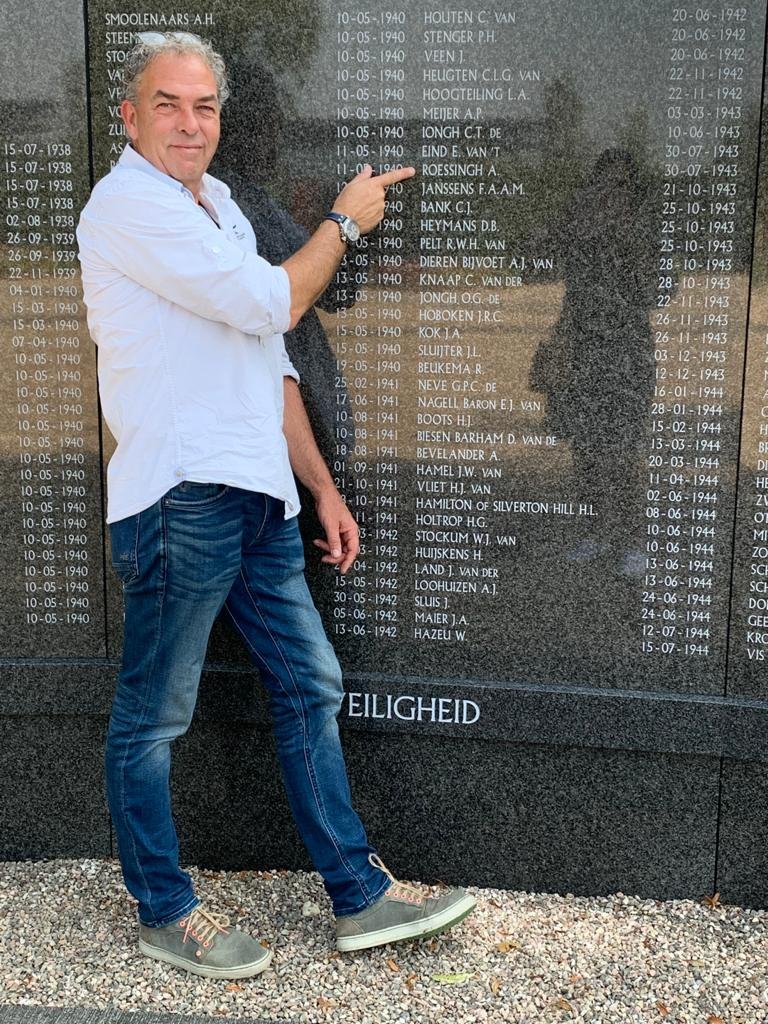
De Jonge Melly, Latuperisa and Vinkesteijn were arrested in March and executed by firing squad on the Leusderheide on 29 July 1943, Moonen on 7 August, and Riep in Vught camp on 28 January 1943. “Dokkie” Krediet died in Dachau on 21 February 1945, and Titia and Dora Gorter in the Uckermark camp on 6 March 1945. Sabine Zuur returned to the Netherlands in 1945 after a stay in a Swiss sanatorium, where she recovered from the severe hardship she had endured in Ravensbrück. She married Peter Tazelaar and they had two children.
Scheepmaker was taken to Dachau as a Nacht und Nebel prisoner, one meant to vanish without trace, and was liberated there by the Americans at the end of April 1945. Hazelhoff Roelfzema, Krediet, Roeper Bosch, Rens, Comfurius, Navis and Knulst stayed out of the hands of the Sicherheitsdienst and survived the war. After a spell in German camps, Wiardi Beckman died of typhus in Dachau on 15 March 1945. Goedhart managed to escape from Vught camp and after the war became a member of the Dutch House of Representatives for the Labour Party (PvdA).
The operations on Scheveningen beach are among the most gripping adventures of the occupation and the resistance. At the same time they were harrowing and tragic events that cost many lives. Many aspects of the war come together on this stretch of beach: the struggle against the occupier, the uneasy relations within the resistance, the tensions in London circles, the difficult relationship between London and occupied Holland, the run-up to the Englandspiel (the German deception that captured dozens of agents), extreme bravery and betrayal. By preserving the casemate, the municipality of The Hague anchors the history that unfolded on the beach in front of the northern boulevard.
Contact Holland became known nationwide through Erik Hazelhoff Roelfzema’s book Soldier of Orange. The feature film Soldier of Orange (1977) and the musical of the same name (2010) are based on it.