The previous instalment told how Albert (Ab) Roessingh trained as a combat pilot in England and Canada, only to be killed shortly afterwards. In this third and final part of the series, we look at the aftermath of an adventure that began with the aim of helping to liberate the Netherlands but ended so tragically.
During an air-sea rescue mission on 30 July 1943, B-25 Mitchell serial number FR144 crashed about 52 km north-west of Terschelling. On board was Ab Roessingh, who had turned 29 a month earlier and was flying only his second operational sortie that fateful day. The other aircraft in the formation, one of them carrying Ab’s good friend Cees Waardenburg, could do nothing more for the crew. They noted the coordinates and flew back to England.
After Albert fled the Netherlands, writing home first from Sweden and then from the ship from Cape Town to Canada, his family heard nothing more from him. They knew nothing of his flight training, of his joining the RAF, or later of his posting to No. 320 Squadron of the Dutch Naval Air Service (MLD).
In November 1943, three months after Ab was killed and three years after he had left home, his parents received a letter from the Red Cross, which had been informed by the Ministry of the Navy in London: “I regret to inform you that word has been received through the International Red Cross in Geneva that your son, Mr Albert Roessingh, (…) Reserve Flying Officer, has lost his life on active service.”
Straight after the liberation, the government, back from London, also sent letters to inform the family and to express its appreciation for Albert’s sacrifice. The Ministry of the Navy wrote: “How dearly the returning navy men would have wished that your son, Reserve Flying Officer Albert Roessingh LLM, could also have come home to the liberated fatherland. It was not to be. On 30 July 1943 he was killed with his aircraft over the North Sea. The comrades who knew him well had nothing but praise for his devotion to duty, his comradeship and his loyalty to his given word.”
They only learned the full story of what had happened to Albert when another letter landed on the doormat in December. “You will no doubt be surprised to receive a letter from someone entirely unknown to you. There is a particular reason for it. You should know that our son C. Waardenburg was very good friends with your late son, whom he met in England and with whom he trained as a pilot in Canada.
Our son kept a diary in which he described your son’s crash in detail, and it shows clearly that they were very good friends. (…) On Sunday René Borgerhoff Mulder visited us, and we asked him for your address, as we wanted to send you the passage from his diary, which you will surely value.”
In his diary, Cees had described how Ab’s last day unfolded: how he started the day with a cigarette as usual, how he put his uniform in order with the correct badges to avoid further run-ins with his superiors, and how they were told they would be flying a mission. How the mission had a few teething problems at the start, and then went off without further trouble.
But that changed quite suddenly. “Almost at the end of the leg, Ritte [the pilot of the Mitchell Ab was in, ed.] apparently sees something. We see him make a fairly steep turn to the right and he disappears under our wing. We turn round and see the kite lying in the water. Stunned, we stare at the wreckage. We fly low over it. No sign of life. Ab and four others suddenly went to their deaths. A dinghy floats above the kite. The aircraft starts to sink. Not a sign of life anywhere, and you still can’t believe what happened before our eyes. A moment ago they were flying beside you. Now there is nothing but wreckage and no trace of the men. Life goes fast, and you are reminded once again how short and fleeting it is. Ab, who had been in the Navy less than a week, is gone, just like that. I can’t believe it.”
Cees was brutally confronted with mortality, something he and Ab had often discussed. “The two of us fly home. It is a strange feeling. You link the endlessness of the sea with the finiteness of our life on earth. Ab has gone before us into death. Who knows how soon I will follow. (…) May I see Ab again in a better and different world. We talked a lot together about all the problems of this life, and now I value even more the good conversations we had.
Ab, who was so sure he would not live to see 30, was right. Strange how a man can foresee his end, and because of it we often talked for hours about home, about the life hereafter, why death was a certain outcome and what would happen after we died. Strange, looking back on it all.”
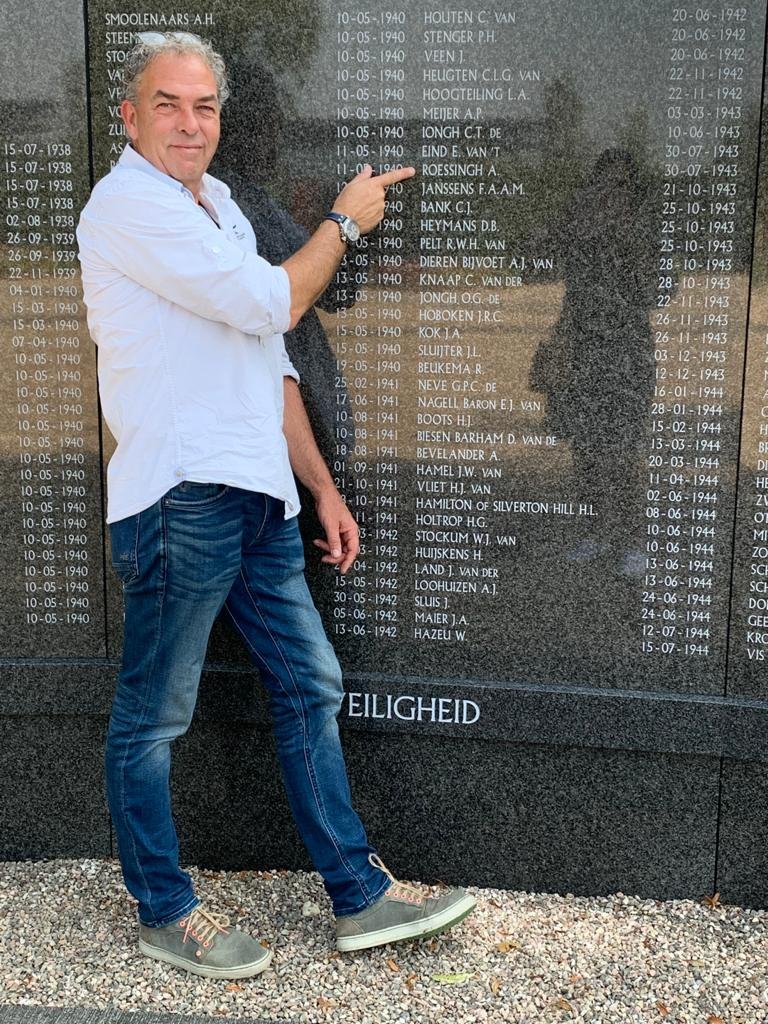
Thanks to René Borgerhoff Mulder, that same month the family also received the belongings Ab had left behind in England, including his uniforms, letters and photo albums. These papers were eventually passed on to Ab’s nephew Diek Roessingh, who set out to uncover his uncle’s story, found the missing information in archives at home and abroad, and so laid the foundation for this three-part series on Albert Roessingh. Ab was never found, but he is remembered by his name on the Aviators’ Memorial (Gedenkteken Luchtvarenden) in Soesterberg.