Fleeing the occupied Netherlands, many Dutch Jews were arrested in Belgium and France and deported to camps in Germany after all. After the war, this group was never investigated further, because the government made no funds available for it. That is how it came about that the disappearance of “Engelandvaarder” Victor Mandaat was not officially resolved until 2006.
Victor Alexander Mandaat was born in Borgerhout, Belgium, on 9 June 1920. During the occupation he studied law and lived at Emmakade 9 in Haarlem. There he joined the resistance, together with his fiancée Elly Lijdesdorff, who worked as a sales assistant in a shoe shop. Because they were Jewish, the registrar in Haarlem advised them not to marry: had a civil marriage taken place, Victor and Elly risked being summoned to report to Camp Westerbork. They did, however, sign a marriage deed before a notary.
Haarlem’s city council was led by the NSB (Dutch Nazi party) mayor Simon Plekker, a fanatical antisemite. At the end of January 1943, after the resistance had killed a German soldier, the occupiers cracked down hard in Haarlem. Ten hostages were shot by German troops in the Kennemer dunes, and 92 others were taken to camp Vught. From then on, at the latest, Haarlem was a dangerous place for Jews and members of the resistance. Elly, Victor’s fiancée, felt compelled to leave for Belgium, where she knew an address in the Ardennes from before the war. In Belgium no one asked about her background, and she managed to survive the war there with their two daughters, one of whom was born later in Brussels.
Arrest
Victor tried to escape to Allied territory via France. Only the north of France and a strip along the coast down to Spain were occupied by the Germans. Many Dutch people tried to take advantage of this to reach Vichy France and then, by way of Spain and Portugal, eventually England. Victor made the attempt as well. For a while he stayed in a room in Paris at 27 Rue St. Apolline. It was there that the Sicherheitsdienst arrested him on 4 August 1944. He was taken to the prison at Fresnes, south of Paris. In what was then the second-largest prison in France, many hundreds of resistance fighters were held during the German occupation. Victor was given prisoner number 46,724.
On 17 August 1944, on the orders of the Befehlshaber der Sicherheitsdienst, he was sent via the transit camp at Compiègne to Buchenwald concentration camp. The Sicherheitsdienst had evidently not discovered he was Jewish, or he would have been deported straight to Auschwitz. On 21 August 1944 he was registered at Buchenwald as a political prisoner under number 78,497. In the camp he had to hand over his personal belongings, such as his shoes, coat, trousers, shirt and undershirt, as well as his wedding ring. In exchange he was given clogs and camp clothing with his prisoner number sewn on.
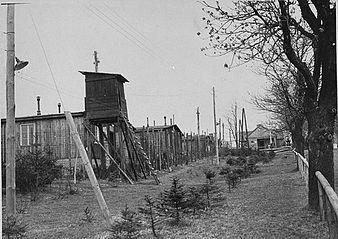
At the beginning of January 1945 Victor ended up as a forced labourer in the subcamp near the town of Ohrdruf in Thuringia. The camp was part of a large project run by the SS-Wirtschafts- und Verwaltungshauptamt (SS Economic and Administrative Main Office) to build an underground factory. It relied on thousands of forced labourers of many nationalities from Eastern and Western Europe. Conditions in terms of food, hygiene, shelter and clothing were appalling. The camp population rose from 10,000 in the autumn of 1944 to 20,000 in March 1945.
Prisoners’ medical condition was recorded in writing in the Krankengeschichte (medical history).
Victor Mandaat’s post-war tracing file contains copies showing that on 15 September 1944 he was given three days’ rest after gallstones were diagnosed. A week later, on 22 September, he was given six days’ rest for appendicitis. It may seem strange that the Germans provided medical care, but as the war went on experienced workers grew very scarce, and it became important to treat them better so that they could keep working.
‘In all likelihood killed’
On 10 December 1944 Victor was operated on for appendicitis. After that, however, his condition steadily deteriorated. The medical facilities at Ohrdruf can hardly have been adequate for such an operation. On 28 December it was noted that a month of light work had been prescribed. On 3 January 1945 he was found to be suffering from general weakness and to be barely able to walk. Under pressure from the advancing Allied forces – the Americans and British from the west and the Soviets from the east – the forced labourers of the Ohrdruf work camp were evacuated by train to Bergen-Belsen on 20 March 1945. The French doctor Dr Bailly, himself a political prisoner at Ohrdruf, was present when the transport left and stated after the war:
‘This transport consisted of men of the second and third category, that is to say men who can no longer work. They left with a transport of Jews. In all likelihood they were all killed. The living were loaded with the dead into closed wagons, without food and without guards.’
When the train finally reached Bergen-Belsen, the dead were dragged out of the wagons and later buried in a mass grave. A month later the camp was liberated by the British, who on 15 April 1945 found mass graves and many thousands of unburied bodies. Of the roughly 60,000 survivors at the time of liberation, some 14,000 died in the weeks that followed.
‘Departed, destination unknown’
The missing-person file leaves no doubt that Victor Mandaat died in mid-March 1945, either during the transport to Bergen-Belsen or shortly after arriving there. Yet after the liberation his death was never officially registered in the Netherlands. In many cases the Informatiebureau (the Red Cross information bureau) did in fact establish the probable place and date of death of people deported from Belgium and France. The results of that research are preserved in files. But officially, little was done with them. In 2004, according to Haarlem’s civil affairs department, Victor Mandaat had been struck off the register on 22 June 1946 with the note ‘vow’ (vertrokken onbekend waarheen: departed, destination unknown). He was therefore still listed as missing.
In 1953 Johan van de Vosse, director of the Informatiebureau, wrote that the aim was to reconstruct as complete a picture as possible of all the Jewish deportations. That meant there would also have to be a special study of the deportations from the Netherlands to camps other than Auschwitz and Sobibor, and of the deportations of Dutch Jews from Belgium and France. These studies were never carried out, because the Informatiebureau had to scale back.
In 2002 Victor’s widow contacted the War Archives of the Netherlands Red Cross to obtain formal confirmation that her husband had died. It turned out that he was still registered as missing. This was the result of the government’s decision shortly after the war to investigate only the fate of missing persons deported from the Netherlands itself.
On the basis of the information in the file, the public prosecutor in the district of The Hague was asked for a declaration of death. After a 15-minute hearing, the court in The Hague issued the declaration in 2006. Only then did Victor Mandaat’s disappearance come to an end, administratively and legally.
Dr Raymund Schütz was a researcher at the Red Cross Archive. He is now a researcher at the municipal archives of The Hague. In the book ‘De deportaties uit Nederland 1940-1945 – Portretten uit de archieven’ (The deportations from the Netherlands 1940–1945 – Portraits from the archives), published by Nieuw Amsterdam in 2017, he wrote a piece about Victor Mandaat, of which the article above is an adaptation.
Victor Mandaat is listed on the Erelijst van Gevallenen (Roll of Honour of the Fallen, p. 006.02). He was also posthumously awarded the Resistance Commemorative Cross.
.
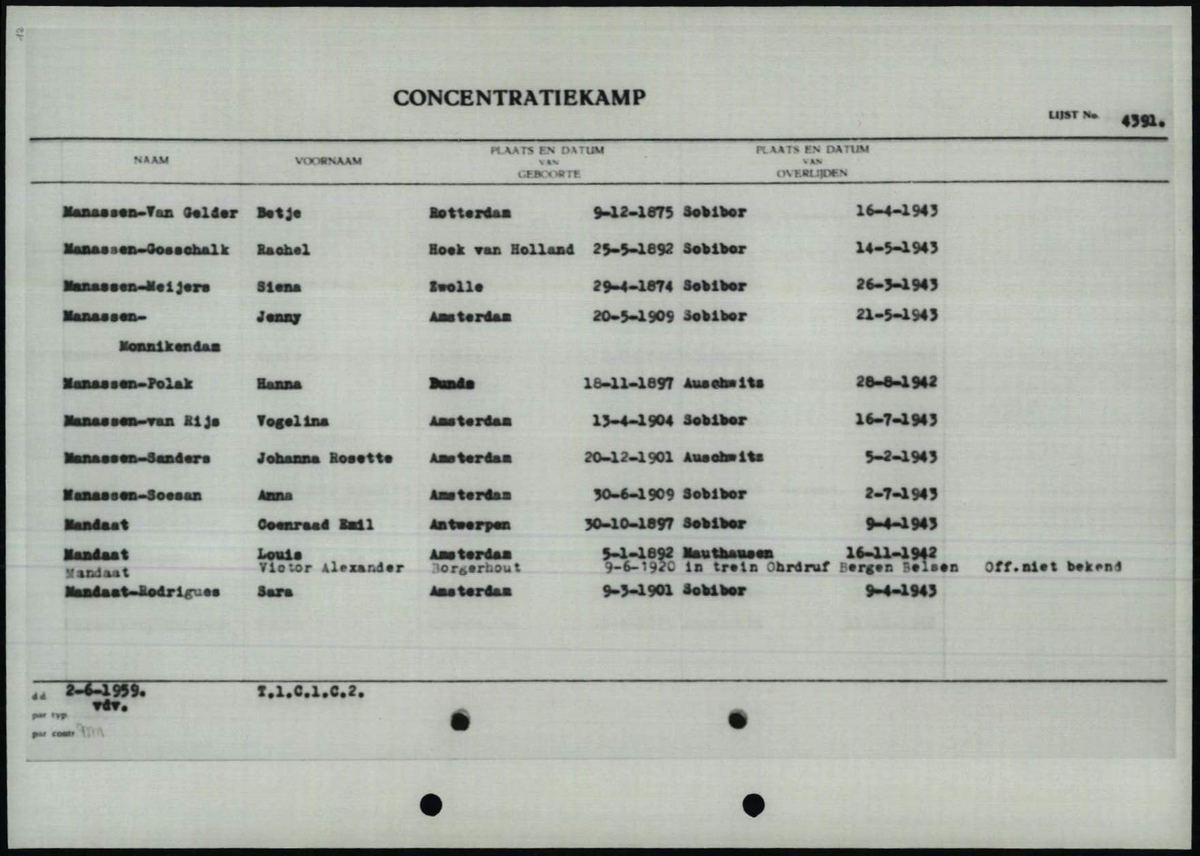
Erelijst van gevallenen 1940-1945 (Roll of Honour of the Fallen)