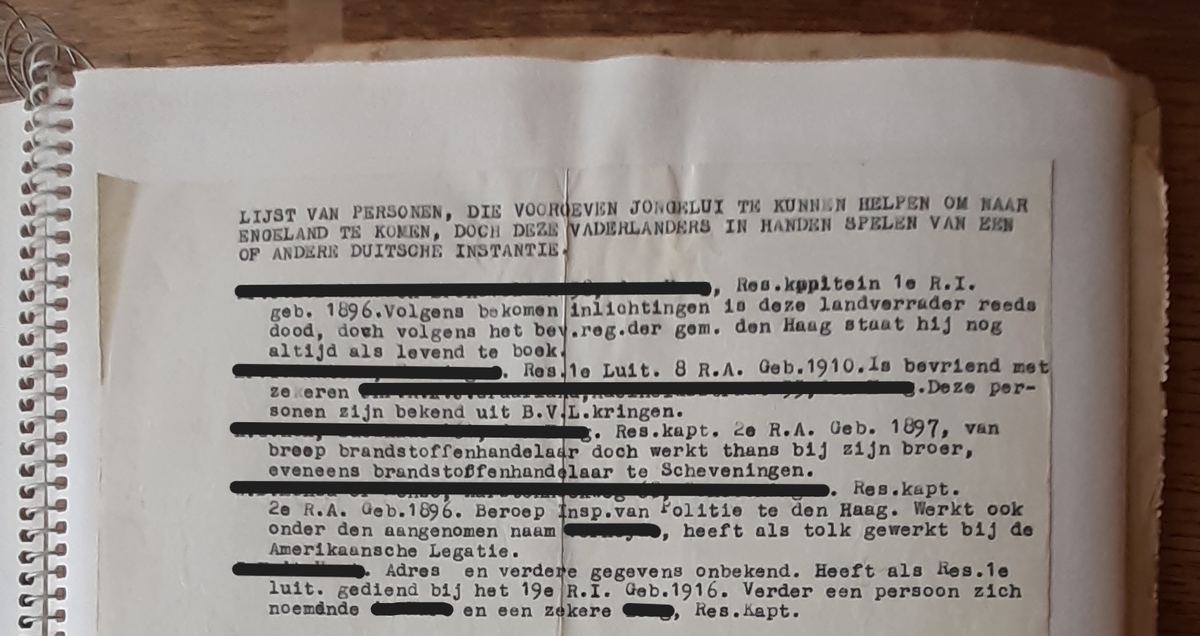
The museum has acquired a list of ‘persons who claim to be able to help young people get to England but in fact deliver these patriots into the hands of some German agency or other’, a list of names of ‘dangerous and treacherous officers’ and a list of ‘persons working for the Gestapo.’ Together the lists contain some 60 names of residents of The Hague, complete with their backgrounds, addresses and occupations.
The lists come from the estate of W.J.A.M. (Wim) van Leeuwen, a professional soldier at the time, and were compiled in 1943. In the early years of the war Van Leeuwen lived with his parents at Valkenboslaan 206 in The Hague, and later on his own at Oudemansstraat 495. What makes the lists so interesting is that they show that, by 1943, the general public evidently knew people were trying to escape to England, even though such attempts were prepared in secret. This may well be the only known document that shows this so plainly.
Van Leeuwen does not say which would-be “Engelandvaarders” these people are supposed to have betrayed. He clearly did circulate the lists in some way, however, as the appeal at the bottom shows: ‘Dutchmen, copy this list and send it to everyone you know; by doing so you may save many well-meaning Dutch people who would otherwise fall into the hands of the Gestapo. (…) Bear in mind, too, that this is not a list of NSB members, but of active traitors.’
It is also striking that many of the people he labels a ‘traitor of “Engelandvaarders”’ lived in the ‘better’ neighbourhoods of The Hague.
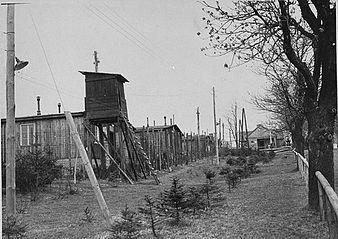
When war breaks out, Van Leeuwen is 27 and fighting as a corporal near the river Waal at Druten. After the Dutch army surrenders he is taken as a prisoner of war to a ‘Durchgangslager’ (transit camp) in Germany, but at the beginning of June he is allowed to return to The Hague after signing a declaration that he is fit and well. Having worked for a while on projects of the Opbouwdienst (a Dutch labour service), in early 1943 he takes a job as a fitter and electrician with the engineering firm Eriksson in the 2e Waldorpdwarsstraat in The Hague. The company arranges papers for him that protect him from forced labour in Germany and from having his bicycle confiscated. He also joins the Nederlandsche Unie, a political movement.
Notorious traitors of (would-be) “Engelandvaarders” include Matthijs Adolf ‘George’ Ridderhof (who, with Willem Pasdeloup, betrayed the network of Erik Hazelhoff Roelfzema and Peter Tazelaar); Mozes Brandon Bravo (who, with Piet Rothert and Jan de Jong, infiltrated the group of Hans Fles, Jacques van Dooremaalen, Henk Kooistra, Lorent Meerman, Aron Polak, Bob Schreiner, A. van Dalen and Peter Habermehl); Anton van der Waals (who, among others, lured the resistance group around the doctor Allard Oosterhuis, ‘Zwaantje’, into a trap); and Freek Weinreb (who denounced Bep Turksma to the Sicherheitsdienst). Many “Engelandvaarders” also reported betrayal when they were interrogated in England, and the “Engelandvaarders” Bert Ligtvoet and Sylvester Susan were betrayed by, respectively, his fiancée’s mother and the informer (Vertrauensmann) G. Stellbrink.