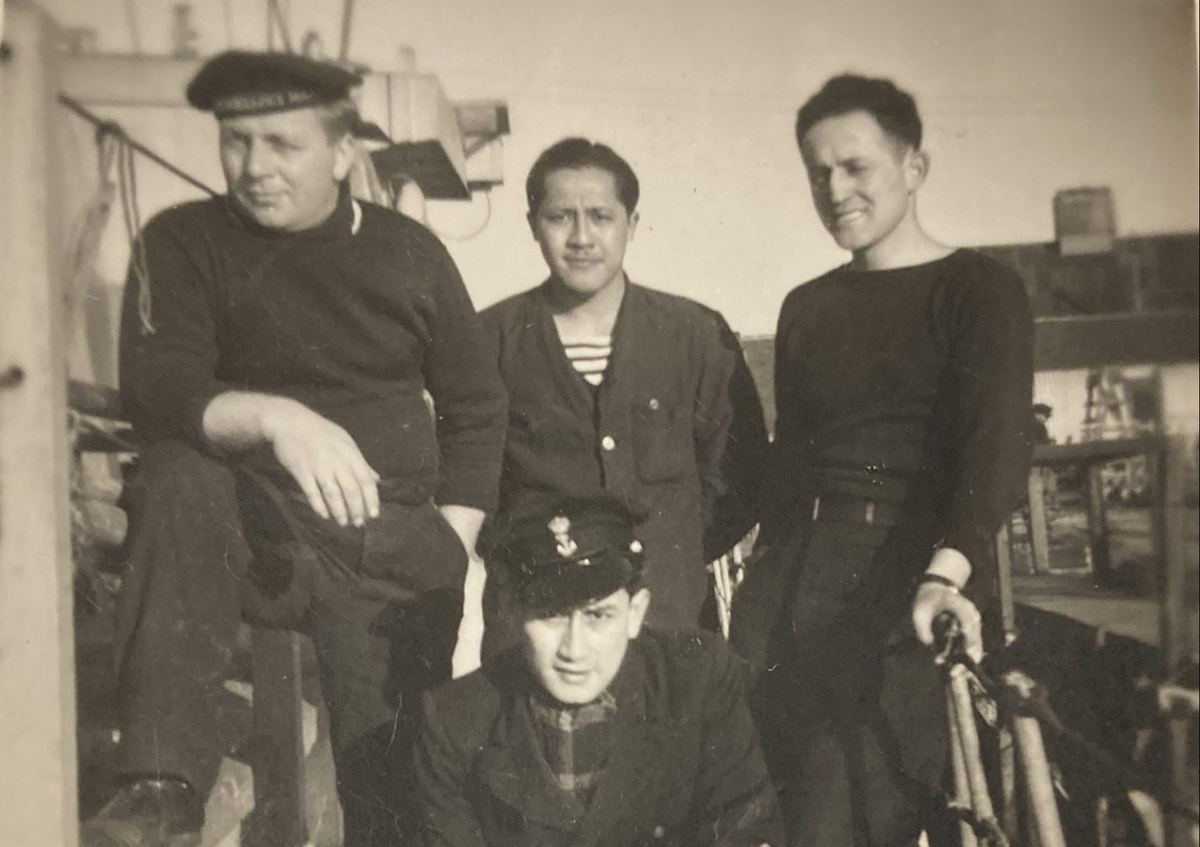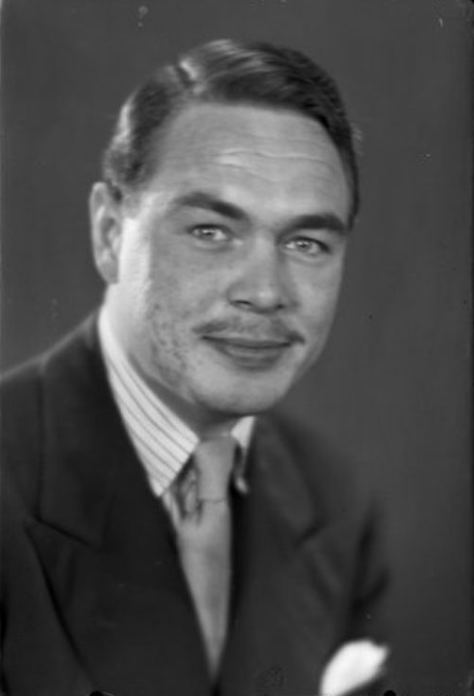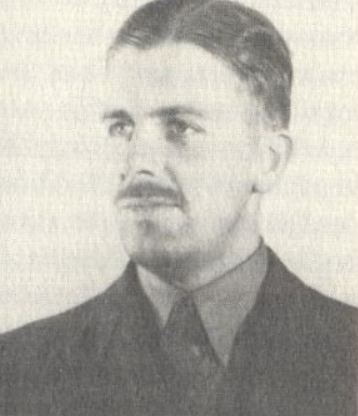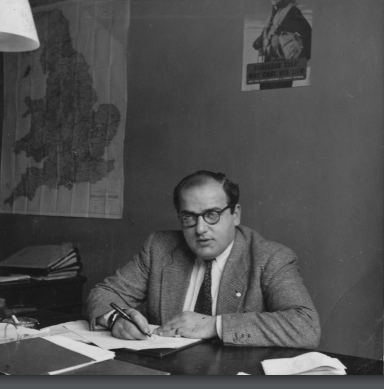
By Jacques Noach, adapted from the talk he gave at Museum Engelandvaarders on 28 November 2024
When I first visited Museum Engelandvaarders in Noordwijk, I had no idea what to expect. But I had barely been inside a few minutes before I found myself on an emotional rollercoaster. A large plaque entitled ‘Redders’ (Rescuers) bears the name of my father, Sally Noach. Next to it is an audio recording titled ‘Goocheme Sally regelt het wel’ (Canny Sally will sort it out). In the database is his ‘wartime CV’, with two photographs from that time. It turned into an emotional afternoon.
In one of the galleries I stood still in front of a comic strip. It was a cartoon with the telling title ‘The Adventures of an “Engelandvaarder”’, drawn in London in 1943 by the “Engelandvaarder” Max Appelboom. I know this strip all too well, because it tells of the complete failure of the Dutch consular service in France and Spain during the Second World War – a failure that my father, a whistle-blower avant la lettre, raised in London. He got no thanks for it. The government obstructed him and branded him a liar, a notorious black marketeer and a charlatan.
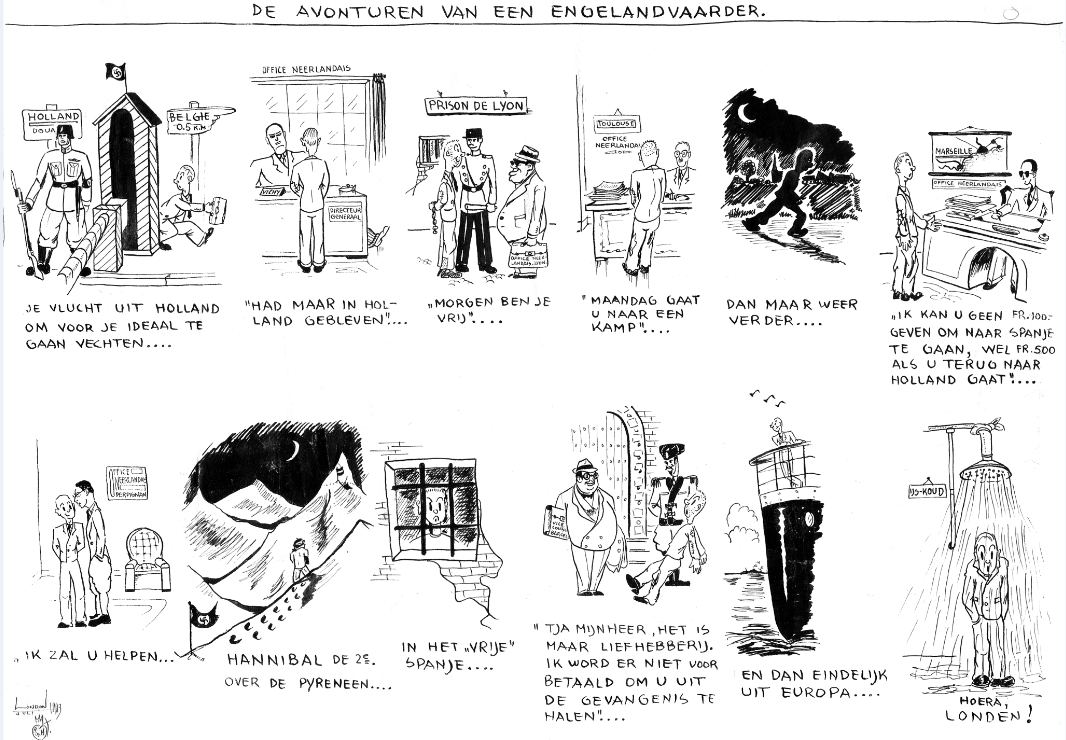
That is partly why I wrote a book about my father, Salomon Jacob Noach (Zutphen 1909 – Amsterdam 1980), better known as Sally Noach. It is about his heroic actions in Lyon, France, during the Second World War. The title of my book is Het ongeloof (Disbelief).(i) Because of the insinuations, a whiff of ‘did it all really happen?’ hung over my father. My book provides the proof that was demanded, and then some. Because that evidence was already in the hands of the authorities concerned during the war, and his deeds were still called into question, I chose the title Het ongeloof.
Lyon
On 13 May 1940 my father fled from his home in Brussels to the south of France. After a period of wandering, he arrived in Lyon in September 1940. During the Second World War, Lyon was a centre of the Resistance and a haven for refugees. Most of the thousands of Dutch people who had fled to France and become stranded there, often in desperate circumstances, were to be found here – illegally, of course. Official Dutch help was scarcely forthcoming, if at all.
Lou de Jong, like several other historians, stresses the lack of imagination, energy and human feeling shown by the Dutch authorities in France during the Second World War, and equally in Switzerland and Spain. Today we would call it ‘a serious lack of empathy’. On the whole, the Dutch envoys, the most senior representatives in those countries, did little for the refugees. Had it been up to the officials, everyone who made the dangerous journey to France would have been sent straight back to the occupied Netherlands.
The “Engelandvaarders” – men and women who, during the Second World War, risked their lives to make the crossing to England and join the Allied forces there – were often asked by these representatives of the Dutch government ‘Why did you leave the Netherlands in the first place?’ It is hard to believe, but anyone who turned to the Dutch authorities in France around March 1942 received 500 French francs – to go back to the Netherlands. Those who wanted to travel on to Spain and England, and so to freedom, got…. nothing. There was also unmistakable antisemitism. The Dutch Consul General in France said that Jewish refugees were ‘inferior’.
When my father reached Lyon in September 1940, he contacted the Dutch Honorary Consul. Because he spoke fluent French, it was decided that he would act as interpreter and translator. My father, who was never officially appointed, never sworn in and had absolutely no experience of consular or diplomatic work, had only his common sense to guide him. And he was strongly driven by compassion for people in need.
Through his work at the consulate, my father came into contact with the commandants of the labour camps, which allowed him to deal with matters concerning Dutch prisoners. He was generous with packets of Gauloises; when no butcher had sausage for sale, he kept a few Saucisses de Boulogne up his sleeve. My father built good relationships with lawyers by taking them out to dinner, and in return those contacts enabled him to get prisoners released. He also supplied false identity papers, money, clothing, shoes and medical care. With daring and brazen nerve, he managed to rescue many of his compatriots from critical situations.
Under consular rules, however, the Dutch authorities regarded his help as ‘illegal’ . My father did not care in the least and carried on doing what he believed had to be done: helping as many people as possible to escape.
In my book I included a list of “Engelandvaarders” and a list of Refugees: the names of men, women and families he helped in difficult times. I wrote that I had compiled both lists with due care, from the letters of thanks my father received and from books and articles mentioning his wartime activities in and around Lyon, and that the lists could certainly not be complete. With every response I receive, I can update both lists further. I have also decided no longer to distinguish between “Engelandvaarders” on the one hand and Refugees on the other.(ii)
Let me quote from one of the many letters from “Engelandvaarders” who managed to escape thanks to my father. Laurentius Punt was awaiting sentence for espionage when my father rescued him from the hands of the Gestapo:
‘Mr Noach, I owe you my freedom and therefore my life.’
The following passage comes from the interrogation of Jaap Hinderink, who was held in the prison at Mâcon with two friends from 6 November to 24 December 1941. Jaap stated
‘…and on 24 December 1941 we appeared in court with that lawyer, and Sally Noach was there too. We were released immediately; wherever Sally Noach turns up, he gets everyone out of the clink.’
The next quotation comes from a diary kept during that period by George van Dam Merrett:
‘Every “Engelandvaarder” who travelled via Lyon speaks of Sally Noach with the greatest respect. With his daring and humour, not to mention the energy with which he took on prison commandants and officials, he was able to rescue many of his compatriots from desperate situations’.
On 1 January 1943, Oscar de Brey, then in training in Wolverhampton, wrote:
‘Yesterday evening was New Year’s Eve, and New Year’s Eve a year ago came back to me so vividly. That evening Bergman, de Bruijn Kops, Kragt and I, among others, once again enjoyed your extraordinary hospitality. It was one of the many bright spots you gave me in the pitch-black darkness of prisons and concentration camps’.
This letter, and many others, can be read on my website
Jewish refugees who came to the consulate were given a different religion and, where necessary, a new nationality. Others were given money to travel on. The senior officials at the Foreign Ministry did not thank my father for handing out passports and money.
By passing himself off as the Dutch consul whenever it suited him, my father managed to get a large number of prisoners released in Lyon, Mâcon and Annecy. In his book Het moest gedaan worden (iii) (It Had to Be Done), my father calls these ‘relief operations’, which the film Forgotten Soldier – more on that below – renders strikingly as freedom missions. But under consular rules, the Dutch higher authorities regarded his help as ‘illegal’.
In my view, my father’s absolute masterstroke came in mid-August 1942. Around 13 August 1942 the first round-up took place in Lyon. All the Jews arrested were taken to the St. Jean prison (the Petit Dépôt), which was used as an assembly point for people to be deported, much like the Hollandsche Schouwburg in Amsterdam. My father hurried to the prison, which stood behind the Palais de Justice. With a great deal of nerve, and under the eyes of German and French officers, he succeeded in getting 118 so-called ‘Dutch nationals’, many of them Jews, out of the prison.
To get into the prison – where a few foreign representatives were also waiting outside in vain – he said angrily to the prison governor ‘Do you refuse diplomats too?’, reaching into the inside pocket of his jacket as though about to conjure up his official credentials. He then took the whole crowd that followed him out of the prison to the Dutch consulate to register them, as the Germans had demanded in return for their safe conduct.
London
In the end my father had to flee as well. Travelling via Spain and Portugal, he arrived in England on 5 December 1942. There he was welcomed as a hero by the many “Engelandvaarders” he had helped who had also reached London. They made him an honorary member of their club, Oranjehaven.
Yet during the war my father was blackened in London, where Queen Wilhelmina and her government had fled in the very first days of the war. Why was he so reviled in government circles? That was the central question of my research into the ‘Sally Noach’ file.
In London my father made no secret of his views and criticised the conduct of Foreign Ministry officials in France and Spain.
He accused three officials in particular of an attitude of indifference and unconcern that proved fatal for refugees. His criticism was that the official bodies had done scarcely anything for Dutch refugees.
Emanuel Adelaar, a Jewish refugee, wrote in his account of his journey:
‘For the sake of completeness, it should be said that the consulate in Lyon came under the supervision of the Dutch representative in Vichy, a certain Mr Van Sevenster, who, however, cared precious little about the difficulties of all those fleeing’. Adelaar’s journey to Marseille, too, and ‘the conversation with van Lennep, was a great disappointment. Van Lennep was “possibly” prepared to help, but Adelaar’s wife would then have to stay in France or, if need be, go back to the Netherlands’.
Jonkheer Daan van Lennep was the Dutch consul in Marseille.
Like every “Engelandvaarder” who managed to reach London, my father was invited to meet Queen Wilhelmina. Somehow a special bond formed between him and the Queen, who is not known for having drawn attention to the fate of the Jews in the Netherlands. As one historian puts it: ‘There was really only one Dutch Jew in London with whom Wilhelmina was in regular contact and whom she trusted completely’. She trusted him, and he trusted her more than the many yes-men and place-seekers around her. One or two writers suggest that my father was perhaps not important, but he was influential.
Because of his critical stance, the Ministry of General Warfare asked my father for a report on his experiences. As Wilhelmina also urged him to write it, he handed his report to her. The report (iv) ran to eight and a half A3 sheets of closely typed lines, and it landed like a bombshell. A few days later my father was summoned to the Foreign Ministry, where none other than the minister, Eelco van Kleffens, was waiting for him. At an earlier meeting my father had already asked the minister whether he was being sent from pillar to post. This meeting was no more pleasant.
The minister felt bypassed because the report had gone straight to the Queen, even though my father raised matters that concerned his ministry. The atmosphere did not improve when my father replied: ‘Your Excellency, you are a civil servant, even a very senior civil servant. I am a businessman. If I want to sell something, I go straight to the managing director, not to the clerk.’
Two worlds collided here: the young Jewish businessman facing both a merciless enemy and the gentlemen of the punctilious old school of the Dutch consular and diplomatic service. When he pointed out to the Dutch authorities that the enemy did not stick to the rules either, he was told that the Dutch were too decent for that.
The officials had no wish to hear his catalogue of complaints. They took offence and retorted that nobody had asked him to help “Engelandvaarders” and Jews. Relations with the office-holders hardly improved when my father replied: ‘Your Excellency, you and I are in the same position. I did it because there was nobody else; there was no choice… if they had had more choice in London, they would never have made you a minister.’
Where did it go wrong for my father? On 27 April 1943, Prime Minister Pieter Gerbrandy wrote to his Minister of the Interior, in a letter stamped TOP SECRET: ‘Should Your Excellency agree, I would like to nominate him [Sally Noach] for the Knight’s Cross of the Order of Orange-Nassau’
Within three days, however, Binnert Philip Baron van Harinxma thoe Slooten, the London government commissioner for refugees, replied with a letter claiming that what was attributed to my father was not true at all. All my father had done, according to this baron – who had already resigned himself to a German victory in the first months of the war – was to collect Dutch nationals whose release had been secured by others. His defeatist attitude would hardly have inspired a very active policy. As a nice aside, I can report that someone had pencilled in the margin of this letter that what Harinxma wrote was an entirely false account of events. The baron also considered it highly questionable that my father had given people the opportunity to escape by providing them with false passports. In short, Harinxma could not see on what grounds my father – who, according to the baron, was merely an employee – should be considered for any decoration. Next to this passage, too, a pencilled note in the margin said that what Harinxma wrote was incorrect.
But…. the damage was done. When Queen Wilhelmina wanted to decorate my father for his services, the Dutch government blocked it. Awarding him a royal honour would have meant recognising not only his achievements but also the objections he had reported against a number of senior Foreign Ministry officials.
No decoration during the war, then, apart from honorary membership of Oranjehaven. Nor after it. For then my father had to deal with the former Consul General in France, Ate Sevenster, who, despite his utterly dismal conduct during the war, had been restored to favour. Before the Parliamentary Committee of Inquiry (v) he described my father as ‘the king of the black market in Lyon’. In a later letter, Sevenster advised ‘giving credence to Noach’s claims only insofar as their accuracy is irrefutably proven by entirely reliable documents
and receipts.’ I can just picture it: my father paying a smuggler to help an “Engelandvaarder” across the border, agreeing a price and then asking: ‘Could I have a receipt, please?’ Sevenster, incidentally, was also the man who, when questioned by the Cleveringa Committee (vi), stated that the Jewish refugees were the lowest sort of people you could help. Not one member of the committee took him to task for those words.
Recognition
On 28 December 1969, his sixtieth birthday, my father finally received a royal honour: he was awarded the Erekruis in de Huisorde van Oranje (Cross of Honour of the Order of the House of Orange). The Order of the House of Orange is conferred on Dutch and foreign nationals who have rendered services to the monarch or the Royal House. Admission to the Order is an entirely personal matter for the head of the House of Orange, who decides who is appointed to it – not the government.
Real recognition came with a film about the true story of my father’s wartime past, with interviews with survivors of the Shoah and their families. This film, Forgotten Soldier, has been shown at many film festivals in Britain, the United States, Canada, South Africa and Israel, where it was very well received. On 10 November this year the film was – at last – shown on Dutch television. (vii) That, too, took quite some doing.
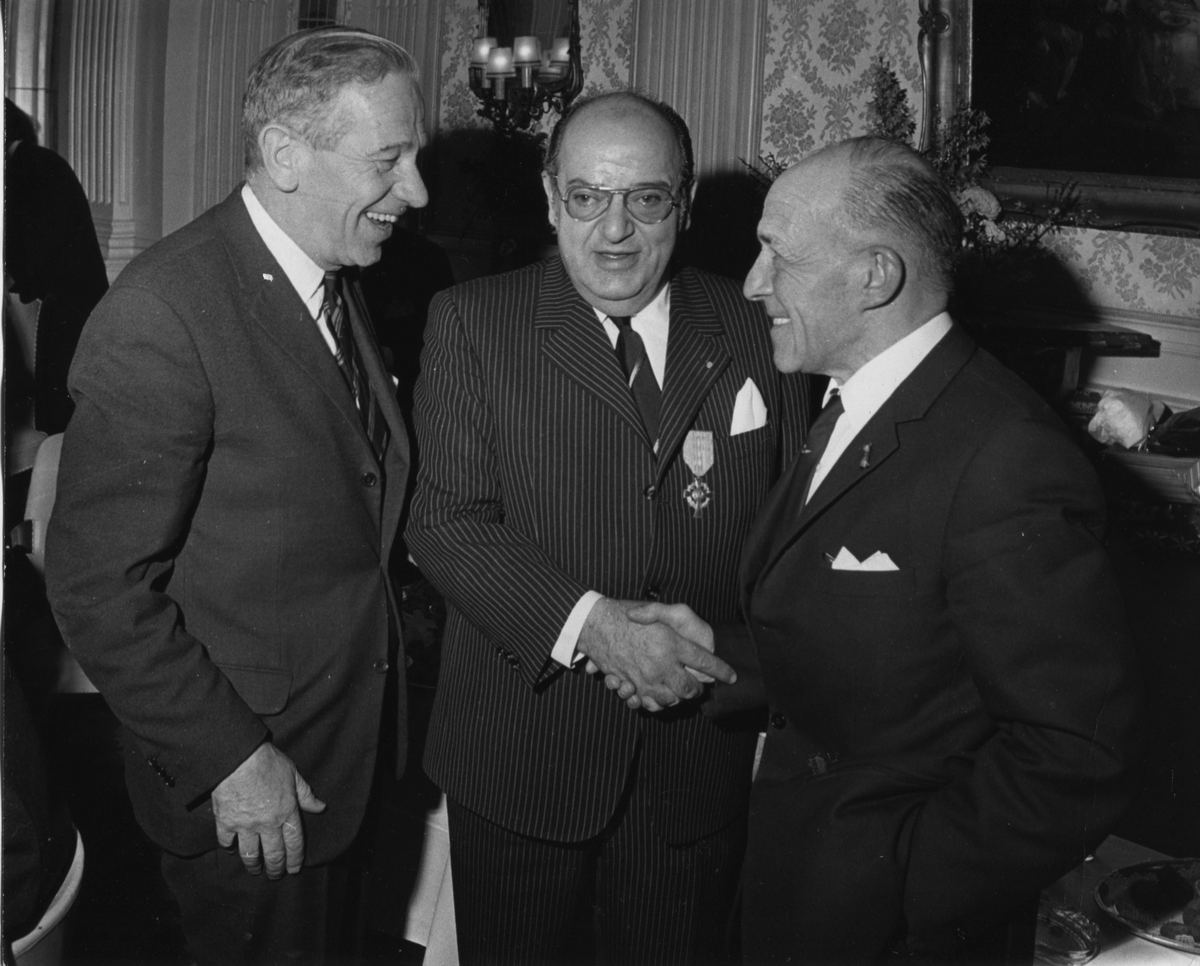
I took up the idea of naming a park in Israel after my father and contacted the Jewish National Fund (JNF), the organisation that plants trees and creates forests in Israel. The JNF was immediately enthusiastic and made the initiative a reality. I then emailed our family and friends asking for contributions. The response was overwhelming and led to the creation of the Sally Noach Park in Haifa. The festive opening ceremony took place on Thursday 2 May 2019.
Thursday 2 May 2019 was Yom HaShoah. Yom HaShoah Ve-Hagevurah is also a tribute to the heroes: Hagevurah contains the root Gabor, meaning hero. I made that connection in my speech at the opening of the Sally Noach Park in Haifa. ‘My father Sally Noach was such a hero’, I told my audience. Between September 1940 and September 1942 he saved hundreds of Jews and non-Jews from the hands of the Germans and their accomplices, at the risk of his own life. I closed with these words:
“My father was a warm and modest man whose conduct in the Second World War showed great courage. He was the living example of ‘so many Jews who, despite their most exceptional position, took up the fight against the enemy’. Sally Noach was one of those people who stood up and dared to cross the boundary of fear.”
The Sally Noach Park in Haifa is a tangible and lasting tribute to my father. Young and old can use it for walks and other recreation. In this way my father will live on for many generations. No royal honour can match that.
Through my research I know far more about my father in that period than he did himself. He was on the stage; I stood in the wings and, by opening the archives and reading the files, I could see how people in his day were pulling the strings. I saw things my father did not know, and the picture was shocking. It troubled him all those years.
‘What I am owed won’t put bread on the table’, he said more than once. He had been awarded a high honour, and the government blocked it. Had they recognised him for his deeds, they would also have had to admit that they had been wrong. As he himself put it: ‘the people I saved all got a medal; I got mine through them’.
Book
Doing my own research has let me see it differently. I now know what happened to my father. I never doubted his story, and during my search it was only confirmed, which made the writing flow more easily. Now I can look at it more dispassionately. I now have proof that his story is true.
When I presented my book at the former Verzetsmuseum (Resistance Museum) in Amsterdam in March 2022, someone asked me ‘Why yet another book about the Holocaust? Don’t we already know everything about the Holocaust?’ No, we do not yet know everything about the Holocaust. There are still archives to be consulted. Things are still coming to light. My book, too, describes an aspect of the Holocaust that was not widely known.
Sadly, my book could hardly be more timely. None of us expected to live in a time when antisemitism would once again become socially acceptable and even lead to a hunt for Jews in our own country – in Amsterdam, the city that fondly calls itself Mokum. Disgusting!
Against this background, I hope my book will prove to be both a reminder and an inspiration.
I dedicated this book to my father’s seven grandchildren, charging them to let the actions of their grandfather Sally guide everything they do and think.
I prefaced this dedication with a saying from the Talmud: ‘whoever saves one life saves an entire world’. A beautiful Jewish saying.
(i) Jacques Noach – Het Ongeloof, Uitgeverij Verbum, 2022. See also sallynoach.com. For information and requests, please write to info@sallynoach.com.
(ii) I am happy to send interested readers an update on request.
(iii) Sally Noach – Het moest gedaan worden, Uitgeverij Semper Agendo, 1971. Because the book has been out of print for many years, apart from the occasional second-hand copy, my father’s book is reproduced in full in part II of Het ongeloof. Its content is unchanged; only the modern preferred spelling has been applied and obvious typing errors corrected.
(iv) The ‘Rapport voor Koningin Wilhelmina’ (Report for Queen Wilhelmina) is reproduced in full in my book.
(v) Enquêtecommissie Regeringsbeleid 1940-1945. This parliamentary inquiry examined the policy of the De Geer/Gerbrandy and Schermerhorn cabinets from the German invasion of the Netherlands on 10 May 1940, and of the war with Japan, until the opening of the session of the provisional States General on 20 November 1945, as well as earlier policy insofar as it was directly related to events in those periods.
(vi) Commissie-Cleveringa: Commissie tot Onderzoek naar de Houding van Nederlandsche Diplomatieke en Consulaire Ambtenaren tegenover Nederlandse Uitgewekenen (Committee of Inquiry into the Attitude of Dutch Diplomatic and Consular Officials towards Dutch Escapees).
(vii) The Joodse Programmering (Jewish programming) department of the broadcaster EO produced the Dutch version of Forgotten Soldier. This meant not only adapting it to the NPO broadcast format, with Dutch subtitles and Dutch voice-over, but also giving it a Dutch title: Sally Noach: een formidabele redder in nood. For anyone who would like to see the film (again), a file is available on request.