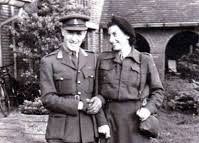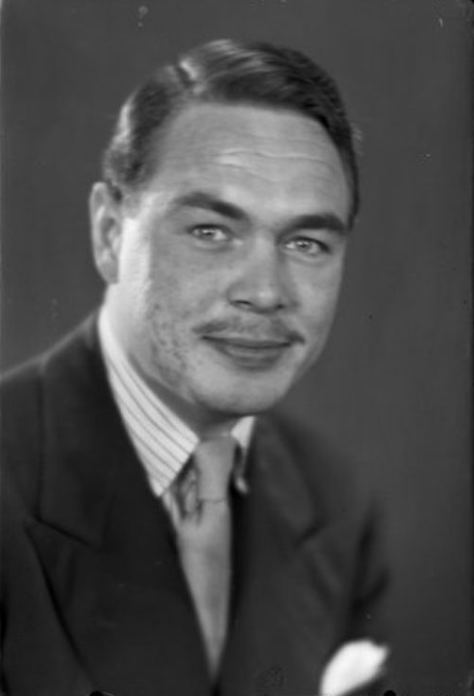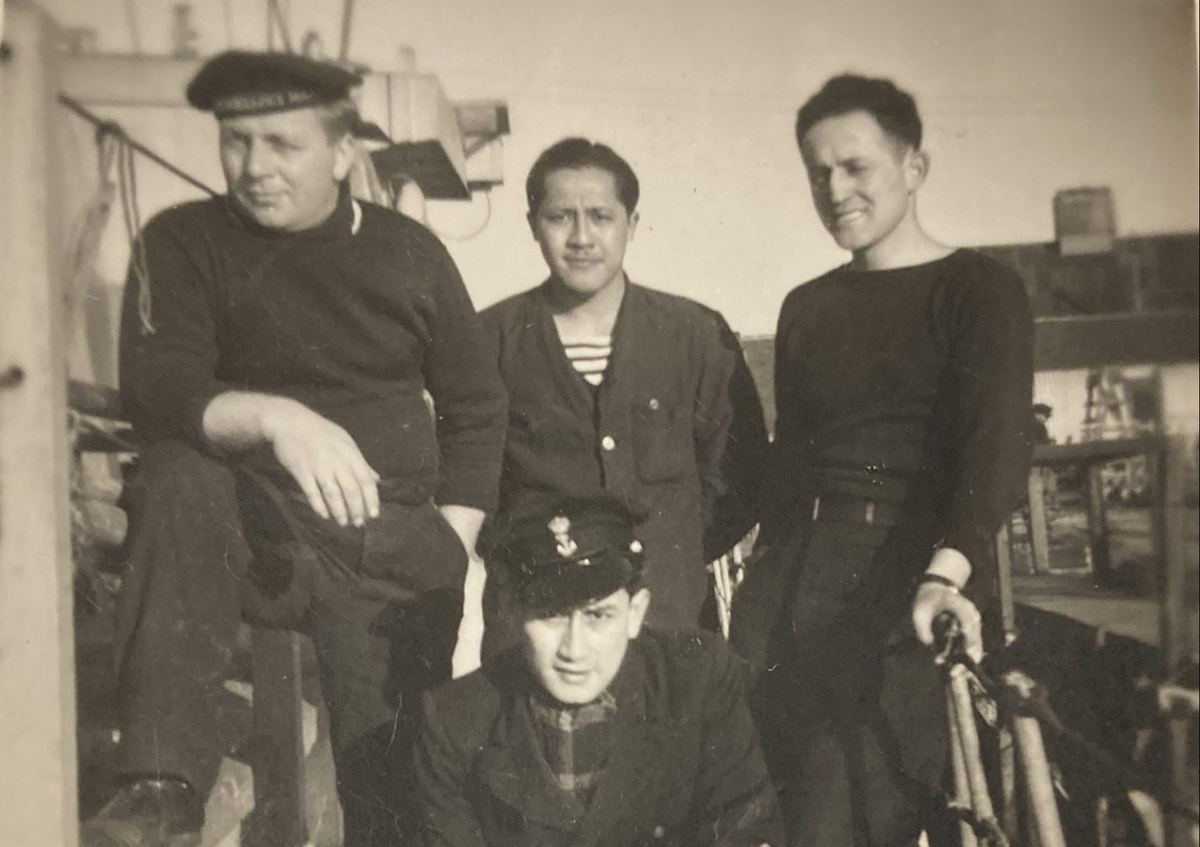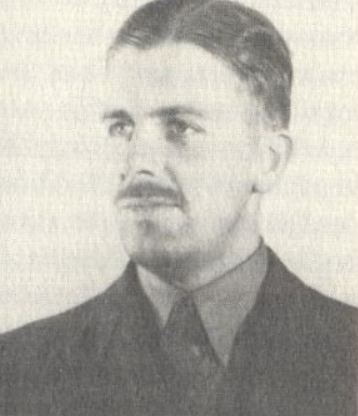
Talk by Sierk Plantinga on the first “Engelandvaarders” Day, 9 November 2024
Frans Dijckmeester was born in Haarlem, where his father worked at the provincial registry. After only a few months the Dijckmeester family moved to Zutphen, where father Jan Dijckmeester had been appointed mayor. In doing so he followed his own father into a post in public administration: at the time of Jan’s appointment as mayor in 1917, his father was the Queen’s Commissioner in Zeeland. Jan Dijckmeester would remain mayor of Zutphen until December 1943. He was then dismissed by the German occupiers because he had too often shown that he was not cooperating loyally; moreover, two of his sons had gone into hiding because the Germans were looking for them on account of their resistance activities.
Father Jan was arrested by the SD in May 1944 and taken to the Huis van Bewaring (remand prison) in Arnhem. His son Willem (1922-2020) followed him soon afterwards. Both were freed in the great raid on the Huis van Bewaring by the Resistance on 11 June 1944. Unfortunately, Jan Dijckmeester was arrested again at the end of July 1944 and ended up, via Vught camp, in Sachsenhausen concentration camp, where he died on 6 October 1944. And for the sake of completeness: his son Willem was also arrested again, but managed to free himself and, after a time, resumed his resistance activities in Baarn until the liberation.(i)
Frans Dijckmeester grew up in Zutphen, went to school there and in June 1935 passed his final gymnasium α exams (the classical stream with a focus on languages) at the Stedelijk Gymnasium in Zutphen. His final report shows sixes and sevens, no fails; not a brilliant pupil, rather one who could be described as tidy and average.(ii)
Frans then did not go to university but chose to do his military service early. At the beginning of October 1935 he reported as a volunteer ordinary conscript to the 1st Regiment of Hussars of the Cavalry and trained as an officer at the School Reserve Officieren der Cavalerie (SROC, Cavalry Reserve Officers’ School). From 1 July 1936 he was able to put what he had learned into practice ‘with the troops’ in Deventer. At the beginning of September 1936 he was appointed cornet (ensign), and shortly afterwards, in October, he went on extended leave.(iii) Only then did he enrol at Utrecht University, where his father and grandfather had also studied, and begin to read law.
Because he was too late to take part in the regular freshers’ initiation at the Utrechtsch Studenten Corps, he had to go through the rather dull late initiation. “At the prescribed times I presented myself at the students’ club P.H.R.M. and spent most of the time there sitting ‘on my backside’ on the floor. The ‘larks’ were over. I never really got to know my year-mates”, he wrote in 2001.(iv) He also had to return for refresher training in military service every year. On 1 January 1938 he was appointed reserve second lieutenant in the Cavalry.
On 25 August 1939 Frans Dijckmeester was mobilised, like many other servicemen in the Netherlands. His posting was as orderly officer on the staff of the 3rd Division, which was stationed between Haarlem and Leiden. The 1st Division lay to the south of the 3rd and had to defend The Hague against the German paratroopers who wanted to capture Queen Wilhelmina. The 3rd Division, by contrast, had hardly been involved in the fighting in the May days of 1940.
After his demobilisation – he went on extended leave on 15 June 1940 – Frans Dijckmeester continued his studies and, where possible, Utrecht student life as well. In December 1940, for instance, he was elected abactis (secretary) of the Senatus Veteranorum (the board of the student corps). It was not until later, in July 1941, that most student societies were banned by the German occupiers. That ban was the result of the celebrations of Utrecht University’s lustrum (five-yearly anniversary). To mark the lustrum, rowing races for (mostly student) rowing clubs were held on the Amsterdam-Rijnkanaal. At the end, many students sang the Wilhelmus (the Dutch national anthem) as well as other anti-German songs. At the close of the traditional alumni day in Utrecht, too, the Wilhelmus rang out again in the city centre. And at the end of June there was another incident with a group of NSB members. It became too much for the Germans, and so on 11 July 1941 Frans Dijckmeester, as abactis of the USC, was obliged to send a circular to the members announcing that the society had been dissolved with effect from that day by order of the occupier.(v)
With the Orde Dienst
Frans himself had already been drawn into the resistance organisation Orde Dienst (OD) earlier in 1941 by W.A.H.C. (‘Pim’) Boellaard. Boellaard was a director at De Nederlanden van 1845 in Utrecht and a reserve captain in the artillery. Frans Dijckmeester’s task was to form new small groups that could work for the OD.
After the ban on almost all Utrecht student societies, university life went on ‘as normal’: lectures were given and exams were held. Although the student societies had been dissolved, people in Utrecht tried to keep in some contact with one another through the boards of the faculty associations. Underground, ration coupons and safe addresses were collected, and a warning system for students in hiding was also developed. Frans was involved in this too. He graduated on 12 April 1943.(vi)
During that period the occupier had made many arrests among members of the OD. And when, in June 1943, reserve officers also had to report for captivity as prisoners of war, he went into hiding with friends and acquaintances in various places, such as Zutphen, Amsterdam, Leusden and Utrecht. He stayed in hiding until early November 1943.
To England
In the meantime, together with his good friend Jhr. Mr Robert de Brauw, he had worked out a plan to escape to England. On 2 November they left by train for Brussels, accompanied by the Leiden student J.E. ‘Els’ Boon, who acted as their passeuse (escort). In Rotterdam they were joined by the artillery captain J.J. Greter. Greter had been allowed back to the Netherlands from German captivity to recover from an inflamed knee; after his recovery, on the way back to Germany, he had jumped from the train together with his fellow traveller, the cavalry captain Pahud de Mortanges, and made his way back to the Netherlands.
With Els Boon they ended up on an escape ‘line’ heading south. In Brussels Els Boon handed them over to her Brussels contacts, Ir. Jan Strengers, Mr Jojo Everard and Mrs Mathilde Verspyck. There B.W.F. de Beaufort and P. Polak joined them. After a short stay in Brussels, where they were given false French identity cards, they travelled to Paris, where the young Delft engineer Albert Starink lived. By chance, Strengers and Everard had come into contact with a Pole, André Wyssogota-Zakrzewski, alias ‘Georges’ or ‘Georges du Nord’. He was the leader of an organisation that helped airmen and others across the Pyrenees into Spain. So, all of a sudden, a direct line had come into being from the Netherlands (Utrecht and Leiden) via Brussels (Strengers and Everard, among others) through Paris to Spain. In Paris Starink acted as a kind of coordinator.(vii)
Andrzéj Wyssogota-Zakrzewski
Because hardly anything is known about this remarkable Pole in the Netherlands, it seems useful to say a little more about him here.
Andrzéj Wyssogota-Zakrzewski was born on 14 May 1905 in Kalisz, Poland. After the German occupation of Poland in 1939 he made his way via Hungary, Yugoslavia and Italy to France, hoping to escape from there to England. In France he took part in the fight against the Germans and the Italians, and was badly wounded in one leg. That prevented him from crossing the Pyrenees. Instead, he then organised escape routes for others. His ‘line’, called Visigoths-Lorraine, managed to guide many Poles, French, Belgians and Dutch people to Spain. I have counted a total of 34 Dutch people whom he helped on their journey through France to Spain and beyond.
His activities involved an improbable number of arrests for illegal conduct, but also just as many miraculous escapes. In an account by him in a French file I quickly counted some 17 arrests and 16 escapes (jumping from trains and the like). Only after the very last arrest, on 25 November 1943, did he fail to escape. He had been caught on the train from Toulouse to Tarbes with a group he was guiding. Only the Dutchman in that group, A.M.E. Thomann, managed with his help to break out of the makeshift prison in Biarritz and reach Spain. Thomann, later in London: “I ended up in the same cell as ‘George’ and with his help managed to break out on 1 December. He had given me the address of the Hotel Du Rescuis in Peyrehorade, where I arrived in the evening. With the passeur I then crossed the Pyrenees, and I was arrested in Spain. (-) Around 16 January 1944 I arrived in Madrid, a free man”.(viii)
After several further unsuccessful escape attempts, Wyssogota was transferred to camps at Compiègne, Buchenwald and Dora. He survived these camps and returned to Paris after the liberation.(ix) After the war Wyssogota received various decorations – French, Belgian and British – but not a single Dutch one.
The journey continues
From Paris they travelled on south. Dijckmeester, De Brauw, De Beaufort and Polak travelled together from Tarbes to Mauleon-Licharre and from there, with another group and the help of a passeur, into Spain – Greter had crossed the Pyrenees with yet another group. After a four-day trek came the inevitable arrest in Spain by the Guardia Civil. After a first prison in Pamplona and then a résidence forcée, they were transferred to the Spanish concentration camp of Miranda de Ebro, where most illegal border-crossers ended up. Frans Dijckmeester managed to get out of Miranda under a false name and reach Madrid, where he was able to stay with the legation counsellor Jhr. Mr W.E. van Panhuys, a cousin of his. The others were also released from Miranda soon afterwards and arrived in Madrid.
By then several Dutch people had already gathered in Madrid, all on their way to England. From Madrid the group travelled by train to Portugal; not to Lisbon but to the small port of Vila Real de Santo Antonio in the Algarve. There they boarded what looked like a fishing boat but which, out at sea, was transformed into a British warship. They arrived safely in Gibraltar. There military life began for all of them. They were issued British uniforms. As a reserve officer, Dijckmeester was allowed to teach the others the first principles of marching. Then, on 9 March 1944, they sailed in a large convoy to Liverpool, where they arrived on 16 March 1944.(x)
After this came, for everyone including Frans Dijckmeester, the usual ritual of rigorous questioning to establish that the person questioned was not a German spy. For this purpose the British had taken over the large school complex of the Royal Victoria Patriotic School (RVPS) in Wandsworth in south London. The interrogations were very thorough and could sometimes last as long as three weeks. Once they had been found ‘reliable’, those questioned were allowed to leave the complex; for the Dutch, a similar interrogation by the Politie Buitendienst, the Dutch security service, then followed. Only after that could the “Engelandvaarders” report to the authorities of the branch of the armed forces of their choice.(xi)
Secret agent
Frans Dijckmeester reported to the Politie Buitendienst on 11 April 1944; a few days later he received its verdict: ‘Is politically reliable’. By his own account, the plan to go back to the Netherlands as a secret agent took shape in his mind fairly quickly. He ended up at the Bureau Inlichtingen (BI, Intelligence Bureau), headed by Major Dr J.M. Somer. BI’s task was to inform the Dutch government in London about everything that was happening in the Netherlands. A future agent had to undergo the necessary training: parachute jumping, operating a transmitter and other practical matters of that kind. In the middle of his training Dijckmeester was told that he would be leaving for the Netherlands that very evening, because the man originally chosen had been injured in a practice parachute jump. Because little was known in London about the Orde Dienst, and the secret agent Garrelt van Borssum Buisman had been arrested by the SD earlier that year, Frans Dijckmeester’s main orders were to replace Buisman, to make contact with the leadership of the OD and with other resistance groups, to try to bring them together and to report on this to London.
And so, on the night of 5 to 6 June 1944, D-Day, he was parachuted over the Betuwe together with his colleague Rob Mooiweer. It did not go entirely to plan. Over the Betuwe the RAF aircraft was caught by two searchlights and the pilot wanted to get away as quickly as possible; the parachutists therefore had to leave the aircraft immediately and so did not land at the agreed spot. Instead of near Buurmalsen, north of the Linge, Frans Dijckmeester landed south of the windmill at Deil, south of the Linge. In the darkness it was very hard to get his bearings; moreover, part of his equipment had fallen out of his kitbag, including the vital power pack (transformer) for his radio-telephone set. Without that power pack he could neither transmit nor receive.
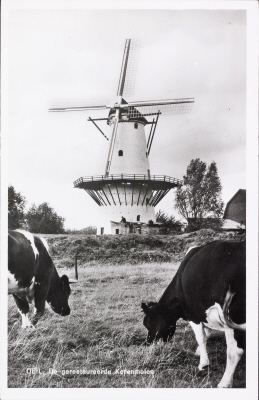
A local resident near his landing site directed him to the miller of Molen De Vlinder in Deil. The miller, Arie van Honk, and his wife Sara Sonnevijlle were part of the local resistance: the De Vlinder mill had become a hiding place and also housed a radio listening post. Together with Arie van Honk, Frans Dijckmeester searched for what had fallen out of his kitbag during the jump, especially that power pack. The search turned up only a packet of cigarette papers. Afterwards the miller and Frans Dijckmeester searched further, without result.Frans Dijckmeester then set off on foot to his first contact address in Buurmalsen, the general practitioner A.M.M. van der Willigen, who was also in the resistance and who then drove the contents of the kitbag from Deil to Buurmalsen in his car. Van der Willigen also gave him a different pair of trousers to replace his far too smart English ones.
In London Dijckmeester had been advised to contact Jhr. Ir. C. van Holthe, who also lived in Buurmalsen. He was said to play a leading role in the underground and could therefore give Dijckmeester a good overview of relations within the resistance. This, however, proved disappointing, and so the next day Dijckmeester left for a contact address in Amsterdam, from where on 8 June he met the chief of staff of the O.D., Jhr. P.J. Six; Dijckmeester and Six turned out to know each other from Frans’s military service, as Six was also a cavalry officer.(xii)
It soon became clear that the coordination wanted by Queen Wilhelmina and the government was already well under way. A core organisation already existed in which Lambertus Neher (alias Naber) played a central role. According to Dijckmeester, it was above all thanks to Neher that the government’s instructions were carried out and that others, including Drees and his Contact Commissie (Contact Committee), could build on them. This also led to the creation of the large Advies Commissie der Illegaliteit (Advisory Committee of the Resistance). Dijckmeester regularly attended meetings on this subject.
Contact between Dijckmeester and London remained problematic. Without the power pack, the transformer, he had to improvise using the older Morse system. Through other channels London was asked for a new one, but it never arrived. And by no means all of Dijckmeester’s telegrams sent via others got through, which led to a good many misunderstandings.
These problems may also have had something to do with the fact that Dijckmeester had been given a new kind of transmitter/receiver: a British radio-telephone set, also known as a ‘speech transmitter’. To hold a conversation, an aircraft had to be nearby with someone on board who could conduct it. The range of an S-phone was about 45 kilometres.(xiii) The British had also given repeated assurances that it could not be located by German direction-finding. In the end Dijckmeester had a replica power pack made in Amsterdam, so that he could use his set at the beginning of September 1944. Asked whether the Germans could locate the system, the experts who had made the replica power pack replied that it very probably could be located.
At the end of September 1944 it happened. Dijckmeester only just escaped. After working at another address for two weeks, he was located there too, and at a third address in Amsterdam after only an hour. Fortunately he had taken security precautions. Gerben Sonderman kept watch over the block of houses where Dijckmeester was, spotted the Wehrmacht’s slow-moving direction-finding vans, and was then able to warn him. A victim of the British assurance that the set certainly could not be located was Dijckmeester’s good friend Robert de Brauw, who was arrested by the Germans on 14 October 1944 while transmitting. De Brauw did not survive his imprisonment. Fairly soon after this the few Dutch agents stopped using this set and switched to more proven methods, with the help of the experienced wireless operator F. van Lokven, among others; and only after the war did the British admit that these sets could be located, because German direction-finding methods were superior to British ones and the British had not been aware of this.(xiv)
It can be argued that the initial lack of the power pack saved his life. After all, it was when the replica was being made that he discovered the transmitter could indeed be located; this made Dijckmeester more careful, and so each time he narrowly escaped arrest.
After the Allies had liberated the southern part of the Netherlands, many meetings on further coordination followed for Dijckmeester. In 1945 he also managed to get a house in Amsterdam connected to the clandestine telephone network, making contact possible with places such as The Hague, Haarlem, Utrecht and Ede. This made sending telegrams a great deal more efficient for Dijckmeester. Among other things, this telephone connection was also used in the negotiations with Seyss-Inquart on food supplies.
On 5 May 1945 Dijckmeester could look back on a highly successful mission: in the last months of 1944 several large resistance organisations, including the Orde Dienst, had been merged into the new Binnenlandse Strijdkrachten (Netherlands Forces of the Interior). He had played a large part in this. He had also survived, or as Mr Donker, chairman of the PEC’s plenary hearings committee, concluded with understatement: ‘Then you didn’t do badly’.(xv)
After the liberation
With effect from 1 June 1945 Frans Dijckmeester was promoted to temporary reserve cavalry captain. This was connected with his new post as representative of the Bureau Inlichtingen, with the rank of attaché, at the legation in Stockholm. His duties included carrying out (or arranging) vetting of Dutch people in Stockholm. He was also to trace Dutch assets that had been illegally transferred to Sweden. And where possible he was to gather and pass on information in the ‘military, political, economic, financial and other fields insofar as these may be considered of importance to the Netherlands’.(xvi)
In fact this was a short task that was winding down, in which he had to wind up the war office there. The following year he returned to the Netherlands, where he was given a post at the Kabinet der Koningin (Queen’s Cabinet). His rank of temporary cavalry captain was reduced again to reserve first lieutenant. Only in 1949 did he regain the rank of reserve cavalry captain, now without the word temporary. At the same time he went on extended leave. He was granted an honourable discharge as reserve cavalry captain in 1956. During his extended leave he worked as a civil servant at the Kabinet der Koningin. Later, as a member of the Christelijk-Historische Unie (CHU, Christian Historical Union), he was appointed mayor of Zierikzee (1956-1965), of Haarlemmermeer (1965-1972) and of Apeldoorn 1972-1981). He was chairman (1981-1987) and then honorary chairman of the Genootschap Engelandvaarders.
For his wartime activities he received various decorations: the Kruis van Verdienste (Cross of Merit), the Bronzen Leeuw (Bronze Lion), the Oorlogsherinneringskruis (War Commemorative Cross), the Verzetsherdenkingskruis (Resistance Memorial Cross), the Military Cross (UK), and Knight First Class of the Order of Vasa (Sweden). He himself was very proud of his Elfstedenkruis (Eleven Cities Tour cross, 1941).
* I am particularly grateful to the former reserve cavalry major E.J. Vinkhuyzen for his countless suggestions and the extensive research he carried out for this essay.
(i) Sources for this paragraph: Nationaal Archief (NA), archief Ministerie van Binnenlandse Zaken, Binnenlands bestuur 2.04.87, inventory number 4253; Frits Broeyer, ‘Het Utrechtse Universitaire Verzet 1940-1945’, Utrecht 2014, p. 325.
(ii) Regionaal Archief Zutphen, archief 0177 Stedelijk Gymnasium, inv. no. 81; with thanks to archivist E. van den Hombergh.
(iii) NA, archief Ministerie van Defensie, Staten van Dienst Koninklijke Landmacht geboortejaren 1911-1920, 2.13.259, inv. no. 36516.
(iv) Typed account ‘Diensttijd bij de Cavalerie 1935-1947’ (Service in the Cavalry 1935-1947) by F.Th. Dijckmeester, Amersfoort, July 2001.
(v) Broeyer, op. cit., pages 73, 76, 77, 80, 81. The circular concerning the dissolution is held by the Stichting Corpsmuseum en Archieven van het Utrechtsch Studenten Corps (with thanks to J.M. Jekel, curator).
(vi) NA, archief Ministerie van Justitie te Londen 2.09.06, inv. no. 11960.
(vii) Sources for this paragraph: NA, archief Ministerie van Justitie Londen 2.09.06, inv. nos. 11960 (PBD Dijckmeester), 11929 (PBD De Brauw), 12020 (PBD Greter), 10678 (PBD De Beaufort), 12157 (PBD Polak); NA, archief Parlementaire Enquêtecommissie Regeringsbeleid 1940-1945, 2.02.27, inv. no. 579, session of 13-5-1949, interrogation of Mr F.Th. Dijckmeester; Bob de Graaff, ‘Schakels naar de Vrijheid’, The Hague 1995; Broeyer, op. cit., p. 234 ff.; National Archives USA, file A. Starink.
(viii) NA, archief MvJL 12228.
(ix) On A. Wyssogota-Zakrzewski see in particular: Service Historique de la Défense in Vincennes, files 16 P 295767 and 17 P 8212. Ippécourt, ‘Les Chemins d’Espagne, Éd. Gaucher, Paris 1948, especially pages 283-300; Megan Koreman has discussed him in a number of posts in her dutchparisblog.com series ‘How to flee the Gestapo. Searching for the Dutch-Paris Escape Line’.
(x) Typed account ‘Diensttijd bij de Cavalerie 1935-1947’, by F.Th. Dijckmeester, Amersfoort, July 2001.
(xi) The official records of the Dutch interrogations are held at the Nationaal Archief in The Hague, in the archive of the Ministerie van Justitie te Londen; the records of the British interrogations are held at The National Archives in Kew, near London, WO 208/3663 ff.
(xii) Sources for this paragraph: typed account ‘Diensttijd bij de Cavalerie 1935-1947’; typed account ‘Rapport Snuitkever’, by Mr F.Th. Dijckmeester (Snuitkever was an alias of Dijckmeester); Chris de Bouter, ‘Een Stille Held. Garrelt van Borssum Buisman, cavalerist, geheim agent en verzetsman 1915-1991’, Zutphen 2020; Bartho van Honk, ‘Molen “De Vlinder” in Deil in de Tweede Wereldoorlog’, in: Mededelingen Historische Kring West-Betuwe, Volume 52, September 2024, pp. 13-16; various emails from R. Dijckmeester, M.J. van Lieburg and B. van Honk, mostly via E.J. Vinkhuyzen, to the author.
(xiii) The American OSS system called Joan/Eleanor (JE) worked differently again.
(xiv) Parlementaire Enquête Commissie Regeringsbeleid 1940-1945 (PEC), part 4-c-II, interrogations of F.Th. Dijckmeester, J.M. Somer, A.W.M. Ausems and P.R. Gerbrands; PEC part 4-c-I, interrogation of Jhr. P.J. Six. Also Dijckmeester’s ‘typed reports’ mentioned in the previous note. With thanks to Harold Jansen, Jan Rijnders and Louis Meulstee for their detailed explanations of the various transmitting and receiving systems.
(xv) PEC 4-c-II, interrogation of F.Th. Dijckmeester, no. 52516. xvi NA, archief Gezantschap Zweden 2.05.219, inv. no. 211.