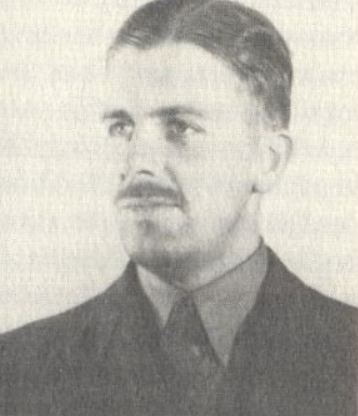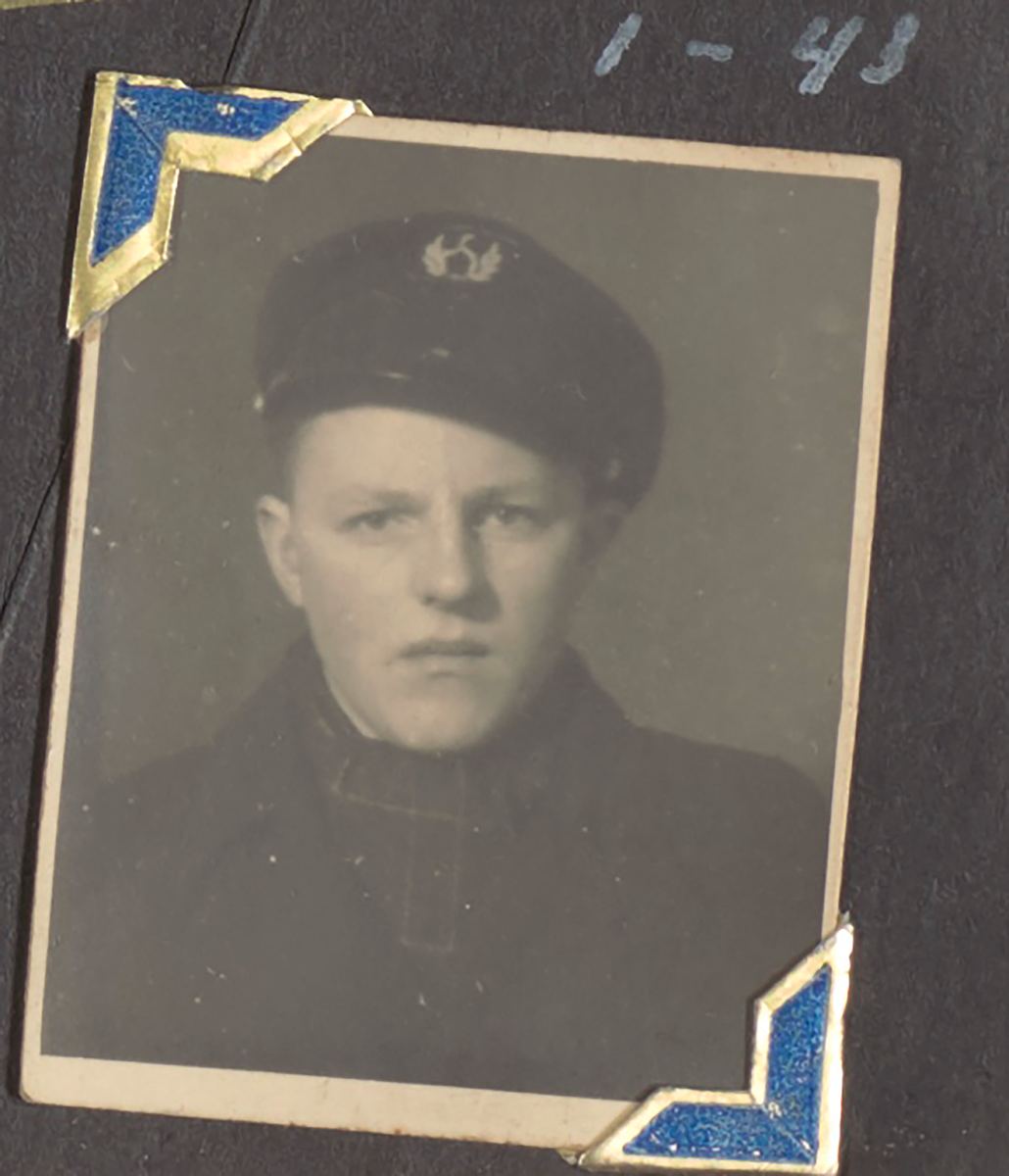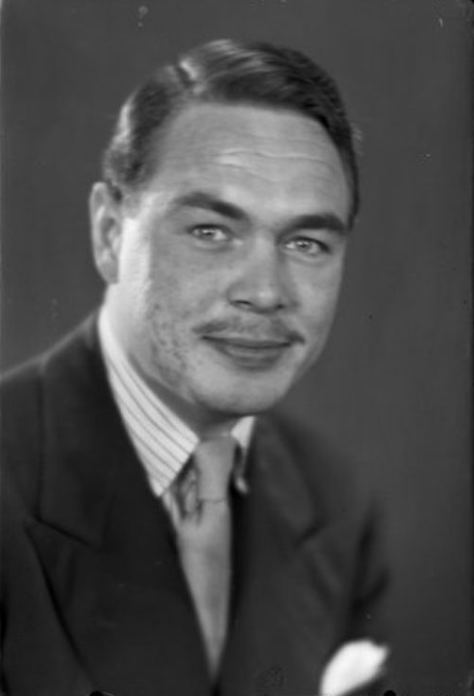
On 19 May 1943 the big day arrived: the opening of the exhibition in Belfast. At noon Bierens de Haan stood with ‘the great gentlemen of Ulster and the dignitaries of Belfast’ at Sydenham airfield (today George Best Belfast City Airport), awaiting the Dutch delegation. The first aircraft to land carried the Minister of War, Van Lidth de Jeude, and several senior officials. It was followed by the plane carrying Prince Bernhard and General Phaff.
The day after the opening the party visited the Short and Harland factory, where Stirling bombers were being built at a rate of one a day. From there they went on to Longford Lodge, the site of a vast American factory where American bombers, including Liberators, were built and repaired.
Besides exhibitions, Bierens de Haan devoted much of his time to Oranjehaven, the club that Queen Wilhelmina had given to the “Engelandvaarders” a year earlier. As chairman of its board he had to settle many a quarrel. That there was plenty of disagreement is hardly surprising: the “Engelandvaarders” were birds of every feather, and by now they numbered around 600.
In June 1943, to mark Oranjehaven’s first anniversary, Bierens de Haan presented the Queen with a print by the artist Cor Visser on behalf of all the “Engelandvaarders”. The gift had in fact been promised for Her Majesty’s birthday in August 1942, but making the print had taken longer than expected.
In the summer of 1943 Bierens de Haan discussed with a few fellow “Engelandvaarders” (Tas, Meerlo, Warendorf, Monchen and Arendsen de Wolf) how to bring more unity to the group. Perhaps by publishing a little newspaper? They also decided to elect a new Oranjehaven board. The publication came about when the weekly Vrij Nederland was asked to set aside a page each week for the “Engelandvaarders” to fill. The column was called ‘Gegist bestek” (Dead Reckoning). No new candidates came forward for the board election, however. Barthold Bierens de Haan was so fed up with the grumbling of his fellow “Engelandvaarders” that he decided to step down. A letter from “Engelandvaarder” Elly Nauta persuaded him to stay on after all.
Appointment to the Military Administration
Amid all these concerns, Bierens de Haan heard in early July 1943 that a post awaited him with the Militair Gezag, the Military Administration for the Netherlands. The Military Administration (MG) was a military government that, on behalf of the Dutch government in London, would take over the tasks of government in the liberated parts of the Netherlands after the German surrender, until those areas could be handed back to a normally functioning civil authority. Preparations had been under way in London for years. The MG came into force on 14 September 1944, once the south of the Netherlands had been liberated, and was dissolved on 4 March 1946. Queen Wilhelmina would have liked her son-in-law, Prince Bernhard, to head the organisation, but the cabinet decided otherwise: Major General H.J. Kruls became its chief of staff.
For Bierens de Haan, news of his appointment to the MG was a godsend: ‘At last,’ he wrote in his diary, ‘…at last a chance to do something directly for the Netherlands, and above all to get away from the RVD.’ Yet his appointment would be weeks in coming. Bierens de Haan suspected that people at Radio Oranje who bore him ill will were working against him.
A visit to the Queen
On 10 September 1943 Bierens de Haan received a telephone call from Mrs Verbruggen, the Queen’s lady-in-waiting, informing him that he and his wife Monique were expected in Maidenhead for the weekend. Barthold was thrilled. In his diary he wrote: ‘… I had to ask her to repeat it three times before I understood I wasn’t dreaming …’
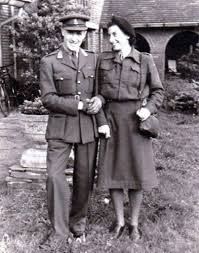
The next day they drove from Chester Square to Maidenhead with Van ’t Sant, the Queen’s private secretary. Monique had brought a pound of chocolate and some honey as a gift for the Queen. Mrs Verbruggen was waiting on the doorstep, and the Queen stood smiling in the hall as though good friends had come to call.
They began with tea in the garden, where an amusing scene unfolded. The Queen opened with:
‘Mrs Bierens de Haan, isn’t the sun bothering you?’
‘No, Your Majesty,’ said Monique.
‘Shouldn’t your husband fetch your hat?’
‘No, Your Majesty, really, there’s no need,’ said Monique.
The exchange went on in this vein until Monique had her hat and the Queen was satisfied.
Dinner was served at seven (simple but good), and in the evening the company – besides the Queen and the Bierens de Haans, it consisted of Van ’t Sant and Mrs Verbruggen – listened to the news and played gramophone records of a sailors’ choir, presented to the Queen by the crew of one of the warships. Bierens de Haan found it cosy, just like visiting your grandmother in the old days. But he was also impressed by the monarch. In his diary he wrote:
‘This lonely, hard-working woman of fine sensibility sees through so much; she knows the intrigues and knows exactly who is waging war and who is merely revelling in it.’
The next morning Barthold and Monique breakfasted alone with Mrs Verbruggen, as the Queen was at work. She did join them for coffee, when the talk turned to the RVD and Oranjehaven. Afterwards Prince Bernhard came to collect his mother-in-law for meetings. In the afternoon the party attended a church service, the Queen going by bicycle and the others on foot. The service was held in an ‘army hut’ where the guards of the house were quartered. It was stiflingly hot, and Barthold had to struggle to stay awake during the ceremony. After breakfast the following day the couple returned to London with a box of mushrooms and flowers from the Queen.
Later that September Bierens de Haan’s appointment finally came through, and for the first time in years he wore a uniform again. Monique Bierens de Haan changed jobs too. Shortly after arriving in London she had worked as a journalist for several Swiss papers. After that she had spent some time working for A.M. Meerlo, an “Engelandvaarder” and psychiatrist who provided psychological advice to the Dutch government (in this case the Bureau Militair Gezag). In September 1943 she took up an administrative post at the Ministry of the Navy.
Disappointment with the Military Administration
Barthold may have hoped that the MG, being military, would be a decisive organisation, but once he started work he soon realised it was just another band of civil servants:
‘The soldier is simply no quicker than a civil servant, especially as they have never seen the war at close quarters.’ In my view, these gentlemen, who shy away from responsibility, have only two thoughts:
a. Slow and steady, and the line won’t break
b. How do I get promoted quickly?(.1)
For a long time Oranjehaven had been pressing for a better reception for “Engelandvaarders” arriving in London. This was achieved in October with the founding of an official reception committee, the “Commissie van Ontvangst Engelandvaarders”. Its members included several “Engelandvaarders”, among them Colonel Buenink, Miss Nina Baumgarten and Sally Noach, the man who had freed countless “Engelandvaarders” from prisons in France. Bierens de Haan also sat on the committee, as the link with the Oranjehaven board. Jaap Burger, a newly arrived “Engelandvaarder” who had just been sworn in as Minister of the Interior, put the new committee forward in the Council of Ministers. According to Minister Burger, its purpose was ‘..through its actions to give the boys the sense […] that we are delighted at their safe arrival and ready to meet any individual wishes‘(.2)
The last entry in Bierens de Haan’s diary dates from December 1943 and concerns the Christmas atmosphere in London, or rather the lack of it: ‘London is packed, everyone is buying like mad. The shops are being stripped bare. Money is no object. Yet there is no festive mood.’ The manuscript ends with a list of the people with whom the couple spent Christmas.
What happened next (.3)
In June 1944 Bierens de Haan was given a temporary commission as a reserve first lieutenant for as long as he was assigned to the Bureau Militair Gezag. In early September 1944 he was promoted to reserve captain, followed in April 1945 by promotion to reserve major on his transfer to the staff of the Military Administration.
From 27 March 1945 he served as Military Commissioner for the Assen district in the partly liberated Netherlands. A Military Commissioner, also known as a District Military Commissioner (DMC), represented the central staff of the Military Administration under General Kruls at district level. From 27 April to 1 July 1945 Bierens de Haan was Military Commissioner for the Meppel district.
Meanwhile in London, Monique Bierens de Haan, who had acquired Dutch nationality through her marriage, had joined the Dutch Women’s Auxiliary Corps. In July 1944 she met the French general Koenig by chance and fell head over heels in love with him. The feeling was mutual (or so we assume!).
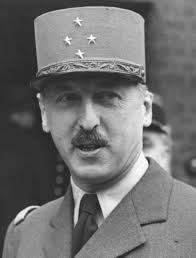
Marie Pierre Koenig (1898–1970) was a French soldier (and later politician) who had fought as a volunteer in the First World War and then spent many years in North Africa serving with the French Foreign Legion. After the French surrender in 1940 he escaped to England and joined the Free French under General Charles de Gaulle. Koenig, by then a colonel, distinguished himself in the Allied campaign in North Africa, first against the Vichy French, who controlled the French mandated territories of Libya and Syria, and later against German and Italian forces under the German general Rommel.
What made Koenig a great hero in France was his part in the Battle of Bir Hakeim (1942). The Free French did not win it – a shortage of equipment and fuel forced Koenig to withdraw – but the Axis powers suffered heavy losses, while thanks to Koenig’s tactical insight French casualties remained very low. Koenig, now a general, was also involved in D-Day and in June 1944 was appointed head of the French Forces of the Interior. In August 1944 he became military governor of Paris.
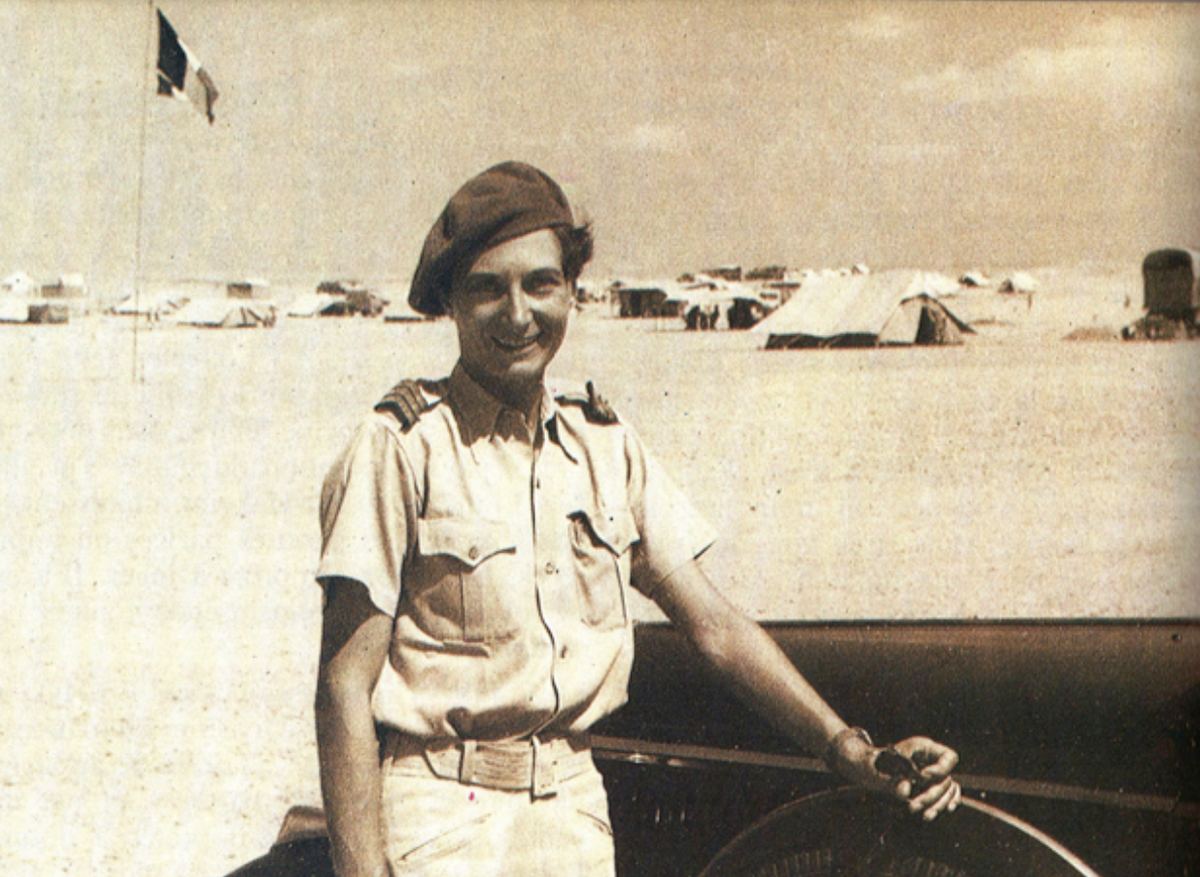
General Koenig was married, but during his time in North Africa he had had an affair with his British driver, Susan Travers (1909–2003). Travers came from a wealthy British family; she had moved to France at the age of 12 and led a jet-set life on the Côte d’Azur. When war broke out she wanted to fight the Germans and ended up in North Africa as Koenig’s personal driver. Back in Europe, their relationship did not last.
In 2000 Travers published her war memoirs under the title ‘Tomorrow to be brave: a memoir of the only woman ever to serve in the French Foreign Legion’(.4) Curiously, Monique bore a striking resemblance to Susan Travers in looks and build (or vice versa), and both women drove military vehicles – but that is by the by.
Be that as it may, in 1944 Koenig was involved with Monique Bierens de Haan. Monique and Pierre had few chances to meet, certainly not once eight groups of the (militarised) VHK, Monique among them, crossed to the liberated south of the Netherlands in the autumn of 1944. There the VHK helped evacuees, handed out food and clothing, assisted the Red Cross and escorted many transports of children to England. Monique’s job was to drive large lorries.
Once the Nazis had been defeated, Germany was divided into four occupation zones: American, Soviet, British and French. General Koenig became military commander of the French zone. On Koenig’s recommendation, Barthold Bierens de Haan was appointed to the Allied Control Council (the body governing the four zones) as liaison officer between the ACC and the Dutch military authorities. In that capacity he reportedly worked to track down Dutch paintings stolen by the Nazis.
In the autumn of 1945 the family moved to Baden-Baden, where Koenig’s “court” was based. Monique, still in love with Koenig, found that the commander liked having her close by but had no intention of divorcing his wife. By the time her husband Barthold found another job in July 1949, her love for Koenig had cooled considerably.
Bierens de Haan’s new employer was the Organisation for European Economic Co-operation (OEEC), founded in Paris in 1947 and later known as the Organisation for Economic Co-operation and Development (OECD). So the family, now joined by a daughter, Camille, moved to the French capital.
In the spring of 1951, after Monique had given birth to her fifth child (a son, Eric), Bierens de Haan, whose health was steadily declining, made his last career move. He accepted a post with Shell in The Hague, and in the autumn of 1951 the family moved once again, this time to the Netherlands (Wassenaar). By then Barthold Bierens de Haan was seriously ill. In the summer of 1952, at Monique’s urging, he was admitted to a hospital in Switzerland, where he died of kidney failure on 20 July 1952, aged just 42. Monique outlived him by many decades. She died on 2 February 1994 following a car accident near Geneva, at the age of 83.
(.1) Diary of Barthold Bierens de Haan, dated 17-9-1943.
(.2) A. DESSING, “Tulpen voor Wilhelmina: de geschiedenis van de Engelandvaarders” (Amsterdam, 2004), p. 236.
(.3) B. BIERENS DE HAAN, Ecume de mėre (addendum to M. BARBEY, l n’y a qu’un facon d’aimer. Paris, 2013).
(.4) The French title of Travers’s book is ‘Tant que dure le jour’. The Dutch translation is titled ‘Een liefde in Afrika: het waargebeurde en moedige verhaal van de enige vrouw in het Vreemdelingenlegioen.’
Nationaal Archief: the journey of Barthold Bierens de Haan
Agnes Dessing’s PhD thesis, University of Amsterdam, 2004: “Tulpen voor Wilhelmina”