A few years ago I happened to meet Falco Friedhoff at the farewell to the Catalina, the flying boat that, after years of loyal service, left Lelystad Airport for the United States. Falco has a great love of old machinery and was the in-house filmmaker for the foundation that kept the Catalina flying. By chance we got talking about the wartime history of Falco’s father, Herman Friedhoff. Falco has always been fascinated by it. As a small boy he played soldiers in the dunes near The Hague and Scheveningen, among the still-fresh traces of the war, and he always pricked up his ears when the war came up in conversation. For a fancy-dress party at school he put on his father’s uniform – and was promptly stopped in the street and asked for his papers. Much later he helped his father write a book about his wartime experiences. It was written in English, because it was meant to give the British, who have no idea what it is like to live under occupation, a picture of that time. He also translated it into Dutch: Requiem voor het Verzet.
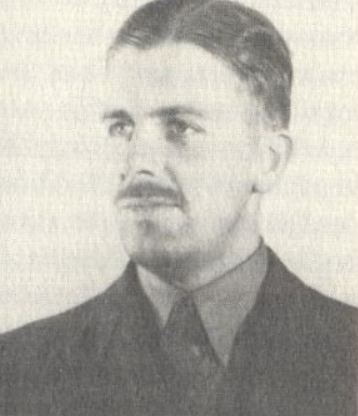
Herman Friedhoff was born on 15 August 1920, the son of the well-known architect Gijsbert Friedhoff and Wilhelmina Anna Ligtermoet. Because of his father’s work, he moved in well-to-do circles from an early age. Gijsbert regularly hosted gatherings at home to discuss the state of the world with prominent figures such as the historian Professor Johan Huizinga and the Hungarian-Dutch pianist Géza Frid. Through these he also came to know Herman Bernard Wiardi Beckman (1904-1945), SDAP politician, senator and editor-in-chief of Het Volk, and Hendrik van Borssum Buisman, director of the Teylers Museum. Friedhoff got on well with the museum director’s sons, Jan and Garrelt.
The young Friedhoff seems to have found it hard to fit into the bourgeois straitjacket of his parents’ world. At secondary school he soon clashed with authority, and he was convinced of his own abilities from an early age. Even as a youngster he saw himself becoming a great writer, producing poems, short stories and plays brimming with teenage romanticism. After starting school in Haarlem, he moved on to the Mulo (lower secondary school) in Baarn, where he met Erik Jurriaans. From there he went on to the HBS-B (upper secondary school, science stream) and sat his final exams in the summer of 1939. During these years he joined the Anglican Church and seriously intended to become a priest in it, taking private lessons in Greek and Latin to that end. This did not stop him from enjoying life. He began a relationship with Ellis Brandon, a classmate at the HBS, and spent many loving hours with her on the beach at Bloemendaal.
All this youthful romance was rudely interrupted by his call-up for military service. Friedhoff was posted to the artillery’s survey service in The Hague. On 10 May 1940 he was under arms at the Frederikskazerne, the barracks on the dunes near Scheveningen. Still in his pyjamas and armed with a rifle, he climbed onto the barracks roof to vent his fury at the German invasion, hoping to hit the German aircraft flying overhead. From the roof he watched the Germans bomb the neighbouring Alexanderkazerne, hitting the stables and killing 66 of the Dutch cavalrymen quartered there.
After the capitulation he was searching for direction. He joined the Nederlandse Unie, a large political movement that accepted the new order but sought to act as a counterweight to the rise of the NSB, the Dutch National Socialist Movement. In October 1940 Friedhoff joined the Legioen Oud Frontstrijders (LOF) through his friend Erik Jurriaans, who with his father had laid the foundations of the resistance in Baarn. The LOF was a paramilitary resistance group made up largely of ex-servicemen and focused on direct armed action against the German occupier. Friedhoff also met Titus Willem de Tourton Bruijns (1898-1943), the group’s leader, who to Friedhoff’s frustration never told him after their first meeting where he would fit into the Haarlem LOF group.
Determined to find resistance work all the same, he turned to Wiardi Beckman on the advice of his father, who said he did not want to know what his son was up to, but that he should be careful and not get involved with shady characters. The politician put Friedhoff in touch with people he knew in the Ordedienst (OD) in Haarlem. Like the LOF, the OD was a resistance organisation run along military lines, but its aims were more conservative: it set out to prevent a power vacuum immediately after the liberation. Through the OD, Friedhoff became involved in a committee of politicians from across the political spectrum that met to discuss post-war political and constitutional arrangements. For the young Friedhoff, this early resistance remained rather abstract. Yet things would turn serious for Friedhoff and his friends. For now, he remains a romantic young man in the resistance.
Part 2 of this story follows in the next newsletter.