‘Whoever betrays anything gets the bullet.’ Thirteen-year-old Tom Wieringa wanted to go to England ‘to fight for the fatherland’ and wrote a farewell letter to his parents, his brother Jos and ‘Granny’. Was it all just make-believe?
When the Second World War broke out, the Wieringa family lived at Schenkweg 314 in The Hague: father Tiemen (42), mother Stephana Schuitema (46), their children Jos (16) and Tiemen Ite (‘Tom’, 13), and a grandmother who lived with them (‘Granny’). Tom was born in Groningen on 10 November 1926. The family moved to The Hague in 1928 and settled in the Schenkweg in 1939.
According to the Hague police daily report of 8 October 1940, father Tiemen asked the police that day to ‘trace and bring back’ his son Tom. The officer on duty noted: ‘The boy left a letter saying he was going to England with two English sailors. Fantasist?!!’
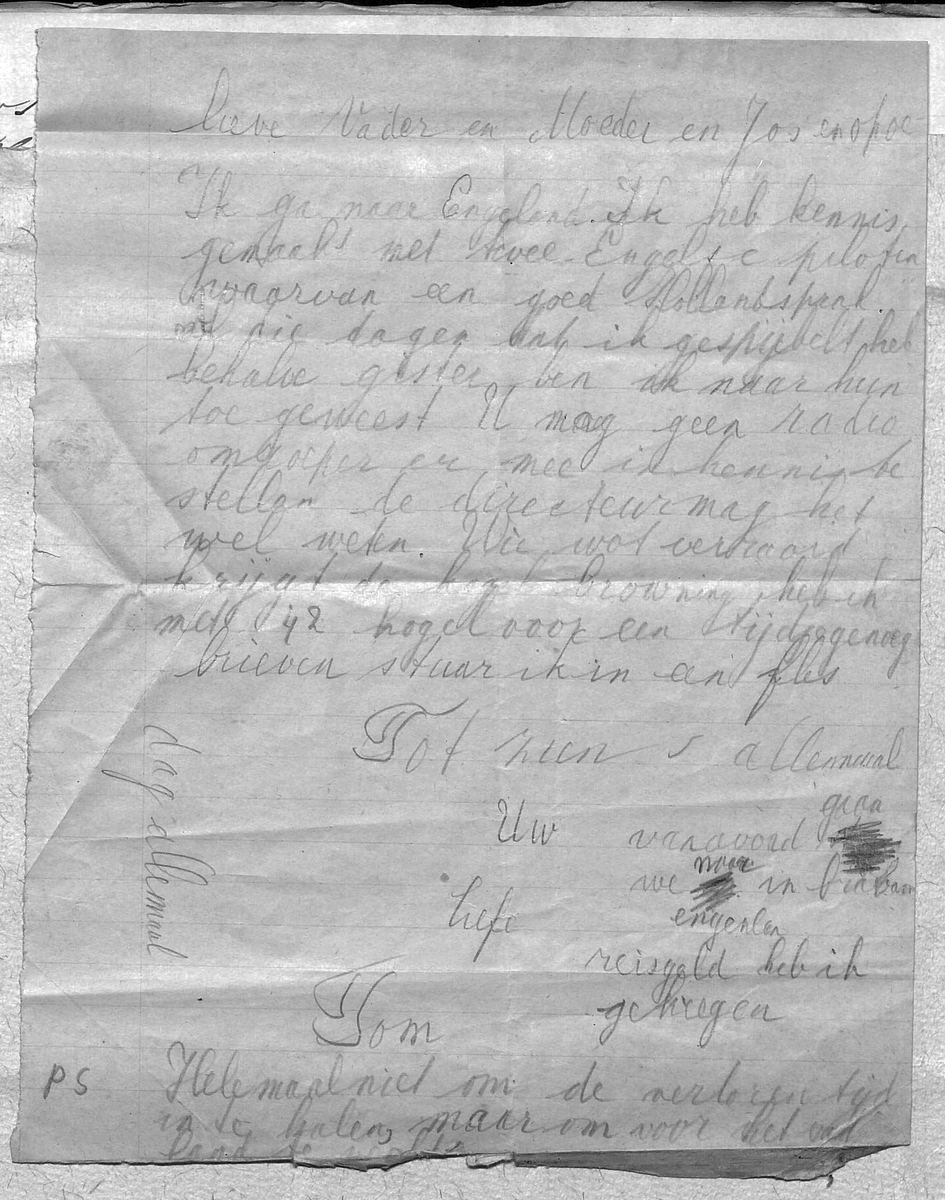
The letter is kept with the daily report in the Haags Gemeentearchief (Hague Municipal Archives). Tom writes:
‘Dear father and mother and Jos and Granny,
I am going to England. I have got to know two English pilots, one of them spoke good Dutch. On the days I played truant, except yesterday, I went to see them. (…) Whoever betrays anything gets the bullet, I have a Browning with .42 bullets, enough for a while. I will send letters in a bottle. Goodbye everyone, your loving Tom. I have been given money for the journey.
PS Not at all to make up for lost time, but to fight for the fatherland.’
Curiously, the police report mentions ‘sailors’, while Tom’s note speaks of ‘pilots’. Perhaps his imagination ran away with him, or he wanted to sound tough and turned the sailors into ‘English pilots’. He had clearly given his plan to go to England a good deal of thought. He had the route via Belgium and France in mind (‘Tonight we are going to (…) in Brabant’) and knew that betrayal lurked everywhere: by his own account he was taking a pistol with him – a ‘Browning’, no less.
Tom probably never made a real “Engelandvaart”. Later, the police report was annotated in red: ‘Found’. Even so, his letter shows that, from the very start of the occupation, it was fairly common knowledge that some Dutch people were trying to reach England to carry on the fight against the occupier.
For now, the youngest known “Engelandvaarder” is William van Remundt, who was fifteen years and three months old when he made his way to the free world.
With thanks to Ronald Klomp, Stichting WO2 Sporen