Speech by Agnes Dessing at the launch of the book ‘Een familiekroniek over verzet tegen het fascisme 1940-1945’ by Bert Woudstra and Werner Rosenfeld on 30 March 2025
“ENGELANDVAART” FOR REVENGE
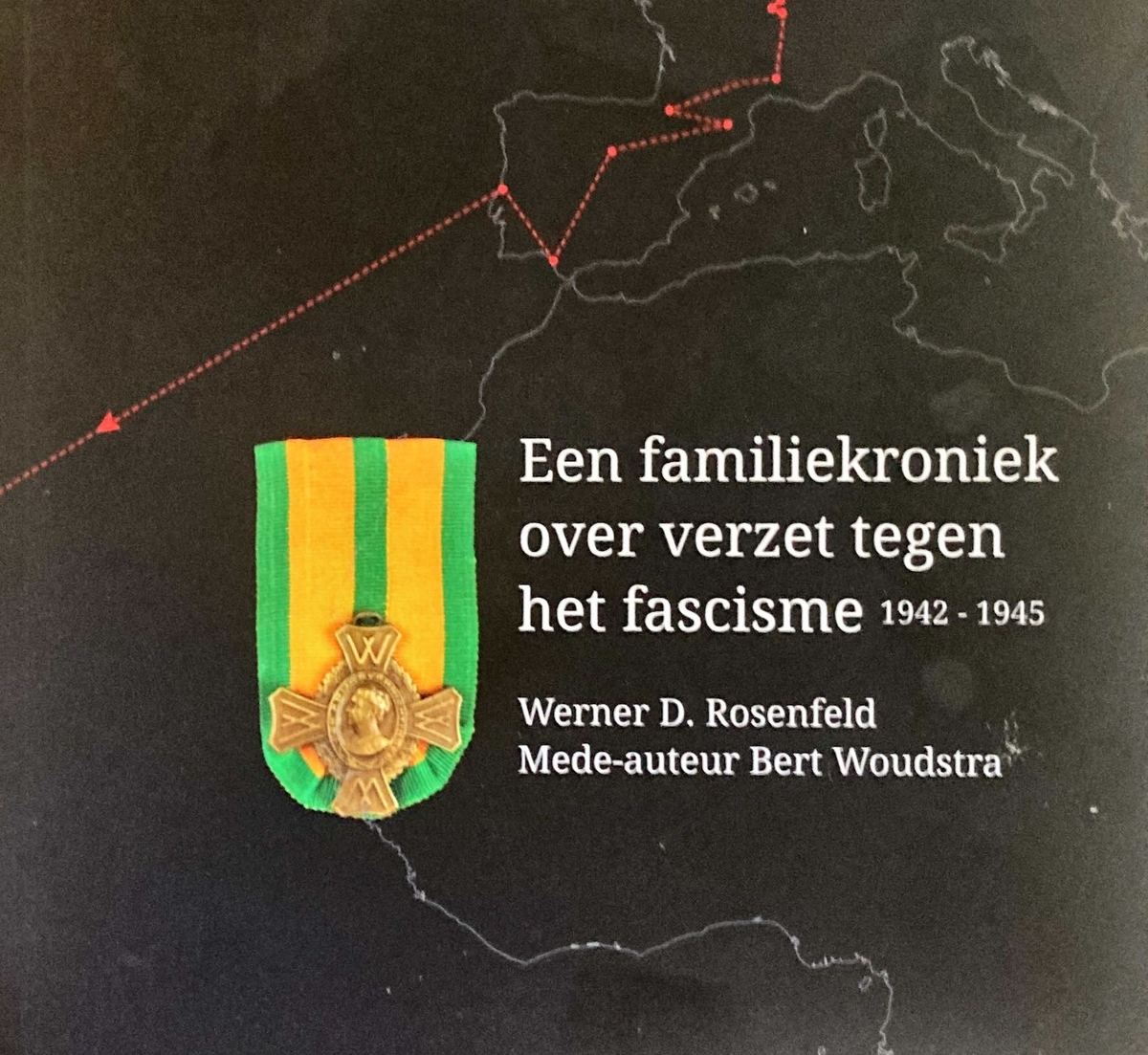
The book by Bert Woudstra and Werner Rosenfeld being launched here today is titled Een familiekroniek over verzet tegen het fascisme 1940-1945 (A family chronicle of resistance to fascism 1940-1945). It is about two young Jewish “Engelandvaarders” from Enschede: Egon Woudstra and his cousin Werner Rosenfeld.
In 1994, more than 30 years ago now, I heard the name Woudstra for the first time. As a historian I had just started a new project: research into the “Engelandvaarders”.
“Engelandvaarders” are Dutch men and women who, in the years 1940-1945, tried to escape from occupied territory and went to England to join the Allied forces and so fight from England for the liberation of the Netherlands. In all, some 2,000 Dutch people reached England.
On arrival they were questioned at length by the British security service to weed out any German spies. Then the security service of the Dutch government in London went over it all again. Those Dutch interrogation reports were (and still are) held in what is now the Nationaal Archief, and they were the main source for my research. I spent years in the archive, working my way through countless cardboard boxes of interrogations. Today this material is online, but sadly it was not then.
To keep in mind that this was about people, not paper, I regularly went to interview an “Engelandvaarder”. I decided to start close to home, in my own town of Haarlem, and so I came to Egon Woudstra, who set off for England in 1942 with his cousin Werner Rosenfeld.
The interview began in a relaxed way, with Egon talking about his childhood in Enschede and how his parents owned a well-known fashion shop there. But then Egon began to talk about the arrest of his father, Samuel Frits Woudstra, on the night of 13 to 14 September 1941. The resistance had cut telephone cables, and in reprisal the Germans decided to round up more than 100 prominent residents of Enschede, some of them Jewish. The non-Jewish detainees were soon released.
The Jewish detainees, Egon’s father among them, were sent to Mauthausen and murdered there. After only two weeks Egon’s mother was told that her husband had died ‘of a heart condition’. As he told me this, Egon became deeply emotional and said through his tears: ‘I could have saved him… if only I had told him to go and stand in the garden.’
Egon Woudstra’s boundless grief and guilt made a deep impression on me, and I will never forget it. But it also taught me something: that revenge could be a motive for “Engelandvaart”. Or, as Werner put it in his account of the journey:
One thought is foremost in our minds: to avenge Uncle/Father Frits, who was taken from his home on 14 September, then deported to Mauthausen concentration camp and murdered after two weeks. We will shrink from nothing to achieve our aim. We want to fight for the good cause, for our parents and family, and for our rights and our freedom!
In just a few sentences, several motives appear here that recur among all the “Engelandvaarders”: love of their country, anger at the German invasion, a longing for freedom and also a thirst for adventure. Remember that in those days very few people had ever been abroad on holiday.
Crucially, these personal motives were closely interwoven with measures taken by the German occupiers, which acted as a kind of push factor, so that people who perhaps had vague plans of an “Engelandvaart” actually set out.
One very obvious push factor was the start of the deportation of Dutch Jews in the summer of 1942, but so was the declaration of loyalty put to students in the spring of 1943, in which they promised to take no action against the occupiers. Only if they signed it were they allowed to continue their studies.
Another push factor was the Arbeitseinsatz announced in 1942. Dutch men aged 17 to 40 were picked up off the street or taken from their homes in raids and forced to work in Germany. The same applied to the measure of spring 1943 requiring servicemen and conscripts to give themselves up as prisoners of war.
It is clear that Egon and Werner, who were both Jewish and had already experienced plenty of exclusion and humiliation, had an urgent reason to leave the Netherlands to escape deportation.
How did such a journey to England work? Broadly speaking there were three routes: crossing the North Sea in a small boat, going via neutral Sweden, or a long journey overland heading south.
I give guided tours at the Museum Engelandvaarders in Noordwijk, and visitors there often think the North Sea route, being the shortest, was also the most used. It was not. This route was very dangerous because people used boats that were not seaworthy, and many drowned. And from 1941, when the Germans began building the Atlantic Wall, it became almost impossible to reach the coast. The coastal strip was declared a Sperrgebiet (restricted zone) and was closely guarded.
That is why most “Engelandvaarders”, Egon and Werner among them, chose the so-called southern route. That route, incidentally, was also fairly dangerous.
From the Netherlands you had to cross a great many borders illegally: first from the Netherlands into Belgium, then from Belgium into France. Within France there was another border too, the so-called demarcation line between northern France, occupied by the Germans, and the unoccupied south, run by Marshal Pétain and also known as Vichy France. Then you had to cross the Pyrenees to get into Spain, and from there you could go on to England by boat or plane.
The risk of arrest along the way was ever present: if not at one of those illegal border crossings, then during a check on the train. Your papers might be found wanting, or you might give yourself away because your French was poor. Some “Engelandvaarders” dealt with this very inventively. One “Engelandvaarder”, for example, was being checked by a German soldier, and when the man asked him something he launched with great bravado into reciting a French poem. A French inspector would never have fallen for it, but because the German soldier did not speak French either, he got away with it.
Another lovely story concerns a very young “Engelandvaarder” of 16 who had run away from home without any money and really did not speak a word of French. He was helped by French resistance people, who hung a sign round his neck with the words sourd-muet (deaf and dumb). That way, if he was stopped, he could simply point to the sign!
Egon and Werner did not have these problems with checks, because on 18 September 1942, at Amsterdam Centraal, they crawled into the so-called wheel boxes under the express train to Paris. From their hiding place under the train they could see the boots of German soldiers on the platform during stops, but nobody saw them.
Until, at the Belgian-French border town of Quévy, a little man with a hammer came to check the wheels for cracks. He saw the men lying there, went away and came back with a gendarme. Egon and Werner thought they would be arrested, but the gendarme asked: ‘Vous êtes prisonniers de guerre?’ (Are you prisoners of war?). Egon had the presence of mind to say ‘Oui’, whereupon the gendarme allowed them to stay where they were under the train.
In Paris they called on a business contact of Egon’s father, who arranged shelter and changed money for them. A few weeks later they travelled on south, crossed the demarcation line and reached Marseille in October 1942.
You would expect “Engelandvaarders” who ran into trouble on the way to get help from Dutch consulates, but sadly that help amounted to very little, as many “Engelandvaarders” found. Consular staff did not understand what the young men had come for and usually advised them to go home. Werner and Egon, who visited the Dutch consul in Marseille, a certain Jonkheer Van Lennep, were also quickly fobbed off. The jonkheer gave them a little money and ushered the young men out of the building as fast as he could.
The pair then made their way to the Office Néerlandais in Perpignan, where they were received far more warmly by the consul, Joop Kolkman. He promised to arrange papers that would allow them to travel officially to England via Spain and Curaçao. While they waited, they were housed in Maison Mazard, a reception house in the village of Le Soler, near Perpignan.
That official route became impossible when, on 11 November 1942, the Germans occupied Vichy France as well. The admirable Kolkman arranged false papers and a passeur (guide). Together with a group of other Dutchmen, Egon and Werner left illegally for Spain. They took a train through the border area, had to get off at a certain point, and were advised by the guide to walk along the railway line only at night and to hide during the day.
That was very good advice, because in Spain too the risk of arrest was enormous – not by the Germans, but by the Spanish police, the Guardia Civil. Spain under General Franco was on Hitler’s side. “Engelandvaarders” and other refugees who came over the Pyrenees were regarded as ‘undesirable aliens’. They were not handed over to the Germans, but they were arrested at once. The men were often sent to the Miranda de Ebro concentration camp in northern Spain, where some were held for as long as six months. Many “Engelandvaarders” were also locked up in prisons in northern Spain: in Burgos, Pamplona, Zaragoza and other cities.
Egon and Werner’s group kept walking along the railway for three days before being arrested and locked up in the prison in Barcelona. They were released fairly quickly through the efforts of the Dutch consulate (that one did help) and put up in a hotel in Madrid.
In January 1943 the group travelled from Madrid to Cádiz in southern Spain, where they boarded the Cabo de Buena Esperanza. Via Curaçao and the United States, Egon and Werner travelled to Canada (where they met Princess Juliana in Ottawa), and from there on to England. An enormous detour to reach a country so close to the Netherlands!
On 18 June 1943 Egon and Werner arrived in England, exactly nine months after leaving the occupied Netherlands. Egon chose the RAF and trained as a wireless operator/air gunner. Werner fought with the Prinses Irene Brigade.
They had stayed out of the hands of the Nazis, had fought for the liberation of the Netherlands, and had effectively taken revenge for the murder of their father and uncle.