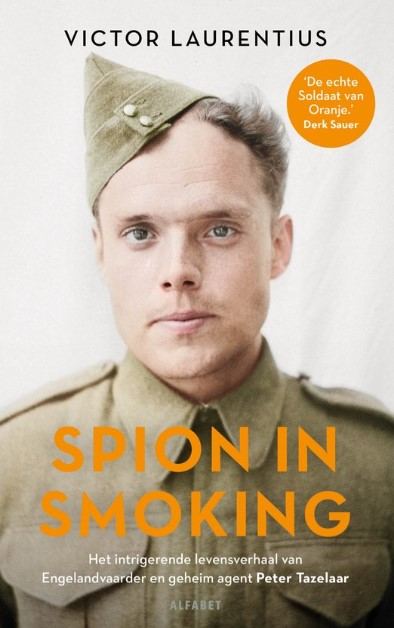
Victor Laurentius’s book Spion in smoking (Spy in a Dinner Jacket) opens with a hair-raising scene that almost every Dutch person knows from the film Soldaat van Oranje (Soldier of Orange), based on Erik Hazelhoff Roelfzema’s book of the same name.
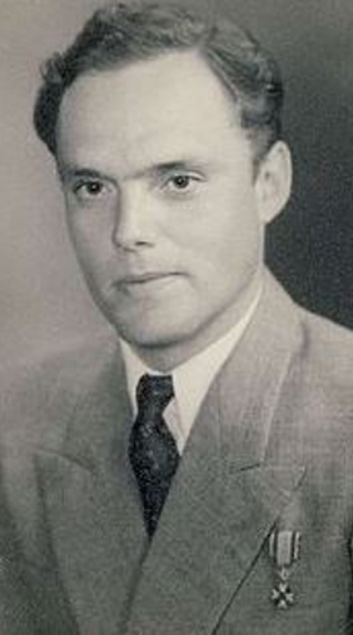
It is Sunday 23 November 1941. At five o’clock in the morning, a British Motor Gun Boat (MGB) puts two “Engelandvaarders” and Dutch secret agents, Hazelhoff and Tazelaar, ashore on the ice-cold beach at Scheveningen. Hazelhoff helps his colleague Tazelaar out of his dry suit, a rubber outfit concealing an immaculate dinner jacket. He produces a bottle of cognac donated by Queen Wilhelmina and sprinkles it over the lapels of Tazelaar’s dinner jacket, so that he can pass for a reveller who has lost his way. Hazelhoff then rows back to the waiting MGB, while Tazelaar walks towards the Scheveningen promenade. His orders are to collect two prominent Dutchmen within 48 hours and bring them to the beach. He is also to establish a radio link between the occupied Netherlands and England and, finally, to set up an escape line for Allied airmen.
First, however, Tazelaar wants to catch a tram on the Gevers Deynootplein. There he unwittingly draws a great deal of attention by paying with silver coins, which the Germans had withdrawn from circulation some time earlier and replaced with zinc ones – something London did not know. He soon gets off the tram and decides to walk to Hollands Spoor station. There he uses banknotes, which are still valid, to buy a train ticket to Vlaardingen, where his grandfather lives. While he waits on the platform, another tense moment follows. Reaching under his coat for his Colt .45, he breaks the elastic holster and the gun hits the tiles with a horribly loud clatter. As casually as he can, Tazelaar picks it up and hides it under his coat again.
This opening is a superb way in that draws you straight into the story. It also shows how immensely brave Tazelaar was and how spectacular his exploits were. Yet in later public perception and in the history books, he never received the credit for his heroism. That was partly down to him: he never traded on his wartime past and shunned publicity. Mostly, though, it was due to his comrade Hazelhoff Roelfzema, who wrote the book Soldaat van Oranje, in which Tazelaar was described as Hazelhoff’s “brave comrade-in-arms”, and even more to the 1977 film of the same name, in which Tazelaar’s name does not even appear and his role is merged with that of another agent, Ernst de Jonge, into the fictional character Guus Lejeune.
Laurentius’s book is therefore one long act of rehabilitation, or as Tazelaar’s great-nephew Derk Sauer put it during a television programme: Tazelaar is the real Soldier of Orange!
With great care, Laurentius reconstructs the life of resistance fighter and secret agent Peter Tazelaar: his childhood in the Dutch East Indies, his strict father, and his admission as a cadet to the KIM (Koninklijk Instituut voor de Marine, the Royal Naval College) in 1938. He did not complete the course – just as, later in life, he would never complete any course at all. He got on well with his fellow cadets but chafed at the discipline imposed on him, was sloppy and did no work.
After the German invasion in May 1940 he tried in vain to escape to England and, through contacts among his fellow cadets, became involved in the Ordedienst (OD), a resistance group of military men whose aim was to maintain order in the Netherlands after a German capitulation. In the summer of 1941 Tazelaar managed to escape to England aboard the Swiss cargo ship St. Cergue. On board he met two other would-be “Engelandvaarders”: the Leiden students Erik Hazelhoff Roelfzema and Bob van der Stok.
While still on the ship, Van der Stok told Tazelaar about a plan he had devised to set up a spy network in the occupied Netherlands by landing agents on the Dutch coast from the North Sea. Hazelhoff was not part of it. But Hazelhoff found out anyway and made off with the plan, at which point Van der Stok withdrew.
Once in England, Hazelhoff, Tazelaar and a third “Engelandvaarder”, Chris Krediet, set to work with Queen Wilhelmina, her private secretary Van ’t Sant and the British secret service to establish a link with the occupied Netherlands. The operation was christened Contact Holland, and landing Peter Tazelaar at Scheveningen was the group’s first feat.
Contact Holland was not a success, however – though that was not Tazelaar’s fault. After several failed pick-up attempts, on 17 January 1942 he stood ready on the beach at Scheveningen with two prominent Dutchmen, waiting for the MGB that was to collect them. His OD resistance friend Gerard Dogger was there too. But they had been betrayed. Everyone was arrested except Tazelaar and Dogger, who waded into the half-frozen sea and hid there up to their necks.
Tazelaar and Dogger travelled to England via Switzerland and Spain – for Tazelaar, it was the second time. After his return, the hero of this story fell into a deep slump. He worried about his resistance friends in the Netherlands and feared infiltration, and he was given a dressing-down by the Minister of the Navy. While his comrades Hazelhoff and Krediet were awarded the Military William Order for Contact Holland, Tazelaar received the Cross of Merit, which he refused. Hazelhoff and Krediet trained as pilots and joined the RAF; Tazelaar worked for the London fire brigade.
In 1944 a guardian angel appeared in the person of resistance man Gerrit Jan van Heuven Goedhart, who had managed to escape from the occupied Netherlands and became a minister in the government in London. He successfully championed Peter Tazelaar’s rehabilitation. On 12 September 1944 a delighted Queen Wilhelmina knighted Tazelaar, and in early November 1944 he was parachuted into Friesland as an agent of the Bureau Bijzondere Opdrachten (BBO, Special Operations Bureau) to support the resistance there – so effectively that the province was able to liberate itself.
After the war a whole life still lay ahead: Tazelaar died in 1993 at the age of 73. But by then the high point – the war – was long behind him. His career never got off the ground, and he married four times, but none of the marriages lasted.
When the film Soldaat van Oranje premiered in 1977, Tazelaar’s friends from the resistance protested, believing that both book and film misrepresented what had happened. Tazelaar himself was unmoved: ‘Then I should have written a book like that myself,’ he said of Soldaat van Oranje, ‘….but I’m too lazy for that’.
Victor Laurentius’s book is the true story of Peter Tazelaar and richly deserves to be read. It is on sale in the museum shop.