A few years ago I heard a nice anecdote about a small group of “Engelandvaarders” who had arrived in London on 12 July 1942. One of the Dutch officials referred to ‘that group of 8 “Engelandvaarders”’, whereupon Truus Vollema, the only woman in the party, protested and promptly corrected the official by pointing out that this was not a group of 8 “Engelandvaarders” but of 8 ½: she was, after all, pregnant, and in her view the unborn child counted as at least half an “Engelandvaarder”.
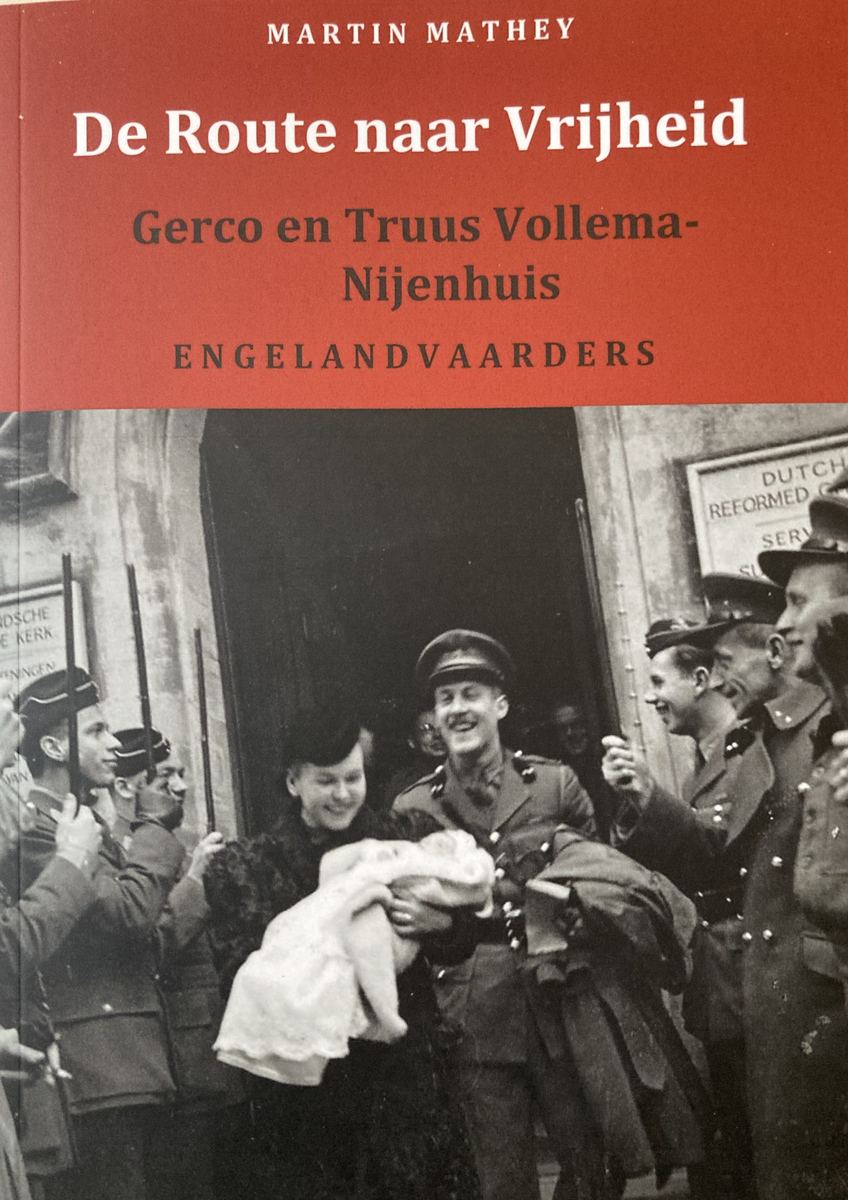
The nice thing about anecdotes is that they do not often tell you what really happened, but they do give an impression of the circumstances. In this case, though, Hannewietske Vollema, born on 25 December 1942, appears in a photograph after her christening in London on the cover of the book ‘De Route naar vrijheid. Gerco en Truus Vollema-Nijenhuis; “Engelandvaarders”’ (The Route to Freedom).
‘De Route naar Vrijheid’ is the account by the Vollema-Nijenhuis couple’s grandson of their experiences during the war, and above all of their departure and journey from the occupied Netherlands to England. Gerco Vollema (1915-1985) was commissioned as a reserve second lieutenant in the artillery in December 1936, and in February 1939 his reserve commission became a regular one. The couple married in August 1939, and at the end of that month Lieutenant Gerco was posted to The Hague.
On 26 April 1940 Gerco had a serious riding accident in The Hague that badly injured his left foot; at first it was feared the foot could not be saved. A long recovery followed in The Hague’s Bronovo hospital. His wife Truus managed to get a job there, so she could visit him every day; she found lodgings in a guesthouse near Bronovo, at Floris Grijpstraat 7, an address that would later matter to several “Engelandvaarders”.
At the end of August 1940 Gerco was able to leave Bronovo – by then he could walk carefully on crutches – and he too moved into the guesthouse at Floris Grijpstraat 7. There he still had to do a great deal of exercise to help his foot recover. In the guesthouse he also met a future “Engelandvaarder”, Theo Wachtel, whose mother ran the place. Also staying there was Laurus Melse, a civil servant with close ties to the resistance. He was a key figure in the so-called Van Niftrik route from Brabant to Switzerland and would help many “Engelandvaarders” on their way from The Hague via Van Niftrik in Putte.
At Bronovo Gerco had many visits from colleagues, among them his regimental commander, who advised him to sign the declaration of honour he had brought with him. Gerco did so, and after the war, questioned by the parliamentary Enquêtecommissie (commission of inquiry), he gave his reasons: ‘It was explained at the time that you could withdraw that declaration at any moment. That was the main reason I signed it. We saw it more as a scrap of paper, a formality. (-) It was more permissible to give “this” word of honour than “a” word of honour, because the Germans did not behave as a normal enemy behaves’.
At the end of October 1940 the couple moved back to their old address in Utrecht. Through the compulsory Opbouwdienst, Gerco ended up in the Nederlandse Arbeidsdienst (Dutch Labour Service), but by applying to the Police and Marechaussee he managed to avoid that compulsory service: he got a job in the identity card department at Utrecht town hall, where he was able to steal passports, ink pads and the like for English pilots, among others. This also brought him into contact with the resistance organisation Ordedienst, the OD.
The continuing arrests within the OD, and his gradually improving foot, led to the plan to escape to England. Laurus Melse was a great help to him, and Truus persuaded Melse to let her go with her husband. On Saturday 1 November 1941 they left for Putte, to ‘Uncle Job’ van Niftrik. Via Putte and Antwerp (the Van Dulken family) they came into contact with Madame Caumeutin, a passeuse (people smuggler) who guided them across the Belgian-French border; two other “Engelandvaarders”, Albert Scheffer and Theo Wachtel, joined them along the way.
After slipping through French and German checks more than once, they reached Besancon and Pontarlier; in Pontarlier they met the guide who would take them through the Jura mountains to Switzerland, and Madame Caumeutin’s task was done. Via La Ronde, the Swiss border village, a Swiss border guard took them to Les Verrières for an initial interrogation and then, on 14 November 1941, to Neuchâtel. Gerco and the other two “Engelandvaarders” were locked up in the local prison, and Truus was placed with the Salvation Army.
On 20 November they were all released and taken under Swiss escort to Bern, to the office of the Dutch military attaché. There came the first real disappointment: the idea that they could travel on quickly from Bern to England proved to be a misconception. Various visas were needed, French and Spanish; men had to be no older than 18 and no younger than 41, the age of conscription, or the Germans would regard them as helping the Allies. So a fair number of fraudulent birth years were entered in passports. Gerco, with a moustache and dark glasses, was to be 42 years old (‘he looked it’, according to Truus, who posed as his secretary). Moreover, the Spanish government would not allow them to go straight to England, though a Latin American country was acceptable. All these requirements took a good deal of time.
At that time so-called sealed (locked) trains ran fairly regularly between Switzerland and Spain. On 21 May 1942 they left Geneva on one of these trains through Vichy France to Cerbère on the Franco-Spanish border. The Franco-Spanish hurdle, too, was overcome with the false papers. In Barcelona they were able to board the Cabo de Bueno Esperanza. What Truus did not know was that Gerco had arranged with the English consul in Geneva that, as supposed spies, they would be taken off the ship by an English naval vessel off Gibraltar and brought to Gibraltar. This happened on the morning of Wednesday 3 June, to the fury of the Cabo’s Spanish captain.
It was almost a month before the party of Dutch refugees could leave for the United Kingdom on an English transport ship, arriving in Glasgow on 12 July 1942. From then on, the usual sequence of events followed: screening first at the Patriotic School, then by the Politie Buitendienst, and then the search for a wartime job.
Grandson Martin Mathey has described his grandparents’ journey to London clearly, regularly supplementing his own text with diary notes and memories his grandparents wrote down later. The result is a very readable book, with many illustrations as well.
The book, 206 pages (ISBN 978-94-6522-412-1), is on sale in the museum shop.