Book review by Sierk Plantinga
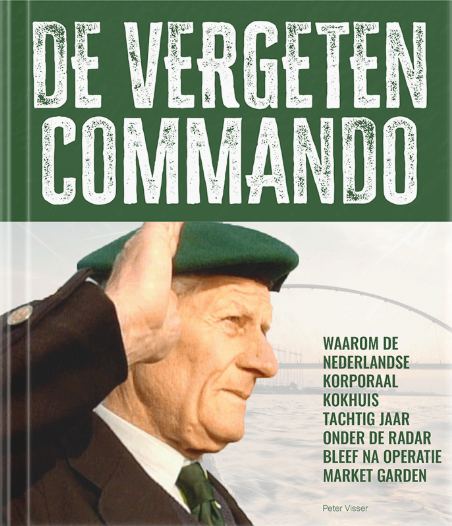
To get straight to the point: it is always a great pleasure to read a well-written book free of all sorts of language errors, and that is true of this book, De Vergeten Commando, written by the author and former journalist Peter Visser.
The book is about the Dutchman Valentijn (known as ‘Val’) Gerardus Kokhuis. In May 1940 he served in the 41st Infantry Regiment of the Peel Division in Brabant, stationed near Bakel and Oploo. The unequal struggle between the German army and the Dutch sent Val Kokhuis and his unit wandering from place to place until those wanderings came to an end: Gemert, Tilburg, Breda, Zeeuws-Vlaanderen, Bruges, Koksijde, Abbeville (20 May 1940, just before the German troops arrived there), Evreux and Cherbourg.
It is well known that many Dutch servicemen managed to escape to England by ship from Brest. Less well known is the route via Cherbourg, from where the Lady of Mann safely reached the port of Southampton on 23 May 1940. From Southampton the men travelled on by train to Haverfordwest in south-west Wales.
Several maps in this book illustrate the various routes, and the conditions, daily discomforts and problems this group of Dutch servicemen faced are also described, giving the reader a good impression of this relatively unknown episode of wartime history.
After a stay of a few weeks they moved to Porthcawl, where there was a large tent camp, entirely surrounded by barbed wire for fear that traitors and Germans might be hiding among the Dutch. A lieutenant is quoted in the book: “And what did we do every day? During the day we took down tents, only to put them up again fifty metres further on. And in the evening we propped up the bar or painted Porthcawl red.” To break the low morale this caused, a PE teacher organised all kinds of sport for the men: gymnastics, football, athletics competitions and cross-country runs through the dunes. Val Kokhuis never missed a football match: he was the sporty type, and in those matches he developed into a creditable goalkeeper. In Wales he was allowed to train with the professionals of Cardiff City and Swansea Town; things got rough, as it earned him a broken nose, “bendable in every direction”.
In January 1941 the Royal Netherlands Brigade was formed in Congleton. In 1941 the brigade was stationed at Wrottesley Park near Wolverhampton, with new barracks, electricity and running water – unheard-of luxury for the soldiers. When plans were made for a Dutch military football team made up of servicemen stationed in England, Val Kokhuis was selected too. On 1 February 1941 the match Holland–Belgium was played. Kokhuis was reserve goalkeeper; his rival was Wim Brinkman, who had already kept goal for the Hague club Zwart-Blauw before the war. The match ended in a 3–3 draw. Val Kokhuis made his debut in the orange shirt in May 1941, in a match against an army team from North Wales.
In 1942 Val Kokhuis left the Brigade to undergo special commando training with a number of other Dutchmen in the Scottish Highlands. The training programme was extremely tough and many did not make it through. The book gives a great deal of information about the training programme. After six weeks, those who stayed the course, Val Kokhuis among them, received the commando qualification and the green beret (still worn by the Dutch Korps Commandotroepen). In the course of that year No. 2 Dutch Troop was formed and attached to a British commando unit.
In September 1943 Val Kokhuis married an English girl, but real military action was slow in coming, until a transfer to Bombay followed. In the end, for lack of military targets, it was decided that 2 Dutch Troop would return to England, where it was hoped they would see action after all – not least because the invasion had already taken place on 6 June 1944.
After two weeks’ leave, part of the unit was attached to the American 101st Airborne Division and another part to the 82nd Airborne Division. Val Kokhuis belonged to the latter. On 18 September 1944 he left for the Netherlands in a glider with a number of comrades: Operation Market Garden had begun.
After a somewhat difficult glider landing, Corporal Kokhuis set about his task: finding and maintaining contact with local resistance groups. But first another action awaited: crossing the River Waal at Nijmegen. This turned out to be a very bloody affair. Val Kokhuis took part in that crossing too, the only Dutch serviceman from No. 2 Dutch Troop to do so. The aim was to capture the north bank of the river (the Arnhem side) and so establish a bridgehead from which Arnhem could easily be reached. The various small boats full of soldiers proved an easy target for the Germans, with many wounded and killed as a result. The book goes into great detail about the crossing and exactly how and where it took place. Val Kokhuis’s conduct earned him the Bronze Cross in 1951.
The book then continues with a detailed account of Ben Bouman, a student in Nijmegen at the time, who was in hiding in Mook. Bouman offered his services to the American troops, as an interpreter among other things. He later claimed that he had been the only Dutchman to cross the Waal with the Americans. The author examines this claim of Bouman’s closely and therefore also looks at what happened to Val Kokhuis during the Waal crossing – Kokhuis, who by his own account was the only Dutch serviceman to take part in it. In effect it is a detailed reconstruction of the Waal crossing and of the events surrounding Val Kokhuis and Bouman.
At commemorations of the Waal crossing, Bouman was always presented in the press as the ‘only Dutchman’ to have taken part in it. Val Kokhuis was not mentioned. Nor did he ever talk later about what he had been through there.
After the fighting around Market Garden, the Dutch commandos were brought together again and, after regrouping, all of them were deployed in the Battle of the Scheldt. There was fierce fighting in that period, with many wounded. Val Kokhuis, too, was wounded at Dishoek on Walcheren, in his right thigh and upper arm; he was operated on by a Canadian surgeon, which, as he later said, saved his leg.
After his repatriation to England in November 1944, where he was able to recover from his wounds, Val Kokhuis was promoted to sergeant. After the German capitulation his unit was stationed in Winterswijk. There, too, he was sought out as goalkeeper for a match between Dutch servicemen stationed in the town and a team from the local club WVC; a newspaper report said: “Kokhuis made several splendid saves”. The cheers in Winterswijk were followed by the great victory parade in Amsterdam, where the Dutch commandos received loud and enthusiastic applause.
On 7 August 1945 they all returned to England, from where everyone could at last go home to the Netherlands for good. After six years of military service, No. 2 Dutch Troop was disbanded in October 1945. Around that time the Stormschool was set up in Bloemendaal, where young new commandos were trained by instructors, many of them former commandos of No. 2 Dutch Troop. Val Kokhuis was appointed as an instructor too. In March 1947 he moved from the armed forces to the municipal police in Haarlem, where until his retirement he was a senior constable serving as instructor in sport, weapons and shooting.
As I said at the outset, this is a very enjoyable, readable book with a wealth of information about the various events Val Kokhuis was involved in. The only thing that bothered me somewhat was the extensive attention given to Ben Bouman as the supposed only Dutchman involved in the famous Waal crossing. Why Bouman profiled himself in this way is not clear: professional jealousy? Kokhuis’s modesty, which meant he went unnoticed? But the aim of the book was to make Kokhuis’s activities known once and for all; it is no accident that its subtitle reads: “Why the Dutch corporal Kokhuis stayed under the radar for eighty years after Operation Market Garden”.
The book De vergeten commando (2024, 206 pages, ISBN 978-90-834077-0-8) is on sale in the museum shop. See also: www.devergetencommando.nl.