On 13 November 1944 eight militarised groups of VHK women (Rie Stokvis-Knapper among them) crossed from Tilbury in Britain to Ostend in Belgium. This came after an earlier attempt to cross the North Sea on 8 November had been thwarted by a storm.
In Ostend the women were met by General Kruls, head of the Militair Gezag (Military Authority), who had brought flowers for the VHK commander, Smit-Deijserink. Then the VHK could at last begin its task: helping the needy population of the newly liberated south of the Netherlands, the very reason the women had joined the corps. And help they did, with great enthusiasm. Food and clothing were handed out, undernourished children were evacuated to England, the sick were treated for scabies, and the women who drove lorries went back and forth carrying food, medicines or people.
Even so, the organisation of all this left something to be desired. Some groups were extremely busy while others had little to do. Nor did the VHK women always work well with local (Dutch) groups doing relief work.(1)
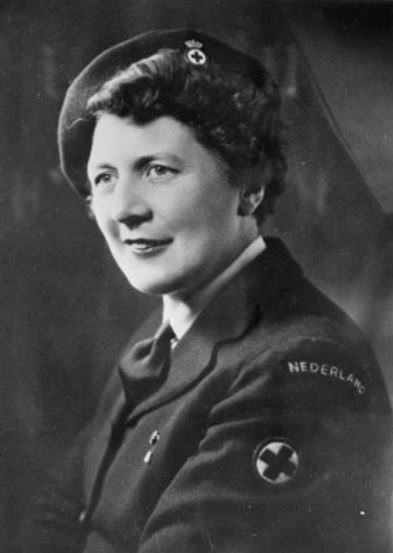
Rie Knapper was liaison officer of Unit VII, the group that settled in Oudenbosch in North Brabant. As was her habit, she set to work energetically and soon made several official trips to “sort things out”, one to Nijmegen and one to Maastricht. Each group, however, had been assigned a particular area, and Rie’s trips and initiatives cut straight across these. This irritated (senior) VHK women in those other areas, and before long complaints about Rie reached the VHK commander:
“Mrs Stokvis appears to have been visiting places as far apart as Nijmegen and Maastricht; making recommendations for the transfer of VHK-officers and personel, reporting availability of supplies and generally performing duties which cannot be said to be within her jurisdiction[…]”
Smit-Deijserink expressed her appreciation for what Stokvis-Knapper had meant to the VHK, but was otherwise very strict: Rie was to keep to her clearly defined duties and was no longer to overstep her authority.(2)
Three days later Stokvis-Knapper replied to this letter. She had observed, she wrote, that there was a lack of coordination within the VHK. As a result, in her view, the corps was not working efficiently and 50% of the good effect of its work was being lost. Knapper felt hampered by the demarcation of areas, which in principle she thought right, ‘if only there were a competent figure who, as it were, oversaw it all’. She proposed that she, Stokvis-Knapper, should take on such a role to ensure the groups were deployed more effectively.
This was all the more important because, according to Rie, the lack of coordination was causing discontent among the VHK women. ‘Many women,’ Rie wrote, ‘……feel that they are not being used to the full. This feeling makes the sacrifice they have often made, by leaving their husbands and children behind, seem too great compared with the usefulness of their presence here. [….] This leads to resentment and the wish to leave the corps as soon as possible.(3)
What happened next, and whether Rie got the coordinating role she wanted, is not known. A few months later a very different call would be made on her, and she would leave the VHK.
Aide to Wilhelmina
In April 1945 Stokvis-Knapper received a letter from the Queen’s private secretary, Mr Van ’t Sant. Her Majesty, he wrote, would soon be leaving for the Netherlands for good. In keeping with the wishes of the Dutch people, she would not live in a palace and would do without a royal household. She would, however, need a lady who could run the household and show visitors in. Would Rie be willing to do this?(4) Her answer was yes.
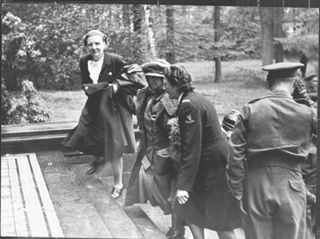
Stokvis-Knapper was honourably discharged from the VHK but was allowed to go on wearing her uniform for the time being. Together with her fellow aides Peter Tazelaar and Erik Hazelhoff Roelfzema, she accompanied the Queen on her final return to the Netherlands. On 2 May 1945 the Queen and the Princess, with their entourage, landed at Gilze-Rijen airfield. The party then settled at Huize Anneville in Ulvenhout, near Breda. Photographs show Queen Wilhelmina, Princess Juliana and Rie Stokvis-Knapper arriving at Anneville and climbing the steps to the terrace together.
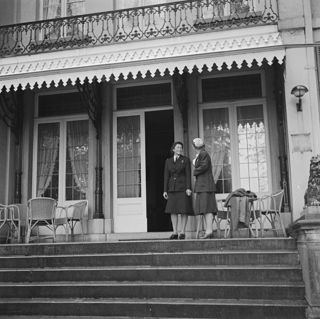
If Anneville still had something palatial about it (a country house with a front terrace), Her Majesty’s next residence was an “ordinary” house on the Nieuwe Parklaan in The Hague. The Queen lived there from September 1945 to April 1946.
Nico Knapper, Rie’s nephew, who lived in Amsterdam, remembers a jeep driving into their street, the Jan van Eijkstraat, not long after the liberation. Out stepped his aunt Rie, whom he had not seen for years. She had come to borrow crockery for the Queen, and left again laden with plates, dishes and cutlery.(5)
Nico Knapper, who later directed popular TV series such as Zeg ‘ns A and Oppassen, also says that his aunt never let slip anything about her dealings with the Royal House.
Even after her job as the Queen’s housekeeper had ended, Rie Knapper remained part of the entourage of the Queen and the Princess.
This is borne out by the many letters and birthday cards from Princess Juliana in Rie’s archive.
Already in London during the war, the Queen had been taken with the idea of ‘renewal’. This meant Wilhelmina hoped that the parties based on pillarisation (the division of Dutch society along religious and ideological lines) would not return to parliament after the liberation. Instead she wanted resistance people in key government posts and – very importantly – wider powers for herself as monarch.
The first post-war cabinet, Schermerhorn/Drees, formed in June 1945 and in office for only a year, had a broad base and could be called somewhat reform-minded (Prime Minister Willem Schermerhorn was a reformer). But in the 1946 elections the Dutch people voted for the traditional parties as of old, and everything went back to the way it had been before the war.
This was a major setback for Queen Wilhelmina. For Rie and her husband Frits, too, the failure of renewal was a great disappointment. Among his aunt’s papers, her nephew Nico found a card with a portrait of Wilhelmina bearing a personal inscription: “In memory of a dream that never came true”.(6)
So great was the disappointment that in 1950 the Stokvis-Knappers decided to leave the Netherlands and emigrate to the south of France. On the Côte d’Azur, then still mainly farmland, they bought a plot of land with a villa and a farmhouse. At first they grew carnations, but that was not much of a success.
The marriage to Frits Stokvis did not last. The divorce was granted in 1958.
A third husband came along in the person of Gerrit Havercate, a textile baron from Twente who had gone bankrupt.
Rie remained, as ever, an enterprising and energetic woman. She bought a winter sports area in France, for instance, and a plot of land in Italy on the Ligurian coast, for which she drew up all kinds of plans. In the midst of all these undertakings, “Engelandvaarder” Rie Knapper died suddenly on 24 February 1970, aged only 66.
(1) A. BIERMANS, Vrouwen onder de wapenen: de oprichting van het Vrijwillig Vrouwen Hulpkorps en zijn eerste optreden in bevrijd Nederland (1943-1945). Master’s thesis, Nijmegen, 1983, pp. 153-154.
(2) Letter from Mrs Smit-Deijserink to Stokvis-Knapper dated 10-1-1945. Collectie Rie Knapper, Museum Engelandvaarders, no. 0002.
(3) Letter from Stokvis-Knapper to Mrs Smit-Deijserink dated 13-1-1945. Collectie Rie Knapper, Museum Engelandvaarders, no. 0024.
(4) Letter from F. van ’t Sant to Stokvis-Knapper dated 23-4-1945. Collectie Rie Knapper. Museum Engelandvaarders, no. 0008.
(5) Interview with Mr Nico Knapper dated 16-7-2025.
(6) Ibid.