Part 1: Berlin, Breda and Amsterdam
By Maurits Huijbrechtse and Frans Jansen
A chance encounter at Museum Engelandvaarders put us in touch with Marianne Spangenberg-Carlier. Marianne was looking for answers about the wartime past of her father, Gerard Antoine Jan Carlier. This first part focuses on Carlier’s life before his “Engelandvaart”
The 1936 Olympics
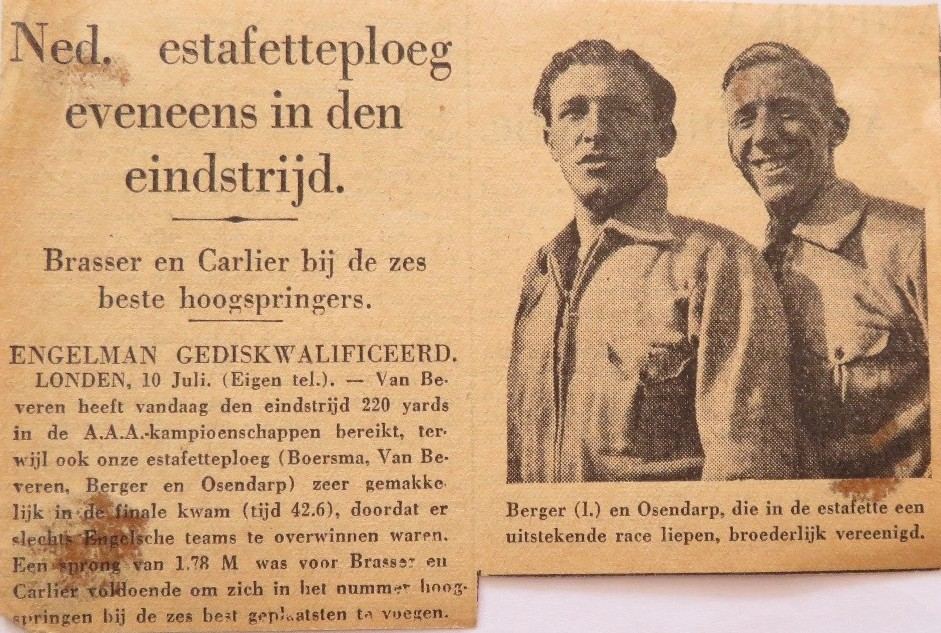
The war story of Gerard Carlier, who was born in the Dutch East Indies, began on the athletics track in Berlin at the 1936 Olympic Games. Competing as a member of the Amsterdam club AV’23 in his favourite event, the high jump, Gerard cleared 1 metre 80, a personal best. Even so, Carlier got no further than the qualifying round. The Nazis turned the Games into a propaganda show meant to demonstrate to the world how the ‘New Germany’ had developed since 1933. His surviving pre-war (sporting) archive shows little sign of politics. Above all, it reveals a young man absorbed in his sport. The newspaper cuttings he kept give rousing accounts of the triumphs of the sprinter Tinus Osendarp, who later became a notorious collaborator. The American athlete Jesse Owens also features in the cuttings.
Cadet in Breda
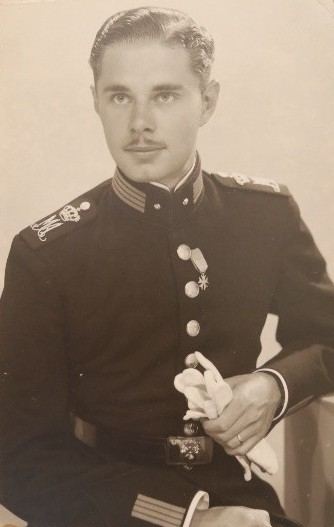
As the clouds of war gathered ever more thickly over Europe, Carlier reported to Breda Castle on 15 September 1938 to train at the Koninklijke Militaire Academie (KMA, Royal Military Academy) as an infantry officer in the Koninklijk Nederlands-Indisch Leger (KNIL, Royal Netherlands East Indies Army). This career choice meant that Carlier would return to the land of his birth in what was then the Dutch East Indies. Life as a KNIL officer was not Carlier’s first choice: he made enquiries with several bodies about becoming a pilot. Nevertheless, he threw himself wholeheartedly into his preparations, taking a preparatory course to get through the rigorous medical.
Within the gates of the KMA, the young cadet was initiated into the cadet corps through hazing that closely resembled the initiation rituals of a student society. Carlier will have come through these ordeals well. At the academy, too, much of his scarce free time went on his sport, athletics. In 1939 Carlier took part with the KMA cadets in the Nijmegen Four Days Marches. That year groups from Nazi Germany were also represented at the walking event. One wonders how Carlier and his fellow cadets regarded these German participants.
Among the cadets the atmosphere was that of an elite club; the gentlemen were drilled in the idea that they belonged to the upper stratum of society and were to behave accordingly. Shaping the men to this ideal required hard study, as Carlier’s diary from those days shows. In all honesty, it is questionable how much use his KMA training eventually proved to Carlier in the field. In the Mastbos, just outside the KMA grounds, they did practise operations in ‘the East’ in a mock-up kampong (village). Sport was an important bond at the KMA, so during his time at the academy Carlier could carry on playing sport to his heart’s content.
On 1 September 1939 Nazi Germany invaded Poland. Two days earlier the Netherlands had moved to general mobilisation of its armed forces to defend its neutrality. In response, the cadets were sent to units of the Royal Netherlands Army on 26 August 1939. Carlier was assigned to a depot battalion in Hoorn, where he served until October 1939. He then returned to Breda to continue his studies.
The war finally reached the Netherlands on 10 May 1940. The day before, the KMA had been moved from Breda to Haarlem, safer within Fortress Holland. The cadets were deployed to round up NSB members and to hunt German paratroopers said to have landed around Haarlem. The rumours proved groundless; the only fire the cadets came under was their own side’s.
On 15 May the Netherlands capitulated. After the capitulation a small group of cadets tried to get away to England. They were forbidden to do so by Gustaaf van Lawick, the governor of the KMA, who believed they should above all treat the Germans correctly. Some of the navy’s midshipmen, naval officers in training, did manage to escape to England.
After two weeks in Haarlem the remaining cadets returned to Breda by train and bicycle. On the way they saw the still-smouldering destruction German aircraft had wrought in the centre of Rotterdam.
A cadet under occupation
Back in Breda, conversation among cadets and instructors was dominated by the declaration of honour that the Germans expected Dutch servicemen to sign. The text of the declaration put to the cadets and all regular servicemen on 14 July 1940 read:
I hereby give my word of honour that during this war, at least for as long as the Netherlands is in a state of war with the German Reich, I shall take no part, either directly or indirectly, on any front, in the struggle against Germany. I shall commit no act or omission by which the German Reich might suffer harm of any kind.
Carlier signed the declaration, whereas a number of fellow cadets and instructors did not. They were taken straight into captivity as prisoners of war and would not see some of their comrades again until 1942.
Now that Carlier was free for the time being, he had to turn his thoughts to civilian life. This was made easier for him because preparatory courses for civilian studies were offered at the former KMA. Carlier took one such course to prepare for studying mathematics at the Gemeentelijke Universiteit Amsterdam, the forerunner of the University of Amsterdam, which he began in November 1940.
Student life was an early centre of resistance. At first Carlier resisted on a small scale, for instance by distributing among students photographs of the royal family dropped by the RAF. His fellow resisters were arrested by the Germans and sentenced to eighteen months in prison. After this Carlier became involved in distributing the underground paper Vrij Nederland (possibly through his fellow cadet and “Engelandvaarder” Jan Streef, one of the founders of Vrij Nederland).
He saw at close quarters how many of his fellow resisters fell prey to the Germans. Carlier’s first attempt to get away to England should be seen in this light. On 17 January 1942 Carlier, Ed Barten and Henk Peper tried to cross to England from the beach at Zandvoort, with family and friends posted as lookouts. The attempt failed, and Carlier returned to Amsterdam.
Not long afterwards – on 15 March 1942 – the Germans came to search his student room while he was out. His partner and later wife, Wilhelmina Jantina Waterberg, warned him that the Germans were waiting for him at home, and so saved him from arrest.
Carlier was not alone in resisting the German occupation: many officers and cadets did so too, contrary to the declaration they had given the Germans on their word of honour. To the Germans this was naturally a thorn in the side. Through newspaper notices they therefore summoned all regular officers to report for inspection on 15 May 1942. They had done this before, but this time the aim of the summons was to take them into captivity as prisoners of war.
For Carlier it was a difficult decision. He did not want to come to the Germans’ attention again, and sought the advice of an older naval officer, Kooyman, who lived nearby. Kooyman told him he had nothing to fear, because it was the Wehrmacht, not the German police, that was responsible for this inspection. What Carlier decided to do, you can read in the next part.