The first Dutchman to be punished for (alleged) help to “Engelandvaarders” was the Scheveningen guesthouse keeper Jan Veraar. The German court was unrelenting.
In 1939 the 36-year-old Johannes Cornelis Veraar is running a guesthouse at Gevers Deynootweg 38 in Scheveningen, without much success. To supplement his income he also deals in cars, and he has a small restaurant in the building too. There he serves coffee and the odd drink, among others to Dutch soldiers on duty at the machine-gun posts along the beach at Scheveningen.
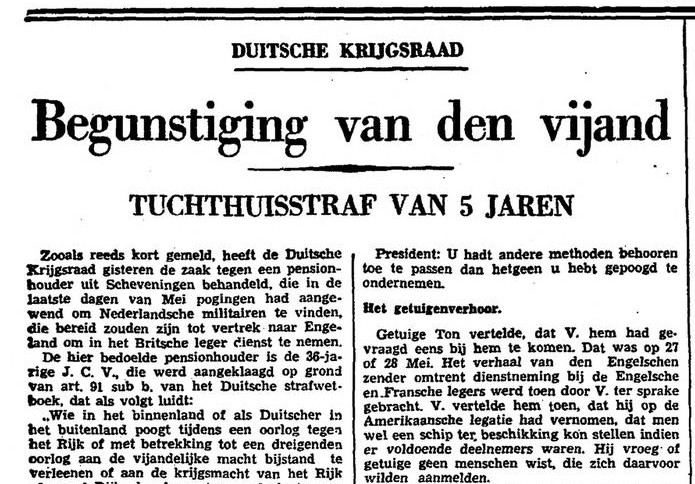
Veraar is arrested, probably at some point in June 1940. At the end of May 1940, a few weeks after the surrender of the Dutch army, he is said to have tried ‘to find soldiers willing to leave for England to enlist in the British army’, according to the daily Het Vaderland, which reports on the case against him.
Veraar is charged under Article 91, sub 1, of the German Criminal Code, which reads: ‘Anyone who, at home or as a German abroad, attempts during a war against the Reich, or in respect of an impending war, to give assistance to the enemy power or to cause harm to the armed forces of the Reich or of the Reich’s allies, shall be punished by death or by penal servitude for life.’ The article contains a mitigating clause: ‘If the act has caused only insignificant harm to the Reich and its allies and only insignificant advantage to the enemy armed forces, and could also not cause serious consequences, penal servitude of not less than two years may suffice.’ Under Article 161 of the German military penal code, Article 91 also applies to non-Germans in territory occupied by Germany.
The case against Veraar is heard on 10 July 1940 before the Feldkriegsgericht Luftgau Holland (field court martial) in Amsterdam. The witnesses are the Scheveningen ex-serviceman J.B. Ton (51), who also keeps a guesthouse further along the Gevers Deynootweg, and the 49-year-old C. van der Maden from The Hague, who reported Veraar’s initiative to the military police. The Amsterdam lawyer (and later well-known poet) François Pauwels defends Veraar.
‘Crazy people who want to go to England’
Veraar tells the court that he heard on English radio that the ‘royal house’ had called on Dutch soldiers to report in England to continue the fight against the German occupier. He approached the ex-serviceman Ton to ask whether he knew anyone who might want to go to England for that purpose. Ton is said to have replied that he might well know such soldiers, ‘but how are they to get there?’ Veraar is said to have suggested that it might be possible by ship. He himself knew ‘someone who wishes through thick and thin to go to England to enlist in the army there.’ At the American embassy (‘legation’) in The Hague he had heard ‘that a ship could be made available if there were enough participants.’
Ton states that he discussed Veraar’s idea with Van der Maden, a former logistics officer in the Dutch infantry. Both are said to have concluded that ‘no takers were to be found’, and Ton passed this on to Veraar. ‘After that we didn’t talk about it any more,’ Ton says.
Veraar defends himself by claiming that he had told Ton and Van der Maden that he did ‘not believe there are still such crazy people who wish to go to England.’ But Ton and Van der Maden deny this. Ton: ‘If he had said that, I would not have passed Veraar’s request on to Van der Maden. I had told Veraar that I wasn’t interested, but that I did know there were soldiers who wanted to fight against Germany. That was quite logical at the time, but now everything is completely different.’
Van der Maden, for his part, tells the court that Ton had asked him whether he knew anyone in ‘the company’ who would be willing ‘to go to England by ship to fight against Germany.’ He had told Ton that he would raise it ‘with a few soldiers whose sympathies he knew well enough’ and wanted to know from Ton ‘where the men could sign up’; Ton then supposedly gave Veraar’s name and address.’ Van der Maden felt that ‘this would be a blunder towards the victor and that it would be dangerous for our Dutch soldiers.’ He then reported the matter to the Marechaussee (military police). He also says he warned Dutch soldiers not to respond to any such appeal.
‘With iron force’
The German prosecutor considers the charge sufficiently proven. In setting the sentence he is prepared to take into account that Veraar has no criminal record. But he also believes that Veraar’s conduct ‘is aggravated by the circumstance that he spoke with others about enlisting in the English army at a time when the Netherlands was occupied by Germany, which enlistment would have meant taking up the fight against Germany. Such an act carries the death penalty. We cannot imagine that Dutch soldiers, who thanks to the greatness of the Führer may walk free wherever they wish, would be willing to take up the fight against the German army again. In any case, any attempts to do so must be countered with iron force.’
Because Veraar’s offence did not cause serious harm to the German army and ‘not a single Dutch soldier was found for the plan’, the prosecution does not demand the death penalty but eight years’ penal servitude.
Defence counsel Pauwels argues that the evidence is ‘insufficient’. Moreover, the witness Van der Maden never spoke to Veraar himself, and Ton presented the matter in the light most favourable to himself. Thirdly, Veraar’s plan should not be taken seriously because it was based on fantasy. ’Is this not rather a case of boasting by someone who was weighed down by the great nervousness in which the accused lived after the invasion?’
After Veraar, in his final words, says he is a ‘broken and remorseful’ man, the court martial retires to deliberate.
Three quarters of an hour later the session resumes. The president of the court finds both Veraar and Ton guilty. In his view, the offence must be punished in such a way that it acts as a deterrent. Veraar is sentenced to five years’ penal servitude. Until 14 February 1945 he is held in several prisons in Germany. He dies in Leiden on 15 February 1959, aged 54. What sentence Ton received is not known. Van der Maden, who reported Veraar to the police, was apparently never punished for it; the Centraal Archief Bijzondere Rechtspleging (CABR, the central archive of post-war collaboration trials) holds no file on him.
The case against Veraar shows once again how risky it was even to talk about the possibility of going to England, and that helpers who were caught faced the same fate as “Engelandvaarders”. They, too, could expect no mercy.