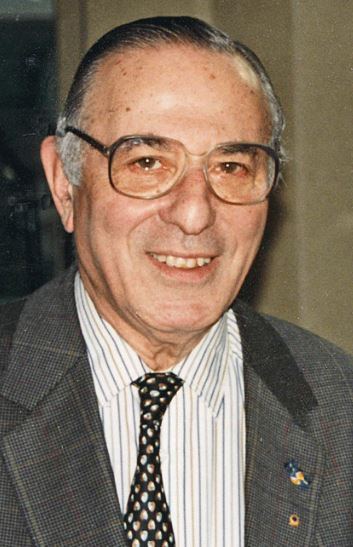
From ‘milksop’ to pilot of a Mitchell bomber: in his youth “Engelandvaarder” Paul van Hessen had a low opinion of himself. ‘But in difficult circumstances you discover there is more in you than you thought.’
‘My grandfather was a butcher’s boy. Around 1885 he started his own butcher’s shop in the Jansstraat in Groningen. His marriage produced seven children: five boys and two girls. The eldest boys, Leo and Julius, went to work in the shop; they earned the money that allowed the other children to study. My father Julius and uncle Leo lived in the building above and next to the shop. As an only child, born on 10 March 1914, I grew up there together with my uncle Leo’s two children. My aunt kept the shop’s books, my mother ran the household. We were a large, close-knit family.
I went to the state primary school in the Jacobijnerstraat, and later to the HBS (secondary school) in the Jansstraat. I also went to the Orthodox shul, but I had an ordinary, average Jewish upbringing; there was no Liberal Jewish congregation at the time. I never experienced being Jewish as anything special. To me, Jews were and are the same people as those who think differently. Even so, I felt that as a Jew you were put in a separate box. ‘Ugly Jew’ was on the tip of many people’s tongues. I did not experience it as antisemitism, and back then I could not understand that people would deliberately want to harm one another.’
He joined the Jewish sports club Attila, which his father had helped to found. ‘I also played football and tennis, and later I took up riding too. On top of that I had piano lessons between the ages of six and twelve. Although I enjoyed it, the fun eventually wore off. I probably did not have a good music teacher. Besides, I was jealous of my cousin Hans, who played the piano superbly and was also better than me at all those sports.
At 17 I obtained my HBS-A diploma. Straight after the final exams I went to The Hague. An uncle of mine got me a job at De Bijenkorf, where I could start as a trainee for fifteen guilders a month. After a year I became a salesman in the menswear department and got a five-guilder rise. Not long afterwards I called it a day, because in those days you could get by on a salary of 100 to 110 guilders, and I was nowhere near earning that. I wanted to support myself and no longer be a burden on my parents.
In 1933 I was able to join the business of my uncle Ludwig, who had opened an office in Rotterdam for the factory he had started in Groningen in 1902 to produce natural casings for the food industry: the ‘NV Nederlandsche Industrie van Dierlijke Producten, voorheen S. van Hessen & Zoon’. Since 1923 he had also had a similar company in Hamburg, with a staff of 150. Suddenly I was earning more than three times as much: 75 guilders a month.
In 1934 I had to do my military service in The Hague and joined the Grenadiers and Jagers, who had barracks on the Waalsdorperweg. I did a lot of guard duty there, including at Huis ten Bosch, where I occasionally saw Queen Wilhelmina riding her bicycle. In the evenings I could take the train on the Hofplein line, which ran right alongside, to the office in Rotterdam. I had been with the company only a few months when Hitler came to power.
When life became increasingly difficult for Jews in Germany, my uncle dismantled the factory in Hamburg and moved it to Rotterdam. That was a great advantage for me: I could continue my training there. I soon became the factory manager. In 1937 we had around 150 employees in Rotterdam. The factory was moved to a warehouse in the port area. We were able to work there until war broke out.’
‘Nothing can happen to me’
In ’39 he had to serve again, this time because of the threat of war. ‘I became a driver with the motor transport service of the First Army Corps, where I had to drive shower trucks and lorries and now and then a general. In May ’40 I was quartered in the Haagse Schoolvereniging building on the Nassaulaan in The Hague. In the night we heard that war had broken out. We received no more orders.
At one point barbed wire had to be taken to Utrecht. Someone had been assigned the job, but because he was married I offered to do it in his place; after all, I was not married. The drive to Utrecht was not without danger, because German paratroopers had landed outside The Hague. But I love adventure. All my life I have had the feeling that nothing can happen to me anyway. I received a decoration for that job.
On 15 May ’40 – the capitulation of the Dutch army – I was taken to Rotterdam by German soldiers as a prisoner of war. Along with other conscripts, I was put in a park without any facilities, sanitation, food or drink. The next day we heard that only men who belonged to a unit were allowed to return to their barracks; individual soldiers were to be sent to Germany as prisoners of war immediately. So I gathered some sixteen men from my company and took command, making it look as though we were a unit. We marched out of the gate at the double. I took them to the company premises, as I had the keys with me. After we had eaten something there, I drove them to The Hague in the lorry.
A few weeks later I was given permission to drive the lorry back to the business, but in the end it was requisitioned anyway. From then on the company had to be run by our ‘Aryan’ bookkeeper. The name also had to be changed to ‘NV Nederlandse industrie van dierlijke producten’; during the war it led a dormant existence. That was the moment for me to make a plan to get out of the Netherlands.’
In June ’41 Van Hessen makes a first attempt to escape from the Netherlands in a canoe. Together with the brothers Harry and Sam Meijer, also Jewish, and their Jewish friend Joke Sanders, he draws up a plan: in a steel canoe with buoyancy tanks and an outboard motor, enough provisions, waterproof clothing and a compass, the crossing to England should succeed.
Van Hessen: ‘Harry’s family had a summer house in the dunes near Noordwijk. If anything went wrong, we could take refuge there. But I did not feel easy about this plan, and people advised me against it from all sides. I did manage to arrange for the canoe to be taken to Noordwijk on a trailer by the Rotterdam garage owner Jan Hoogeboom. The launch went well, but at sea the canoe capsized. With great difficulty they managed to reach the beach.’ In October the three tried again, this time by the route through France and then via Switzerland to Spain. They were arrested at the Franco-Swiss border. The brothers and Sanders did not survive Auschwitz.
‘I looked too Jewish’
Through an acquaintance of his parents, Van Hessen was given an address in Switzerland. ‘Beyond that this gentleman, a Mr Mulder, could not help me, because in his view I ‘looked too Jewish’. My parents, my uncle and aunt and my girlfriend Nina knew about this plan, and nobody was against it. But we did not talk about it any further. I got in touch with Arie Brandon, a fruit trader in Rotterdam who also wanted to get away; he knew a route to unoccupied France. Brandon was not Jewish and was about to marry Willy Sjouke, but he sold his trousseau to raise money for the journey.
With Marcel Adler joining us, we set off by bicycle towards the Belgian border on 5 March 1942. Brandon had supposedly signed up with the Organisation Todt, the German construction company that built bunkers on the French coast, with the task of escorting workers to France. He had obtained papers that allowed him to take us with him on the train to Cherbourg and Boulogne sur mer.’
After a journey full of danger and obstacles, they reached the unoccupied part of France via Paris. ‘When we got there I felt freedom again: tears in my eyes. Against advice, we sat down in the waiting room at a station. There we were picked up by gendarmes. I was put in a cell with four men, on bread and water. After three weeks I was brought before a court and acquitted. We had entered the country illegally, but they were understanding about that. I was given a résidence forcée, a kind of pass that let me travel to Lyon. There I was helped by Mr Meijlink, our Rotterdam company’s representative in France, and also by the office neerlandais.
In Marseille I got a visa for Curaçao and an exit visa for France, which you could only get if you had a transit visa for Spain. But you only got such a visa if you were unfit for military service or over 30. A doctor gave me a certificate of unfitness. Brandon and Willy got a visa for Switzerland and Adler one for Argentina. At the end of September I took the train to Spain. In Madrid the Dutch consul gave me some money for clothes. On the ship ‘Cabo de buena esperanza’ I reached Curaçao, where I was received by the Dutch governor, Piet Kasteel.
As a conscript I was called up immediately. I was able to travel to England on a tanker, the Falcon. We set off in a convoy of 21 tankers. Two tankers were set ablaze by gunfire, lighting up the whole sea. I was on a tanker carrying heavy oil – not petrol – so the danger to us was not so great. From New York we headed for England in a convoy of 52 ships, of which 31 arrived; the rest were torpedoed on the way. Then, too, I kept feeling ‘that won’t happen to me’. I had had that since birth: you have to survive.’
Latent antisemitism
Van Hessen arrived in England on 4 December 1942. He was kept in quarantine for ten days and questioned several times. ‘I had been quite critical of the diplomatic establishment in France. In a report I stated that I suspected them of latent antisemitism, and I was afraid they would not thank me for that in London.’
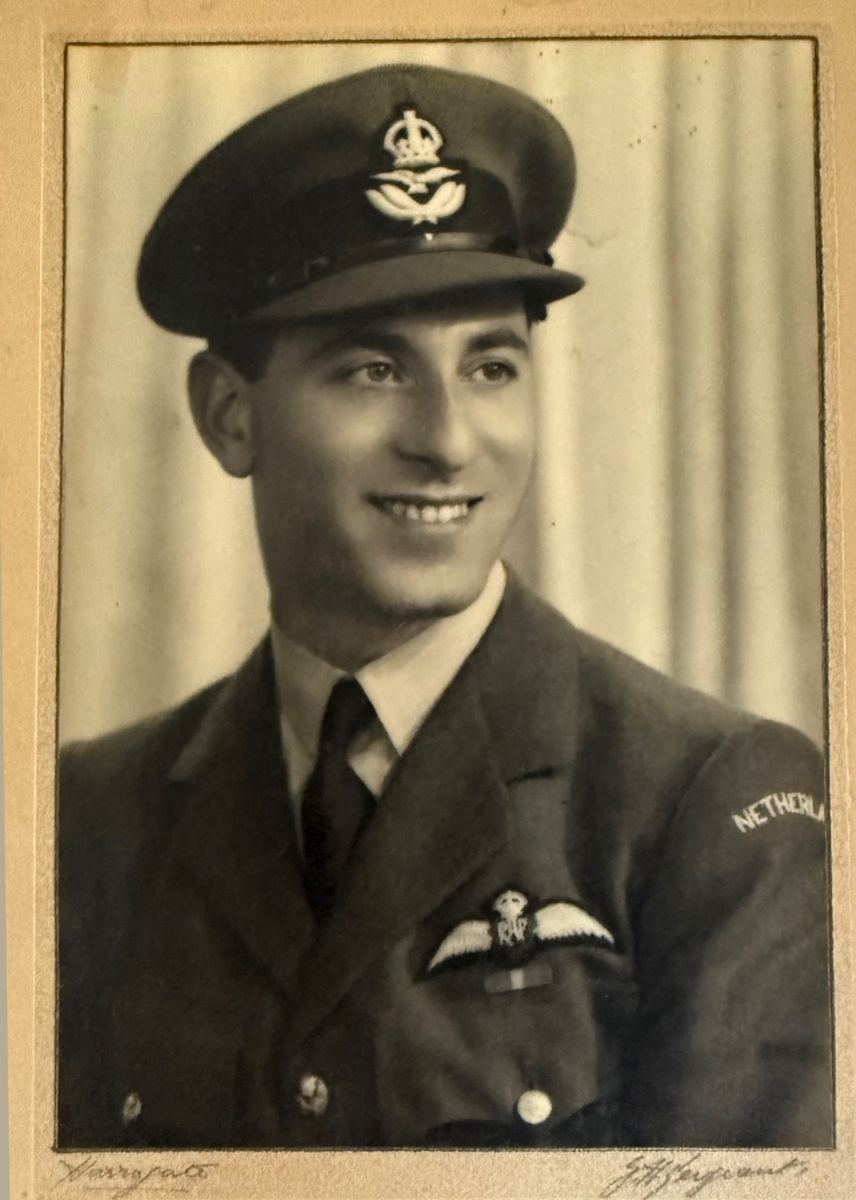
He reported to the Marine Luchtvaartdienst (MLD, Naval Air Service). ‘In early ’43 I had my first training, and in mid-’43 I went to Canada, where I gained my pilot’s licence. In the summer of ’44 I was trained in England for service on the Mitchell bombers. During my leave I spent a lot of time at Oranjehaven; the ‘clubhouse’ of the “Engelandvaarders” in London became my second home. My first operational flight was at the end of ’44. With three other men, an observer and two air gunners, I was stationed at Melsbroek airfield near Brussels, later Zaventem.
I arrived there on 31 December, and on 1 January 1945 I had my baptism of fire: in a last convulsion, the Luftwaffe bombed airfields in Belgium.
Luckily for us, most of the aircraft were in the air; there were only about ten on the ground, seven of which were destroyed. To escape the fire I lay down in a ditch. In the days that followed I made my first flight. After the briefing we had another hour to prepare. I was scared, and so was everyone: of course in a situation like that you are frightened to death.
On my fifth flight I was hit by flak: I took a shell splinter in the shoulder, fortunately not directly but through the steel protective plate in my kit. I left the formation at once and made a precautionary landing at Melsbroek. In hospital they neatly stitched me up again, and after a few weeks I flew another 20 missions without any problems: supporting ground troops and bombing gun positions, road junctions, marshalling yards and bridges. We did everything by day, so that we could photograph the damage we had done.
It had to be done; there was no alternative. At the end of April the war was drawing to a close and I took leave. I went straight back to Holland.
The war shaped my character to a great extent. Before the war I felt like a milksop. Great things were not for me, I thought back then. After the war I shook that off. In difficult circumstances you discover there is more in you than you thought. That is why you must never give up and say ‘I can’t do that’.
The above article is adapted from a filmed interview with Paul van Hessen on 18 February 1996 in The Hague. He died in 2000.
The Van Hessen family business is known worldwide for producing ‘natural casings’ (the edible skin around sausages).
Paul van Hessen ran the company until the 1990s, and more than a hundred years after its founding it has offices and factories in Australia, Belgium, Canada, China, France, Hong Kong, Italy, Mexico, the Netherlands, New Zealand, Poland, Slovakia, Spain, the Czech Republic, the United Kingdom and the United States.
The company also does business in countries such as Brazil, Chile, South Africa, Japan and Russia. Van Hessen can call itself the world’s largest company in the field of natural casings.