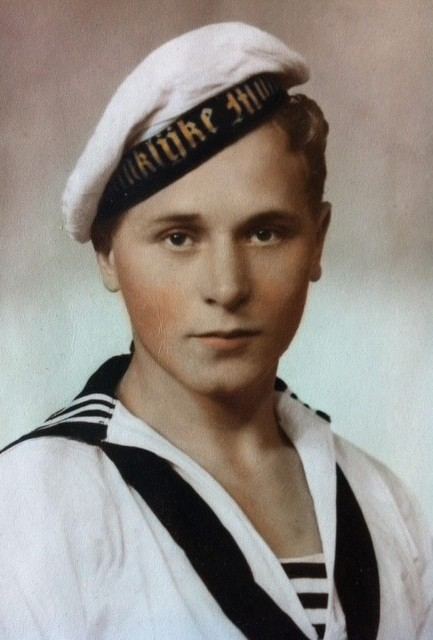
In 1941 Henk de Jong from The Hague, just 15, receives one summons after another to go and work for the German occupiers. As a sailor, cook and stoker on the Scandinavia run, he eventually reaches England. He wrote an account of his experiences.
Hendrik de Jong, born in Scheveningen on 17 September 1925, is only 14 when the Second World War breaks out. He lives with his parents at Ankerstraat 46 in Scheveningen. In 1941 he gains his diploma as a machine fitter at the two-year technical school. Almost immediately he is summoned by the labour exchange, run by the German authorities in The Hague: he is to make steel bolts in a factory.
From his account: ‘We started at half past seven in the morning, and I was put behind a lathe. After three months we had to work shifts round the clock: from 6 in the morning until 14.00, or from 14.00 until 22.00. Then I’d had enough and I stopped.’ In Scheveningen he finds work with the fishmongers Korving and Van der Zwan. When the people of Scheveningen have to move out to make way for the Atlantic Wall, Henk moves with his parents, brother and sister to Begoniastraat 214.
By 1943 Scheveningen has been almost completely sealed off – abgesperrt – by the Germans. ‘You weren’t allowed to go there any more. I got another summons from the labour exchange: I had to report on the Monday. When I got there, someone told me I had to be ready at 13.00 the following Friday, ‘because then you’re going to Germany by train’.’ His father, Gijs, advises him to report to the KWW shipping company in Rotterdam instead.
There he is given a seaman’s book and put to work as cook and sailor on the tug ‘Wilhelm’, a Dutch vessel seized by the Germans. ‘Make sure you’re on board by six o’clock on Thursday afternoon, because we’re leaving early for Antwerp,’ he is told. On the ‘Wilhelm’ he works for months on the run between Belgium and Delfzijl.
‘Rubble everywhere’
He is then put to work on ships on the Delfzijl–Hamburg–Kiel–Oslo route. In 1944 his ship is held up in Hamburg for a long time. ‘There was always something burning somewhere; it was rubble and more rubble.’ He found Kiel ‘bombed flat’, and from there they quickly set course for Norway. In Moss he hears that ‘a tug with its crew and several ships had made a run for it’ from this port to Sweden.
In Norway he has to work on the MW119, and later, briefly, as cook on the oil tanker ‘Tuorbillon’. He witnesses Norwegian resistance fighters sabotaging German ships. A Norwegian persuades him to come with him and seven other men to Sweden. They set off by night in an open fishing boat towards the Swedish border.
‘We weren’t allowed to strike a light or light a cigarette, and we had to lie on our stomachs under nets. It was so dark you couldn’t see your hand in front of your face, but the Norwegian knew the way. A little later we realised we were in open sea. Morning came, and at around 11 we saw a Swedish patrol boat. We hoisted the Dutch flag then. In a little harbour, Swedish people came to look at us. We were well received and given something to eat. Two men from the Royal Netherlands Navy came to question us. We had to fill in and sign papers. If you didn’t, you were declared stateless and weren’t allowed back into the Netherlands for ten years.’ In Sweden he meets the “Engelandvaarders” Cor Kleijn, Jan Visser, Jacob den Dulk, Kees den Dulk and Jaap Taal, all of them also from Scheveningen and all deserters from ships in Norway.
After a short stay in a camp near Stockholm, Henk has to chop wood in the forests. ‘The snow there was a good 1.20 metres deep, and we got 3 kronor for every cubic metre of wood. On 15 February ’45 we were taken back to Stockholm and got ready in a hotel there for transport to England. For the first time in ages we felt free, and we went to the cinema. There we saw in a newsreel that people in Holland were starving. At the end a Dutch flag was shown going down. I’ve never forgotten that image.’
On the evening of 12 March 1945 Henk is collected and taken to an airfield. ‘We were given extra clothing to wear over our winter coats, and gloves as well. The plane was an American bomber. You were strapped in and given a parachute. When we arrived in England we were checked and then driven to a camp. There were lots of Dutchmen there, French, Norwegians, all sorts of nationalities. I went to work on the ‘Oranje Nassau’, a Dutch navy ship. First I had to attend classes, and I was paid for the first time: 8 pounds, and I went straight off to buy something in the canteen. After four or five weeks I was trained as a stoker on a battleship. I was put among English marines who trained me. Well, they were no pushovers. There’s a Dutch saying for good reason: ‘God made man and beast, but never a marine.’ Later I was transferred to the navy ship the Kortenaer.’
After the liberation, Henk de Jong spends a single day’s leave in the Netherlands before going straight on to continue his service in the Dutch East Indies. He died in December 2003.
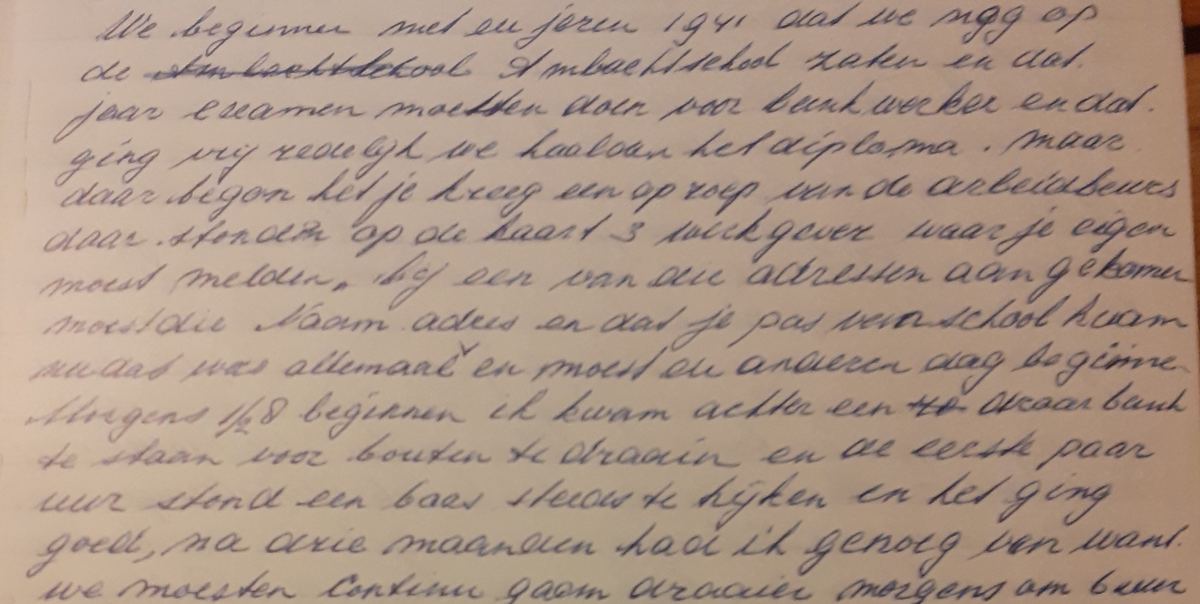
With thanks to Martin de Jong, who donated his father’s account of his “Engelandvaart” to our museum.