Part 1: The “Engelandvaart” of Albert Roessingh and his Leiden friends
By Maurits Huijbrechtse
This is the first part of the story of the “Engelandvaarder” Albert Roessingh, covering his early life and his “Engelandvaart”. The material on which this story is based was gathered by Diek Roessingh, Albert’s nephew.
Youth and friendships in Leiden
Albert Roessingh was born in Tilburg on 28 June 1914. He grew up in Utrecht, where his father, a chief engineer with Nederlandse Spoorwegen (Netherlands Railways), had moved for his work. After grammar school, Albert went to Leiden to study law. There he soon became part of a close-knit circle of student friends who would later play an important role in the war years: René Borgerhoff Mulder, Hugo Pos, Chris Krediet and George Maduro.
At Oude Singel 112 in Leiden, a special bond grew between him, René and Hugo. When war broke out, it was this very friendship that would shape their choices.
After his intermediate law examinations, Albert trained as a reserve officer in the mounted field artillery. He was called up when the army mobilised in 1939. After the Dutch capitulation he went back to the railways, but he refused to accept the occupation. He joined the early resistance organisation Ordedienst (OD), working as a courier and spy for the well-known resistance leader Pim Boellaard, gathering intelligence and maintaining contact with the Amsterdam branch of the OD, which was led by Lieutenant Colonel Boswijk.
The decision to leave
Albert and his friends found the first months of the occupation stifling. The freedoms they stood for as young lawyers were being trampled underfoot. Among the Leiden group this led to heated debate. Should they cooperate with the occupier, as supporters of the Nederlandsche Unie believed, or should any form of cooperation be ruled out? For Albert, the answer was clear. He did not join the Unie and saw nothing in it. The next question that stirred strong feelings was how they could best contribute to resisting the German occupation. Some felt that open resistance would put the population at risk; others wanted to take up the fight actively.
For Albert and René, the choice was obvious: they could do more in England. In November 1940 they decided to escape, together with Hugo Pos. Their plan was to take a ship from Delfzijl to Scandinavia and travel on from there.
Waiting in Delfzijl
In Delfzijl the friends took lodgings at café De Kroonstad, where skippers came to drink. Albert later wrote in a letter to his family:
“We had a fine time there. The landlady looked after us wonderfully; we learned to cook from her, mostly ship’s fare, and served in the café during the day. We spent money from morning to night, drank with all the seamen and had a splendid time.”
Disguised as seamen, they tried to sign on with a ship. That proved difficult. “At first we were full of hope, but after a while it turned out to be far from easy,” Albert noted. “Many skippers were rather suspicious and didn’t dare take us on.”
After three weeks of waiting, Albert found a berth as cook and deckhand on the small coaster Hoendiep. Life on board was hard but also adventurous:
“Cooking by day and at the helm by night. I was filthy – I didn’t get out of my clothes or wash for the whole ten days. We had a storm, and that wretched little ship pitched and rolled like mad.”
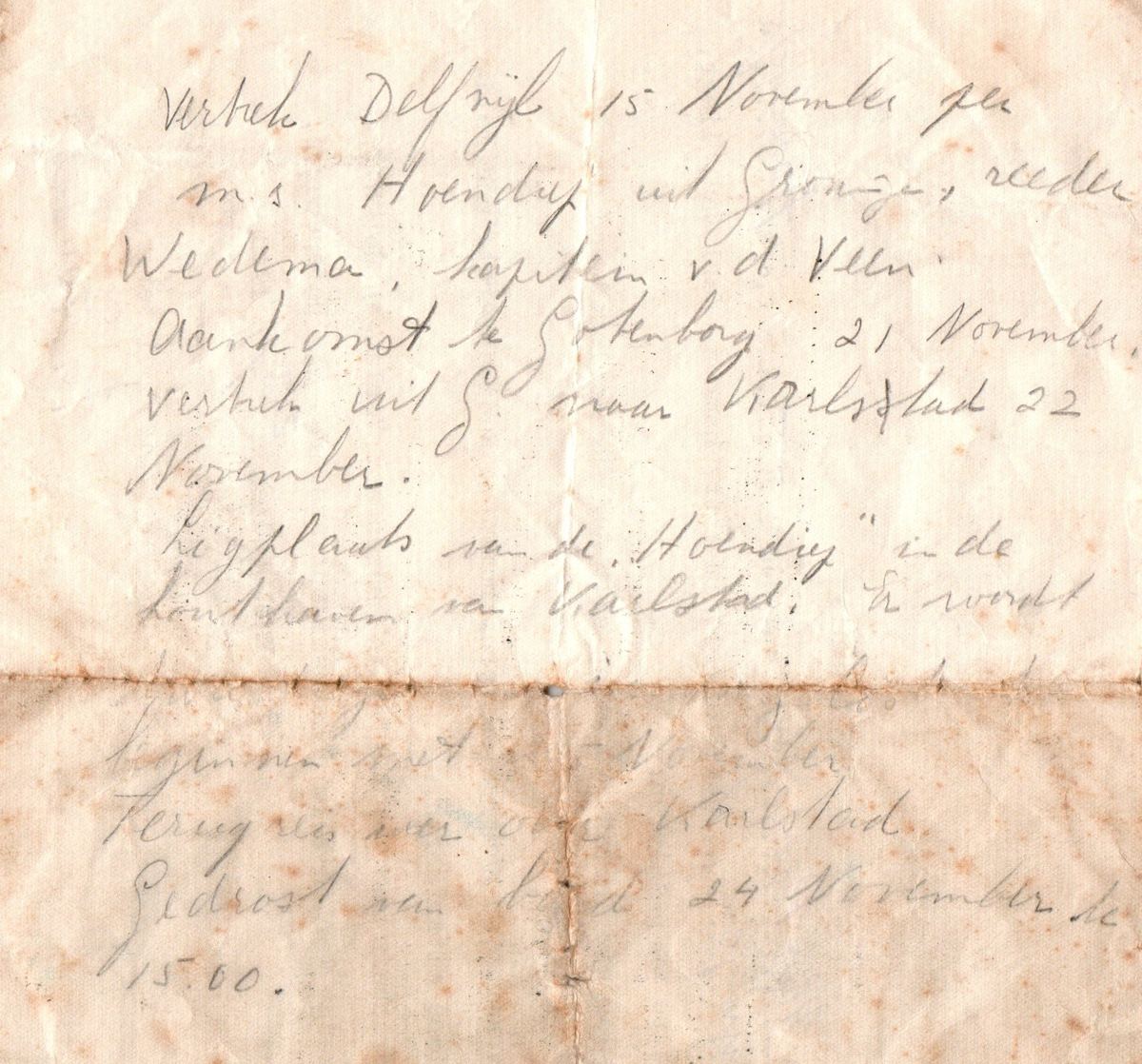
On 21 November 1940, René and Albert set off for Sweden. Hugo sailed to Finland, from where the journey to England turned out to be somewhat shorter.
Stockholm and imprisonment
Albert and René left their ships at Karlstad. Albert travelled by train to Stockholm, where he found René again at an agreed address. Together they reported to the Dutch envoy. Because their captains wanted them back, they ended up in prison. Albert remembered this period with remarkable light-heartedness:
“Our stay in the Swedish clink is marvellous; we got excellent food and a good bed. The only drawback was that you weren’t allowed to smoke, but you could during the interrogations, which went on endlessly.”
After their release they were taken in by the Dutch community. “We regularly go to parties and are constantly invited by all sorts of people – in a word, the life of a gentleman,” Albert wrote. Even so, the waiting weighed heavily: obtaining visas and papers took months.
The long route to England
In early 1941 the route through the Soviet Union via Moscow was open. Albert wrote:
“We hope to leave soon, fly to Moscow, and from there take the Trans-Siberian Railway to Vladivostok… It is a wonderful journey round the world, but terribly tiring. We will be sitting on the train for nine days on end, and not in sleeping cars. We’ll be thoroughly worn out by the end.”
From Sweden the route continued through the Soviet Union, via Leningrad (St Petersburg) and Moscow. In Turkey, after arriving in Istanbul, he was briefly admitted to hospital in Ankara with acute nicotine poisoning; Albert was known as a heavy smoker.
The journey went on through the Middle East, with stops in Aleppo, Beirut, Tel Aviv and Jerusalem. In Jerusalem the British questioned him on suspicion of defeatism, but his reliability was soon confirmed by letters from Dutch diplomats he had met along the way. From there he travelled via El Qantara to Cairo, crossed the Red Sea and headed for Africa, stopping in Aden, where he was admitted to an RAF military hospital. After a long sea voyage he reached Cape Town, where, unexpectedly, he met René again. René, who had travelled via Iran and Iraq, had even landed in the middle of a revolution in Baghdad and had to climb over the fence of the Dutch embassy to reach safety.
The friends sailed the final leg together, via Trinidad and Tobago and Halifax in Canada, finally arriving in Liverpool on 3 October 1941.
After a journey of almost a year that had taken them halfway round the world, they had reached their goal: freedom. Hugo Pos was waiting for them in England. He had been able to take the route that Albert had described to his parents.
Albert and René volunteered for the RAF. How they fared in the RAF is the subject of the next part of this story.