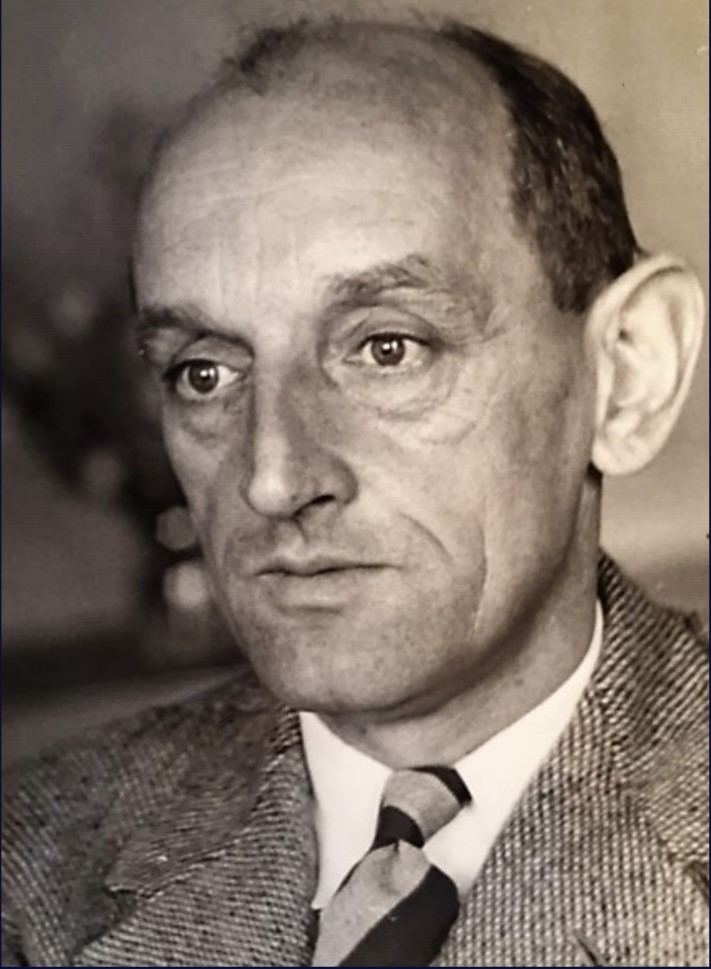
The first Dutch High Commissioner for Refugees was not Ruud Lubbers but “Engelandvaarder” Gerrit Jan van Heuven Goedhart. He laid the foundations of the High Commission and made the UNHCR credible with governments.
Gerrit Jan van Heuven Goedhart’s life was short but highly dynamic. He was born in Bussum on 19 March 1901. At 25 he completed his law degree in Leiden with a doctoral thesis on the development of unemployment insurance, and at 28 he was editor-in-chief of De Telegraaf. In the 1930s he was also vice-chair of the Comité van Waakzaamheid van Nederlandsche Intellectuelen (Vigilance Committee of Dutch Intellectuals) against National Socialism, which among other things campaigned against the government’s policy of turning refugees from Germany away at the border.
His refusal to publish an article containing a glowing phrase about Hitler contributed to his dismissal as editor-in-chief of De Telegraaf in 1933. In 1940 the same thing happened to him at the Utrechts Nieuwsblad. The paper’s owners sacked him immediately after the German invasion ‘owing to changed circumstances’. In the seven years he worked there, he had made the UN ‘the most outspokenly anti-National Socialist daily’.
After the German invasion Van Heuven Goedhart began writing articles for the resistance paper Het Parool. On 15 August 1942 his brother John was executed by firing squad on the Waalsdorpervlakte, having been sentenced to death for trying to escape to England with documents for the Dutch government. When the entire leadership of Het Parool was arrested at the end of 1942, Gerrit Jan took over as chief editor. He ran the paper together with Kees de Groot until April 1944.
In a new wave of arrests in early ’44 Van Heuven Goedhart managed to escape, but his identity and description were well known to the German police: ‘Height 1.92 m, hooked nose, blue eyes, little hair, completely bald at the front, back slightly bent when he walks, wears a black Homburg and always carries a very small brown case.’ Partly for that reason, and to brief the government in exile on the situation within the Dutch resistance, the Het Parool circle decided to send him to London with the help of the Dutch-Paris organisation.
In Sittard a certain ‘Le Jeune’ gave him a Belgian identity card. A Rotterdam timber merchant helped him on his way via Leuven to Brussels, and he then travelled on via Valenciennes and Paris to Toulouse. Led by the mountain guide Pierre Treillet, he set off on foot across the Pyrenees. On reaching Gibraltar he was able to fly to England on 17 June ’44. His journey had taken 55 days.
On 11 July 1944 he was appointed Minister of Justice in the second Gerbrandy cabinet, as a result of which his wife and their two daughters had to go into hiding in the Netherlands. He was closely involved in setting up and staffing the College van Vertrouwensmannen (Council of Trusted Representatives), whose task was to act on the government’s behalf in the Netherlands after the liberation and so prevent uncontrolled popular reprisals (‘bijltjesdag’, the day of reckoning). On 23 February 1945 he had to resign because he had incurred the wrath of the resistance in the already liberated south of the Netherlands by taking measures that curtailed its powers. This led to a smear campaign that eventually cost him his ministerial post. In addition, the strict Queen Wilhelmina was (presumably) not amused by the extramarital affair he had begun in London with his secretary.
Until the liberation he spent his time in London partly writing the booklet De reis van Colonel Blake (The Journey of Colonel Blake), in which he gives an account of himself to his daughters (see box). The booklet was published in London in February 1945. ‘Insiders will understand who is hiding behind a name. And so I send my account out into the world, hoping that here and there it may engage or amuse a reader, and thinking of the little pair to whom I have had to cause so much grief and who therefore have a right to their father’s account.’ Back in the Netherlands he became editor-in-chief of Het Parool and, from 1947, also a member of the Eerste Kamer (Senate) for the PvdA (Labour Party).
After the world-shattering aggression of the Second World War, international diplomacy quickly got going again. As a senator, Van Heuven Goedhart was sent to numerous international conferences. His tall figure, with his pocket square like a white flag in his breast pocket, his eloquent assertiveness and occasional sarcasm in excellent English made a strong impression on the international stage.
In the late 1940s the idea arose of setting up a new United Nations organisation for the more than two million people displaced by the war: the Office of the High Commissioner for Refugees (UNHCR). Van Heuven Goedhart competed for the post of High Commissioner. His appointment on 14 December 1950 was a matter of honour for the Netherlands, then reviled internationally over the Indonesia question. The Americans, however, continued to distrust him because, during the Cold War, he kept insisting that he was there for all the world’s refugees and not only those from Eastern Europe. As a result, the American financial contribution was meagre.
‘The Netherlands became a bit small for him,’ his daughters said later. He made contacts effortlessly and knew the world of international politics and the tug-of-war it involves. He was also very entertaining company. After dinners he would play Chopin for his guests, who considered it an honour to be received by him. For his guests he made bouquets of wild grasses and clover. He preferred to stay away from the fuss in the Netherlands. His family in Geneva hardly ever saw him in those years. From September to March he was in New York, always serving the greater cause. He built a tight organisation, appointed representatives in the countries where the refugees were, and set up a small staff in Geneva. In his view, the High Commission had to get governments to solve the refugee problem and give refugees legal protection. ‘Refugees cannot live on laws. They need bread, houses, work,’ he said. He also believed refugees should integrate. In this way he laid the foundations of the High Commission and made the institution credible with the governments that had to supply the money.
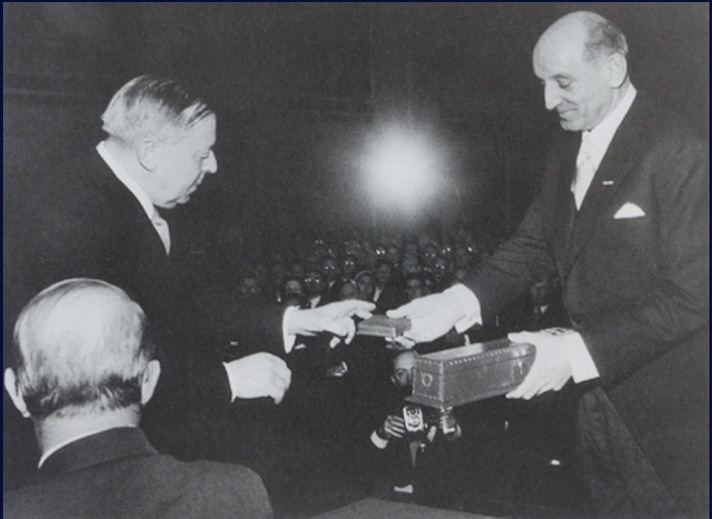
In later years, however, he became disillusioned, according to his daughters. He felt that governments were not really cooperating and were not honouring their financial promises. Nevertheless, in 1955 the High Commission was awarded the Nobel Peace Prize, which he accepted with an acceptance speech. On 8 July 1956 he died of a heart attack during a game of tennis in Geneva, aged 55.
With thanks to Carla Tromp and Ad van Liempt, who made a special episode of Andere Tijden about Van Heuven Goedhart in 2000 (broadcast 14 December 2000).
Streets or roads in Amstelveen, Assen, ’s-Gravenzande , Hoofddorp, Utrecht, Reeuwijk, Schiedam, Voorschoten, Schoonhoven and Gouda are named after him, as is a cycle bridge in Wassenaar. In The Hague, Stichting Vluchteling has awarded the Van Heuven Goedhart medal every two years since 2001. On 1 March 2011 his biography – Riemen om de kin!, by Jeroen Corduwener – was presented at the Anne Frank House in the presence of, among others, Ruud Lubbers and his daughters Karin and Bergliot, from his marriage to the Norwegian Erna Hauan.
‘Farewell, Netherlands, I’m off’
‘It is Monday 24 April 1944, six o’clock in the morning. I jump out of bed and look out of the fourth-floor window on the Amstelveenseweg in Amsterdam, where I have been in hiding for five weeks or so. My fifteenth address or thereabouts since I went ‘under water’ in early 1942. My hostess looks after me as if I were her son. With the courage that in these years has raised many a Dutch woman far above thousands of men, she took me in hospitably, knowing the danger. She knew that on 21 January the Gestapo had thought it worthwhile to raid ten addresses simultaneously, at the same hour, with three men each, in order to arrest me.’ ‘I went to Laren, and a good hour after I left, the Gestapo were at the door both in Amsterdam and in Wassenaar to catch me, ‘Erik van der Velde’, ‘the Jew Van der Velde’. So that time, too, I escaped. (…) I changed name, address and occupation yet again. First I became an assistant accountant and then a minister of religion. I think with sarcastic pleasure of the Landwachter (collaborationist auxiliary policeman) who respectfully handed back my thoroughly false papers with an ‘Oh, I do beg your pardon, Reverend.’
‘The little case was ready; so was breakfast; at barely half past six I went down the stairs and walked to the Haarlemmermeer station to catch the number 16 to Central Station. Farewell Amsterdam, farewell Netherlands, I’m off… but where am I going? To London, yes, but how? Hundreds have tried in all sorts of ways, in vain. They have perished in German and French concentration camps, at the bottom of the North Sea, in the wild mountains between France and Spain. Would I make it?’ ‘The checks on the train were extremely dangerous, especially when ‘the pink book’ came into play, in which the Gestapo had listed every false identity card known to them by letter and number, with, as a friendly appendix, a kind of sheet of descriptions that also included portraits of ‘Staatsfeinde’ (enemies of the state). (…) I reached Sittard without the slightest incident, and there a student from Amsterdam got off the same train: my guide to the Dutch-Belgian border. ‘I had to wait nine days in Toulouse until a suitable arrangement had been found for my passage over the mountains. Whole convoys kept leaving under the guidance of guides, but it had been decided that I would cross alone.’ ‘There I lie, somewhere in the south of France. No rucksack, no food, three cigarettes left. It is pitch dark and cold. In the distance I hear footsteps. They come closer. If it is a patrol, I must not be in this cellar, for then there is no chance of getting away. I shuffle towards the exit. Two men come striding along. I see boots and flat caps. No dog, luckily. I wait. The footsteps die away; I return to my cellar.’
‘I do not deny that I felt considerably embarrassed when I entered Professor Gerbrandy’s room in my indescribably filthy suit and was introduced by my host – who, I did not yet know, adorns the whole world with nicknames – as ‘Colonel Blake’. That very evening we had a first long conversation about what was happening in occupied territory. Only when I rolled into an excellent bed at about twelve o’clock, dressed in a pair of the Prime Minister’s pyjamas – he is evidently of rather different build from me – did I begin to realise that I need go no further. The journey of ‘Colonel Blake’ was at an end…’
From: De reis van Colonel Blake. Published by Erven J. Bijleveld, Utrecht 1945