By Kees Riezebos
During the German occupation, many people tried to escape the oppressive German regime. Exactly how many succeeded is not known. It is assumed that there were about 2,150. Contrary to what the word suggests, “Engelandvaarders” by no means always reached the British mainland by boat from the Netherlands. Attempts were also made by plane. Often a long journey overland was made before the crossing could be made via Switzerland, Sweden, Spain, or via Russia and the Far East.
Museum Engelandvaarders in Noordwijk tells many stories about all those people who, despite dangers and obstacles, made the journey to England. Those stories are based on diaries and eyewitness accounts. At least as important are the reports of the interrogations carried out in London by the British secret services, the Dutch intelligence service and an interdepartmental committee, of everyone who reached London from occupied territory. Reports of those interrogations can be found in the Nationaal Archief.
One of those stories is about Piet Smits: an “Engelandvaarder” from De Lier who, with four others, began his journey across the North Sea on 20 November 1941.(ii) For this piece I have used the documents about the crossing of Piet and his four companions to England that can be consulted through the Nationaal Archief, plus some additional material.(iii) During my research I discovered that Piet’s preparations and crossing had already been described shortly after the war, in some detail and in flowery language, by two of his travelling companions: the Hagemeijer brothers.(iv) In that description, however, they did not use the names of their companions. The value of the one piece that was published is that it covers more than a list of events. It also says something about the experience, the emotions and the mood on board. Here and there I have drawn on it. Dirk Hagemeijer also told the story of the crossing in one of the two albums of remembrance that Queen Wilhelmina was given by the “Engelandvaarders”.(v)
The reports of the interrogations of the five companions largely agree. There are differences, however, and the piece by Toon Hagemeijer also deviates here and there. But these concern details, not the main points. Where they differ, I have chosen what seems most plausible to me. The documents mentioned above naturally say nothing about Piet’s activities after the crossing. For those I have used information from Museum Engelandvaarders and what Piet’s family heard from and about him.
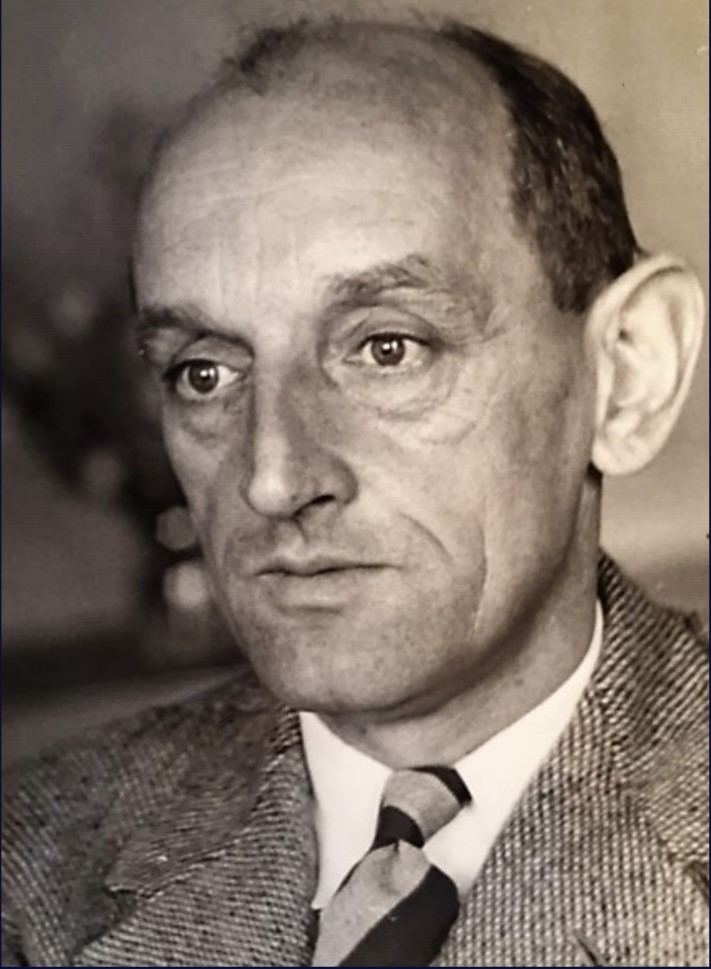
Who was Piet Smits?
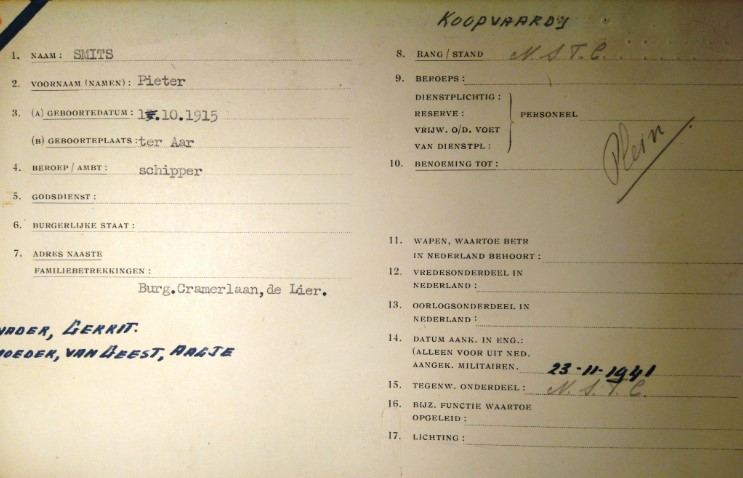
Pieter (Piet) was born in Ter Aar on 13 October 1915, the son of Aagje van Geest (De Lier, 1 September 1884) and Gerrit Smits (Naaldwijk, 3 December 1872). They married on 26 May 1909. Besides Piet they had several children, some of whom died very young. With Adrianus (Janus, 1909; drowned near Schipluiden at the age of 26), Helena (Lena, 1910), Antje (An, 1913), Gerrit (1918), twin brothers Cornelis (Kees) and Arie (1925) and Neeltje (Nel, 1927), they formed a Reformed family. It also included Amerentia Cornelia and Wouter Pieter, from father Gerrit’s first marriage to Amerentia Cornelia Knaap (1900), and Albert, from mother Aagje’s earlier relationship with Jan Koene (vi). They lived at Burgemeester Cramerlaan 10 in De Lier. Father Gerrit was a member of the ARP and son Piet of the Reformed boys’ club, as he told them in London. Father Gerrit was an inland skipper. His life was one of hard work. There was no further schooling for the children. They were put to work at an early age. Life for the Smits family was hard. What the children took from their parents was a strong sense of justice. They combined this with a certain rigidity. In that stubborn aversion to injustice lay fertile ground for resistance to the unlawful German invasion. Brother Gerrit became active in the local armed resistance squad in De Lier and later in the Binnenlandse Strijdkrachten (Dutch Forces of the Interior). Piet went his own way.
If you ask the Smits family today what they remember of their uncle Piet, he is described as someone who was afraid of nothing, who “didn’t care about anything”. A quality that is helpful, up to a point, for an “Engelandvaarder”. Fearlessness, and perhaps a touch of recklessness too, come through in the stories. Piet was not someone who talked much about what he had done in the war, let alone boasted about it. Together the London statements make an exciting story, but the people in it remain “unfilled”. In the interrogations Piet presents himself as a decent, patriotic young man, a member of the Reformed boys’ club. That he no doubt was. The stories told about him in the family, however, fill in the picture of Piet as the stubborn man, hardened by life, with a great sense of justice, that he was. At the same time, after the war he was an uncle to his nephew Jan who took him out for drives and built a cart for him.
Piet was anti-German from the start of the war. Like many other young men, he soon wanted to make the crossing to England after the capitulation. As an inland skipper he at least knew about boats and knew his way to the places from where the crossing could best be made. But he lacked the money to buy the equipment.
He did not merely nurse his anti-German attitude; he gave it meaning in word and deed. According to the family, Piet probably had a scrap with two NSB members or Germans as early as 1941. It happened in front of the Van der Klis bakery in the Hoofdstraat. Shortly afterwards he was warned that the Germans were looking for him, which according to the family was one of the reasons he wanted to make the crossing to England.(vii) From there he wanted to join the fight against the occupier.
After his crossing to London, Piet worked actively to support that fight. Through the Netherlands Shipping & Trading Committee (NSTC), or Nederlandse Scheepvaart en Handelscommissie, he sailed on a Dutch merchant ship, and he told his family that he took part in the famous Murmansk convoys. In that period he led a life that was not for the faint-hearted. It suits someone who “didn’t care about anything”. His loathing of everything German, bordering on hatred, never left him after the war.
Preparing the crossing
As mentioned, Piet had planned to cross the North Sea early on. He does not seem to have had a very tight plan. He also lacked the means to organise the journey. In the end five young men found each other, gathered the necessary equipment and reached the goal they had set themselves.
In London Piet stated that his parents “officially did not know” he was leaving. He probably left without warning, but had let slip at home that he did not intend to stay in the occupied Netherlands. Whether they knew that Piet resigned from his job on 12 November 1941 can no longer be established. By then Piet was already preparing a plan for the crossing.
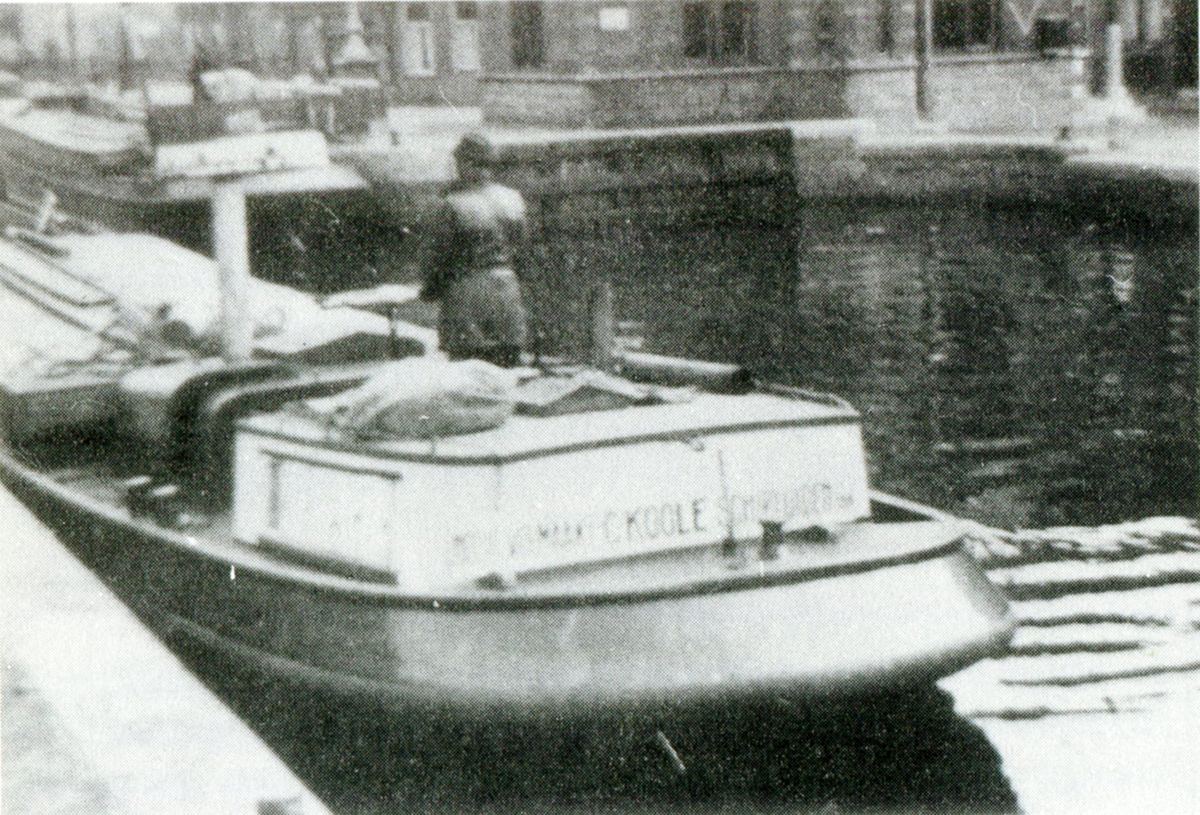
Piet got in touch with the brothers Antonius Marie (Toon) and Dirk Marie (Dirk) Hagemeijer (a doctor born in 1913 and a geology student born in 1912 respectively). They had long planned to cross to England and were looking for contacts who could help them. On Thursday 13 November Toon had received a call from The Hague (viii) asking him to attend a ‘council of war’ at a skipper’s home in De Lier on the Friday. On 8 November Dirk had bought a runabout, a motorboat 6 to 7 metres long, from a certain Brinke in the Vogelbuurt in The Hague, with a four-cylinder outboard engine (Evinrude 22 hp) that could reach a speed of 50 km an hour. His friend Nicolaas Theo Marie (Nico) Koehler had acted as go-between for the purchase. Fuel (150 litres) was obtained through Koehler’s brother, who had taken it from the Wehrmacht. Shortly before the departure for England, this brother and another of Koehler’s brothers were arrested by the Germans for sabotage and arms smuggling. All the more reason for Nico to want to flee to England quickly. The motorboat bore the name “Flying Dutchman”. The name was hard to read because Nico and Dirk had painted the boat grey, Dirk stated after arriving in London, probably to avoid recognition. The boat in which Dirk, Toon and Nico wanted to make the crossing lay in Leidschendam. So as not to attract attention with a motorboat on its way to the crossing, Piet had meanwhile, also on 13 November, hired a decked barge from his brother-in-law Adriaan van Geest, a fruit and vegetable trader in De Lier. Such barges were not unusual for carrying vegetables in those parts, and Piet would attract no attention with it. After the council of war on Friday 14 November he took the barge to Leidschendam, where he and the Hagemeijers loaded the motorboat and the fuel into it. Piet sailed the barge back to De Lier. From there the five men would begin the crossing via Brielle.
The crossing was a considerable financial investment. In December 1941 Dirk Hagemeijer tried to recover the cost of the boat and the other necessities from the head of the Centrale Inlichtingendienst (Central Intelligence Service) using this breakdown: 1,685 guilders in all. By today’s standards just under 34,000 euros.
Besides Piet Smits, the Hagemeijer brothers and Nico Koehler, already mentioned above, the group included Klaas Buisman, a trainee mate from Vlaardingen born in 1921. Klaas had joined the little group at Piet’s suggestion. They knew each other because Piet had worked for Buisman’s uncle, P. van der Windt. During his interrogation in London, Klaas stated that Piet had asked him along in mid-November because, as an inland skipper, Piet knew nothing about navigation. As a mate-to-be, Klaas brought that knowledge with him.
Saturday 15 November was spent conferring and calculating how long the crossing would take. There would be an easterly wind; the estimate beforehand was 15 hours (in London D. Hagemeijer even gave eight to ten hours as the expected duration). For provisions they had a stone jar of Bols gin, a bottle of drinking water, a few slices of dry bread and a tin of Camel cigarettes. There was no chart, but there was a simple compass.
To Brielle
On Sunday 16 November the sun would be fully down by 18.00. In calm weather that was a good moment to risk the crossing. From De Lier they went to Vlaardingen, where they passed through the lock and Klaas came aboard. On the way to Brielle the weather grew steadily worse, fog came up, and the conditions for putting to sea became less and less favourable. The men spent a cold night in the barge’s cabin. Exhausted and dejected, they decided on Monday morning to return to Vlaardingen.
On Thursday 20 November they made a fresh attempt. From Vlaardingen they sailed to a creek above Brielle, arriving at around 16.30. Waiting for darkness, the men again sheltered by the stove in the little cabin from the biting east wind. Only Piet, as skipper, could appear on deck now and then; anyone else would attract attention. At 19.00 it was high tide and properly dark; at 20.00 the motorboat was put into the water. At 20.30 the five pushed off, paddling. It became a journey full of obstacles. The barge stayed behind in the creek near Brielle. Piet had arranged with one of his brothers that he would collect it a day later.
The crossing
The boat had a strong current and an east wind behind it, which helped as long as the engine could not be started. The racket as the boat hit a buoy was therefore an unwelcome break in the silence; just as awkward was the sandbank on which the boat ran aground a little later. The five had to climb out into the cold, slowly rising water to free the boat. With great effort they managed it. Another obstacle was the searchlight from Hoek van Holland that reached far out to sea. For the first part of the journey the course was therefore westerly, to get away from the Hook as fast as possible. To make matters worse, the fog grew ever thicker, making it harder to get their bearings. Once off the sandbank they tried to start the engine. It would not start. By a tiny light the engine had to be repaired, while Toon stood in the water holding the boat in place. At around 2.00 in the morning the engine caught, and at a speed of some 30 km an hour they carried on westward on a calm sea. They had a great fright when two ships of a German convoy with searchlights only just failed to spot them. A little later the weather and sea grew rougher. A south-westerly gale blew up. The boat began to take on water. According to Toon, Piet, who was struggling with his big clogs filling with ice-cold water, then declared: “We’re going to drown”. He decided to put out a sea anchor, because they did not know the boat well enough to tell how it would behave in heavier weather. Cold and tired, but still optimistic because the plan had not failed so far, the men sought some warmth by huddling together.
When it grew light on Friday, they weighed the anchor again and tried to use the waves to stay on course. It was a tiring way of going about it, and they did not make much headway towards England. On Friday night too they lay exhausted and frozen to the sea anchor. The wind stayed ice-cold. Despite their tiredness, and because of the cold, they did not sleep. Their clothes and leaden coats were soaked through and no longer gave any warmth. They took off their outer clothing and pressed close together to draw even more warmth from each other. Dirk Hagemeijer put the mood almost poetically: “Fear in every heart, cold and misery. It took ages before dawn broke and we could look upon that seething, raging sea, with its trails of foam, deep chasms and high, curved ridges of waves.”(ix) According to Toon, despite everything they had not lost their optimism and could laugh at their own wretchedness. At 4.00 on Saturday morning the engine could be started again. It did not run quite as it should. It needed regular repairs; a can of petrol fell into the sea by accident; in one of the cans the petrol turned out not to have been mixed with oil, so the engine had to be drained again; and the tank was swamped with seawater, which made the engine falter even more.
Despite everything, England came closer. The men recognised British patrol aircraft of Coastal Command. That gave them heart. On Saturday night they saw a light buoy and paddled towards it. Another sign that the English coast was near. On Saturday evening they lit an improvised flare there, made from a cleaning rag on a piece of wire, soaked in petrol. It was not seen. Later they heard the sound of a motorboat, but were too exhausted to improvise a new flare quickly. A new attempt at around 4.30 on Sunday morning was spotted by the British destroyer Hambledon. Just as well, because they still had matches, but no dry striking surface left on the box. The Hambledon picked the men up some 8 miles off the coast, level with the small town of Cromer in the county of Norfolk. That was a good deal further north than they had roughly calculated on the way. Because of the waves, the destroyer and the runabout were never steady alongside each other for a moment. That made it hard to get hold of the rope ladder. According to Toon, the last to climb up, in his clogs, was our skipper Piet. The only possession he had taken from the boat was the empty Bols jar.
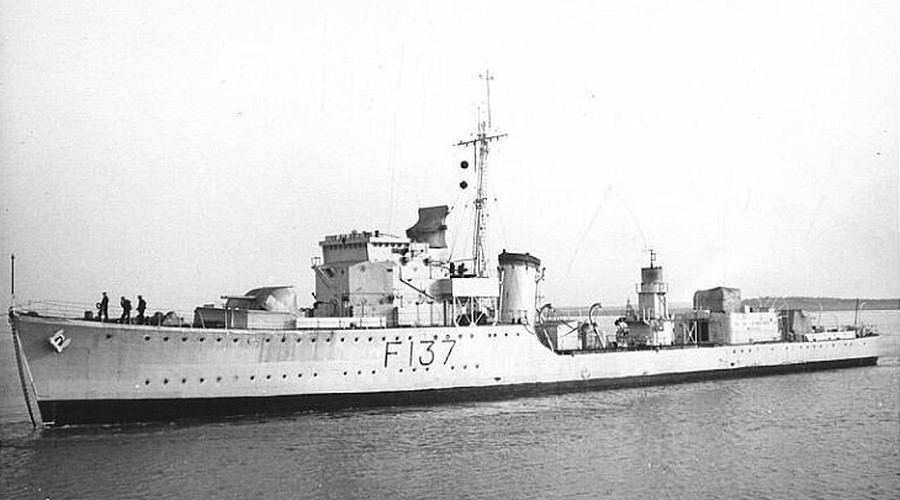
Because of the bad weather the motorboat could not be taken along, and the men never saw it again. A call did go out to the ships in the convoy the Hambledon was escorting to look out for the motorboat and pick it up or, failing that, destroy it. Unfortunately, identity papers, probably belonging to Klaas Buisman, had been left on the motorboat. Piet Smits’s family told me that the Germans must have found the boat. During the war his parents and brothers were warned by the resistance (possibly brother Gerrit) that the occupier knew Piet had crossed to England, though not whether he had arrived. That information may have reached the Germans through Buisman’s family, or objects or documents that could (also) be traced to Piet were found on the Flying Dutchman.
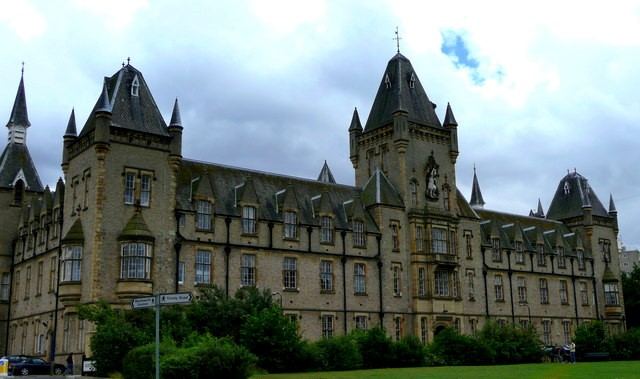
The men were well received on board the destroyer and were given a hot bath, bacon and eggs, blankets, rum and cigarettes. At Sheerness they were put ashore on 23 November at around 15.00, where the military police took them over. A doctor examined them there. Then they went on to the Royal Victoria Patriotic School for further questioning by the intelligence services. They stayed there for five days.
The interrogation
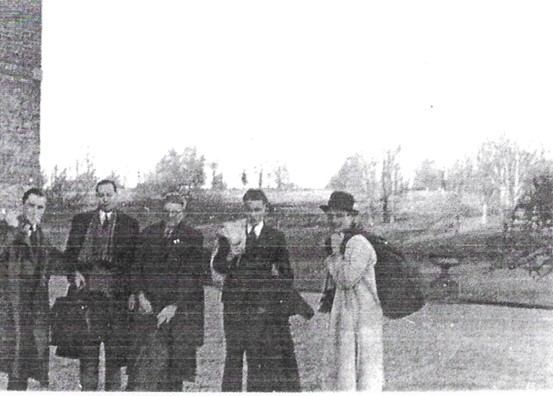
The five men were each interrogated separately by the British and Dutch intelligence services. Only after these had established that the refugees were trustworthy were they free to be heard by a Dutch government committee. In the case of Piet and his companions this took less time than was usual. Within a week they were allowed to go. During his interrogation Hagemeijer said that a certain ir. Walraven would send a telegram to London as soon as the men had left. It is unclear whether that happened and, if so, what came of it.
On 26 November Piet appeared before MI5, the British Security Service. The report is brief. Piet said that his aim was to join the Dutch armed forces in England. He had not collected an identity card when they were issued in De Lier in October 1941. After all, he intended to go to England. Piet also found the people of De Lier optimistic; they trusted in a British victory. The BBC was widely listened to there. The British conclusion: “Smits is a genuine skipper who gave all the information he could”.
On 28 November Piet was questioned by Navy Lieutenant A. (Nol) Wolters of MI6. Together with Oreste Pinto he was responsible for interrogating Dutch refugees to test their trustworthiness and prevent infiltration. Piet said that in the Westland, especially in Wateringen and Monster, there were many NSB members. When asked, he gave the names of eight NSB members in De Lier. He also said that the two municipal constables and the state constable in De Lier were “good”. He called the mayor (Van der Hoeven) a royalist through and through.
As a resistance man he named Johannes Lagerwerf, who lived on the Wilhelminastraat. According to Piet, Lagerwerf was drawing up plans to cross to England with a small group. Sadly it never came to that. Lagerwerf was caught and died in a German camp. In his MI5 interrogation Piet also named his brother “Gerard” (Gerrit) as a “useful contact.”
On 3 and 4 December 1941 the men were questioned together by the “Interdepartementale commissie verhoor overgekomen Nederlanders” (Interdepartmental Committee for the Interrogation of Dutch Arrivals). The report contains a detailed description of the crossing. The men were also asked to say what they knew about a wide range of general subjects, from the use of the radio and the strength of the German occupying forces to fuel and food supplies.
Identity papers were taken in at the Patriotic School. That happened to Piet too. As a result he could not prove that he was Dutch. That could have caused difficulties, but fortunately it did not. Following this case, it was agreed with the Patriotic School that whenever identity papers were taken in, the number and date of issue of the identity document would in future be noted on the back of the immigration form.
A message to the home front and a visit to the Queen
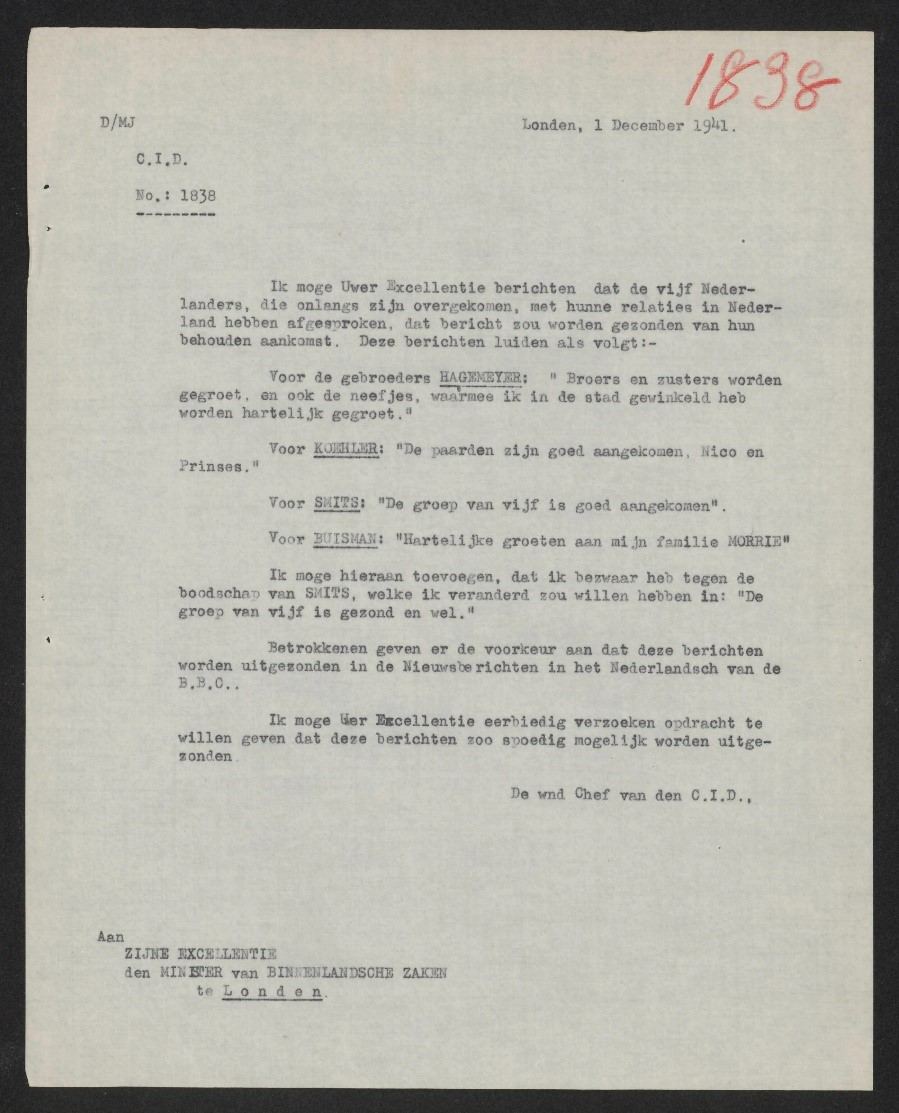
The five men had each agreed on a coded message with which they could let the home front know, via the radio, that they had arrived safely in England. The messages were written on a handwritten note. It also asked for them to be broadcast by the BBC during the Dutch-language news at seven o’clock, “…as Radio Oranje is hardly ever listened to”. The reason was that the Germans were fairly effective at jamming that station’s broadcasts. On 1 December the acting head of the Centrale Inlichtingendienst (CID)(x) asked the Minister of the Interior to order the coded messages to be broadcast as soon as possible. In doing so he made it known that he objected to part of Piet’s message. It read: “The group of five has arrived safely.” The CID probably thought this a little too transparent. An alternative was proposed at once that gave away less about the reality behind the message and yet was recognisable enough for the home front: “The group of five is safe and well”.
After the five were discharged from the Patriotic School on 28 November, the acting head of the CID, Derksema, approached Francois van ’t Sant, private secretary to the Queen. It was customary for Her Majesty to receive “Engelandvaarders” for a cup of tea after their interrogation by the security and intelligence services. She saw them as her most important source of information about the state of affairs in the homeland. Derkzema asked “… whether, and if so when, Her Majesty the Queen wishes to receive those concerned.” They turned out to be welcome on Friday 28 November at Stubbings House in Maidenhead, where the Queen lived after London became too dangerous. It must have been a remarkable and somewhat surreal experience: on Friday 21 November bobbing on the North Sea; exactly one week later sitting comfortably on the sofa with the Queen.
Decorated
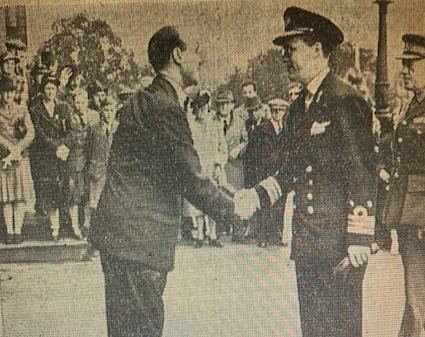
By Royal Decree no. 5 of 30 April 1942, Piet and his travelling companions received the Bronze Cross as a gallantry award “for having, in time of war, prepared with great skill their escape from the territory of the Netherlands occupied by the enemy, and for having carried out with courage and skill their crossing to England, a crossing attended by great dangers owing both to the poor seaworthiness of their vessel and to the actions of the enemy.”
“The Bronze Cross, the design of which shall be determined by Us, consists of a four-armed bronze cross. The cross is attached to an orange silk ribbon 37 millimetres wide, with in the middle a vertical stripe of Nassau blue 6 millimetres wide.” Thus the Royal Decree of 11 June 1940 that introduced this gallantry award (Stb A22).
At first the Bronze Cross could be awarded only to members of the army and navy. On 8 August 1940 it was extended to “persons not belonging to the armed forces”.(xi) This extension was needed because merchant navy personnel and other civilians were increasingly “(…) distinguishing themselves by courageous or skilful conduct in the face of the enemy.” Piet Smits belonged to that group.
The rest of the war
Piet spent the rest of the war in the merchant navy. He did so on the orders of the Netherlands Shipping and Trading Committee (NSTC), the Nederlandse Scheepvaart en Handelscommissie. This committee, set up in London shortly after the occupation, managed the merchant fleet on behalf of the government and enforced the Vaarplichtwet, a law obliging Dutch seamen in wartime to keep sailing aboard their own ship or another Allied vessel. The ships remained the property of the shipping companies. The running costs were borne by the state. Seamen were employed by the NSTC.
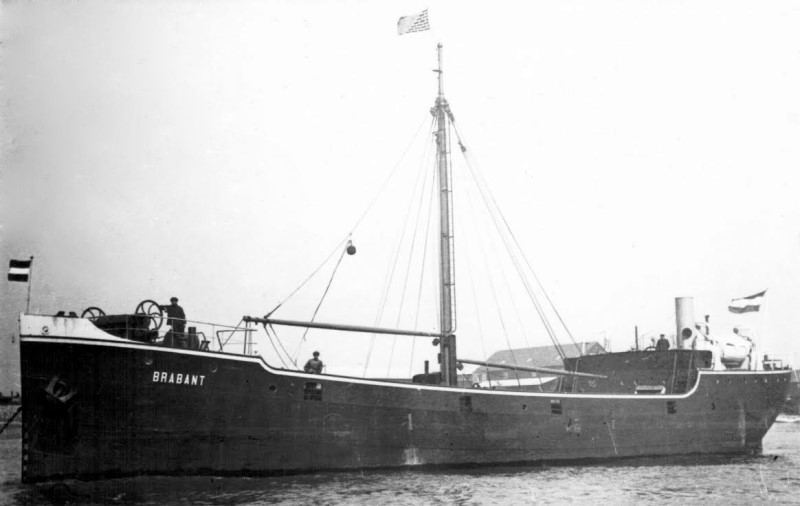
The database of Museum Engelandvaarders records the following about Piet Smits: ‘Pieter Smits serves in the merchant navy until the end of the war. On 11 June he experiences an attack on his ship, the MV Brabant, in which he suffers serious eye injuries.’ Unfortunately, no primary source is given for this statement. Nor have I been able to find confirmation of Piet signing on in the crew list of the Brabant. That does not necessarily mean that Piet was not on board, however, as the records may not have been complete.
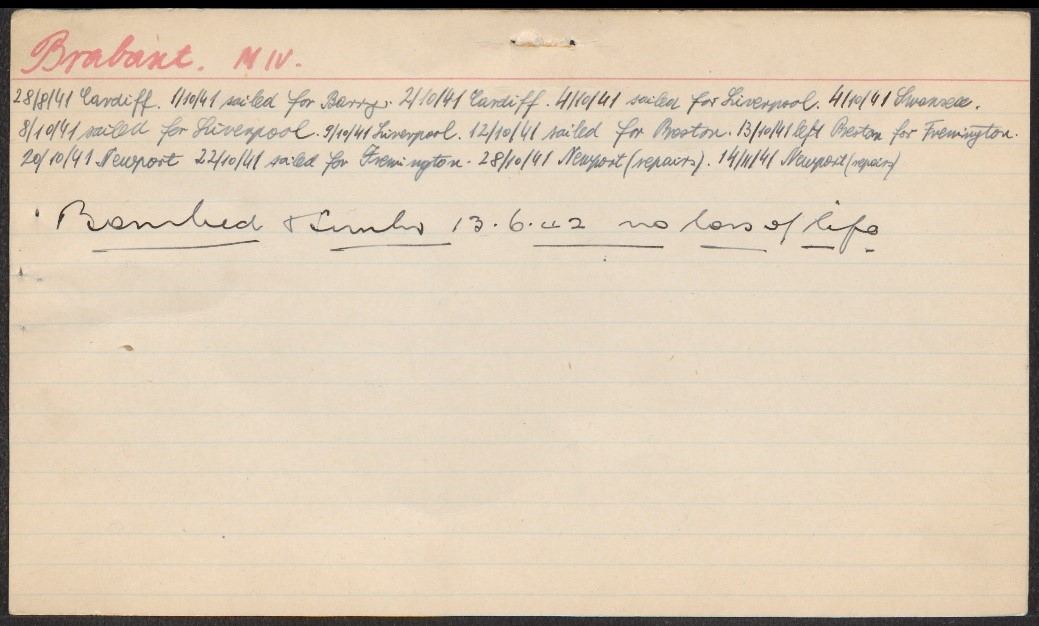
The Brabant was launched in 1927 and sailed under the Dutch flag. The ship was registered as the property of NV Motorschip Brabant (T. den Hartigh). On 16 May 1940 the NTSC took over the ship.(xii) On 13 June, on its way from Hayle to Swansea, 10 miles south of Hartland Point (Bristol Channel), it was bombed by German aircraft and sank. The entire crew abandoned ship in the lifeboat and arrived safely at Clovelly on 14 June.
What else Piet did in the service of the NSTC after this adventure I have not been able to trace in the archives. As mentioned, he told the family that he sailed with the so-called Murmansk convoys. In these, merchant ships protected by Allied warships were used to supply the Russians from England with war matériel for their fight against the Germans. Some of this matériel was collected in the US or Canada and carried in difficult conditions through the Arctic Ocean to Murmansk or Archangel. It was a dangerous route, especially in winter, because German U-boats and aircraft could easily spot the convoys sailing relatively close to the coast. Piet said little about it. He did say that his ship went down and that he and two others saved their lives on a life raft.
Home again
After the war Piet came back to De Lier. In any case, by 1947 he was again living at Burgemeester Cramerlaan 10. After his return he had several jobs; in the end he worked for many years at Brinkman in ’s-Gravenzande.
On 1 December 1948 Piet married Maria van der Zwaal from Barneveld in Rotterdam. On 19 September 1949 they were registered at Prinses Irenestraat 9, on 12 August 1960 at Emmastraat 10 and on 18 February 1976 at Piet Heinstraat 37.
Many people in De Lier will have seen Piet chatting with his brothers as they sat fishing in a little boat on the Lee. There was plenty to talk about with brothers Gerrit and Kees, who had both served in the Indies and had been through a great deal there. Or perhaps, as brothers, they never talked about it at all among themselves, any more than they did with others. The suffering had been endured; life went on. We will never know. What remains are archives and stories handed down.
Piet Smits died on 14 June 1985.
i Many thanks to Jantine Kreeft-Smits and Jan Smits, daughter of Piet’s brother Gerrit and son of Piet’s brother Kees Smits respectively. Their stories about their uncle Piet and their family helped me greatly in writing this piece.
ii On the evening of that same day, nine “Engelandvaarders” left the Berghaven in Hoek van Holland in the lifeboat “Berghaven”. They arrived in England on 23 November: 2.09.06 Inventory of the archive of the Ministry of Justice in London, (1936) 1940-1945 (1953), inv. no. 4340. In that period the North Sea was ‘busy’ in any case: on the night of 22 to 23 November 1941, Erik Hazelhoff Roelfzema (the Soldaat van Oranje) and Peter Tazelaar crossed from England to Scheveningen in a motor torpedo boat to pick up people whom London considered important to bring to England. The operation failed, but, slightly adapted, it made a fine film.
iii 2.09.06 Inventory of the archive of the Ministry of Justice in London, (1936) 1940-1945 (1953), inv. no. 4339; 2.05.80 Inventory of the archive of the Ministry of Foreign Affairs (London archive) and related archives, (1936) 1940-1945 (1958), inv. no. 533. Museum Engelandvaarders also provided me with several images.
iv Toon Hagemeijer gives a vivid account of the journey, recorded in 1946, probably by A. Th. Mertens, in the weekly De Linie, vol. 1, nos. 10 and 11 of 31 May and 7 June 1946, on the occasion of the 50th anniversary of the student society Thomas Aquinas in Amsterdam.
v They were apparently birthday presents for Her Majesty, presented on 31 August 1944 and 31 August 1946. They are held in the Royal House Archives, inv. nos. FA/0840 and FA/0841. In her book on the history of the “Engelandvaarders”, Tulpen voor Wilhelmina, Amsterdam 2004, pp. 100-101, Agnes Dessing also devotes a passage to Piet’s crossing, based on the Hagemeijer brothers’ accounts. His name is not mentioned there either.
vi See the article by Jan den Hoed at www.deTimmerwerf.nl/museum. Under the heading Geschiedenis van de Timmerwerf (History of the Timmerwerf), it tells the tragic story of Aagje’s relationship with Jan Koene.
vii This incident, incidentally, is not mentioned in the report of his interrogation by the intelligence services in London.
viii Toon did not say who had called him.
ix Quotation from Dirk Hagemeijer’s contribution to the commemorative album for Wilhelmina, included in Dessing (2004), 101.
x At that time probably Mr R.P.J. Derksema, who had succeeded Francois van ’t Sant in August 1941.
xi Stb. A23.
xii Source: Marhisdata.nl, Brabant – ID 1087.