By Agnes Dessing. Earlier parts of the diary were published on 8 April and 14 June 2024
Founded in 1934, the British Council set out, among other things, to promote cultural relations between the United Kingdom and other countries. It was evidently British Council policy to invite the various governments in exile based in London (the Netherlands, Belgium, Free France, Norway, Czechoslovakia, Poland and others) to put on an exhibition, so that the British public might learn more about their countries. The Scottish National Gallery came into the picture because the whole building was placed at the disposal of the Dutch exhibition.
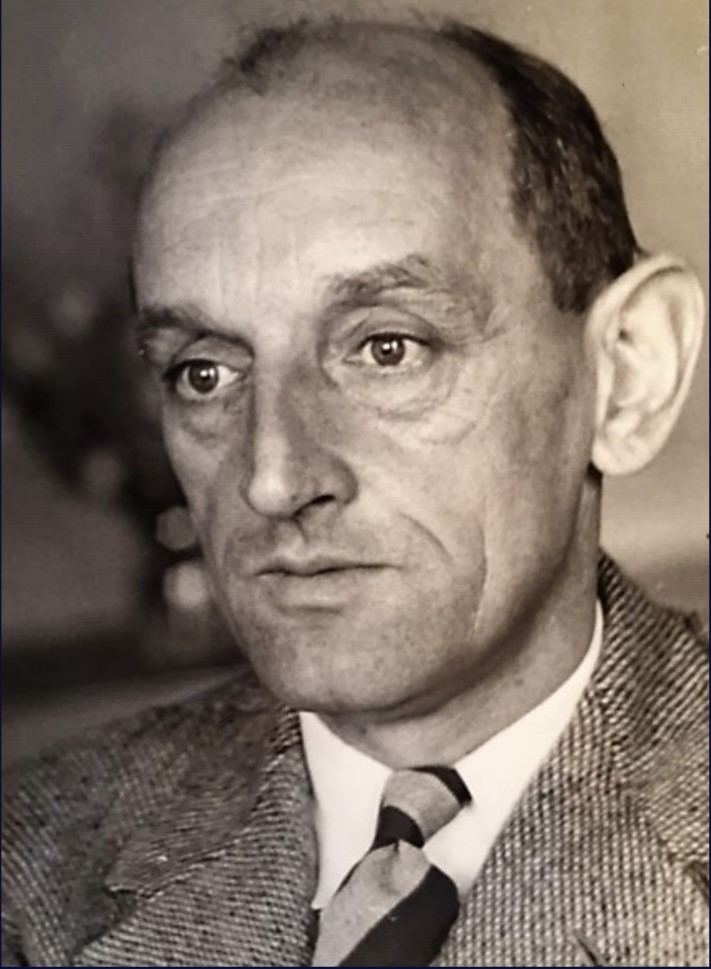
Bierens de Haan worked flat out to get the exhibition off the ground. Wealthy Dutch industrialists such as Paul Rijkens, chairman of the Unilever board, lent him paintings from their own collections, and F.R. Yerbury, a British photographer with a deep knowledge of modern Dutch architecture, gave him a whole pile of superb architectural photographs. He regularly had to take the night train to Edinburgh with a colleague, which did not endear him to his boss, Adriaan Pelt. Barthold’s diary also repeatedly mentions obstruction from the civil service, for instance over transporting exhibition material to the far north. As if this period were not stressful enough, there was a personal matter too: his wife, Monique, had made up her mind to come to England as well. In Switzerland, where she lived, she was in close contact with the Reverend Visser ’t Hooft, an important go-between for the Dutch resistance, who also felt that Monique could be useful in London. Bierens de Haan disagreed entirely. In his view Monique had an important role within the family and should not leave their children on their own.
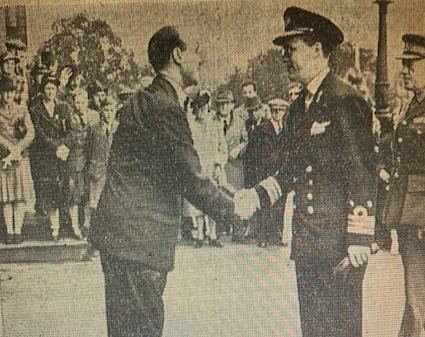
On 10 August 1942 the Dutch exhibition at the Scottish National Gallery opened to great interest. The official Dutch party consisted of Prince Bernhard, Prime Minister Gerbrandy and General Phaff. Bierens de Haan was pleased with the result, yet nowhere in his diary does he describe what the exhibition actually looked like. We can perhaps piece that together from a newspaper article about the same exhibition when it was later staged in Glasgow. According to the article, it portrayed the Dutch struggle to uphold democracy, past and present: in the occupied Netherlands, in the Dutch colonies, in England and America, and at sea.
‘Under the auspices of the Netherlands government’, the article continues
‘[…] the exhibition has been devised by a Dutchman, Mr. B. de Haan, who escaped to this country from Nazi-occupied Amsterdam. Composed of photographic and scenic displays, one section depicts life in the peaceful villages and up-to-date towns in pre-war Holland. The graphic picture of the bombed city of Rotterdam in the wartime-section shatters this pre-war serenity like a warning against complacency. Life in the Dutch East Indies is portrayed in another part of the exhibition. Here can be seen native clothing in batik designs and examples of native art.’
We also have a lively first-hand account from a prominent member of the Dutch community in London, O.C.A. van Lidth de Jeude, who had been nominated to join the second Gerbrandy cabinet as Minister of War but had not yet been sworn in. (That would happen on 15 September 1942.)
Van Lidth de Jeude was on a fishing holiday in Scotland and visited the Dutch exhibition in Edinburgh on 31 August 1942. In his diary he wrote: ‘Visited the Dutch exhibition in Edinburgh, just as the ‘Lord Provost’ was giving a speech. Quite a lot of visitors. The Dutch are very popular in Scotland. On the tour I was introduced to the Provost and his wife. Greeted Consul Van Hamel and Bierens de Haan. The exhibition strikes me as a great success – modest in size, naturally, but what is there is good. Paintings, etchings, drawings, furniture, pottery, statistics, photographs, in a very suitable space, all interconnecting rooms’. i
Lectures
Between organising exhibitions, Bierens de Haan also gave many lectures about Holland at schools, universities and factories. On 25 June 1942, for example, he spoke at two factories in Glasgow: ‘the Singer Works, where the new Sten gun is now being made, and a munitions factory.’ Miners, too, were a regular audience. Everywhere he went he was warmly received with applause, and people listened attentively. Bierens de Haan greatly enjoyed it, though he was surprised at how little his listeners knew about the Netherlands, and how little they grasped of what was happening on the Continent at all. One worker even remarked: ‘This is the first time we realise what we are fighting for!’ In August 1942 the Ministry of Information asked him to undertake another lecture tour, again in Scotland. It began in Galashiels, from where he visited other places nearby, such as Stow, Melrose, St Boswells and Selkirk. The lectures were well attended, and the closing meeting, back in Galashiels, drew no fewer than 1,500 people. The Dutch exhibition in Edinburgh, which closed in early September 1942, had also attracted large crowds: around 1,000 visitors a day on average. As mentioned, the exhibition then moved on to Glasgow (October 1942), Manchester (November 1942), Hull (December 1942) and Sheffield (February 1943). Support from the Dutch authorities remained rather grudging. The exhibition in Hull was to have been opened by Minister Bolkestein, but illness kept him away at the last moment. In the end Bierens de Haan opened it himself – something his boss at the Government Information Service (RVD), Pelt, tried with all his might to prevent. Quite how he tried is not recorded!
Monique Bierens de Haan-Barbey
Meanwhile, Bierens de Haan’s wife had arrived in England on 22 October. She had escaped via Switzerland in much the same way as her husband, helped by the Swiss legation in London, where her brother Eric Barbey worked. She had left her three children with her mother in Switzerland. All this greatly displeased Bierens de Haan, whose diary makes no mention whatsoever of his wife’s arrival. On 30 October Queen Wilhelmina awarded Barthold Bierens de Haan the Cross of Merit, the decoration most “Engelandvaarders” received for their perilous journey to England. This, too, was surely a special moment for him personally, yet Barthold devoted not a single word to it in his diary. Monique, however, did record it in her French-language diary, which was edited and published much later, in 2013, by her son Barthold Bierens de Haan (born 1940) under the title ‘Il n’y a qu’une façon d’aimer’. She writes that on 30 October 1942, after the investiture, she and Barthold went on to Oranjehaven, where la reine Wilhelmine was also present and asked her (Monique) about her journey to England and about her children. The published diary reveals that there was another reason for her coming to London: Bierens de Haan had had a brief affair with a woman in London, who appears in the diary under the name Sheila. This prompted Monique’s (rather domineering) mother and her brother Eric to hurry Monique off to London, in an effort to save the marriage.ii Whether Monique herself knew of her husband’s infidelity is not entirely clear. What Bierens de Haan writes in his diary in the last months of 1942 is dominated by gloom about the ‘wretched state of affairs in Holland’ and dissatisfaction with the attitude of the Dutch government in London, pithily summed up as ‘cover-ups, stifling and scheming’. Monique is now mentioned in the diary for the first time. Bierens de Haan admits that they are both ‘prickly’, and that they must learn to live together and respect one another again:
‘[….] Let us accept each other as we are. And above all not make life a misery for one another with endless nagging…’
1943
The new year did not bring the peace so fervently longed for, but 1943 was the year in which the tide of war finally turned. First came the Allied victory in North Africa in January 1943 (the Battle of Tripoli). That same month the German army was defeated at Stalingrad, while the Red Army was still holding out in the siege of Leningrad. The upbeat tone of Radio Oranje was now better grounded in reality. Radio Oranje and De Brandaris had merged at the end of 1942, and over the year the broadcasts improved in quality. Bierens de Haan was still with the RVD but no longer involved in radio work. He concentrated mainly on mounting exhibitions and giving lectures, more or less independently, no longer counting on any help from his superiors at the RVD, Adriaan Pelt and the writer Herman de Man. On 22 February 1943 General Van Oorschot opened a Dutch exhibition at the Graves Art Gallery in Sheffield, followed on 10 April by one in Leeds. Until the very last moment nobody knew who would open the Leeds exhibition, until finally Van den Broek, the Minister of Finance, was instructed to do so against his will. Bierens de Haan noted wryly in his diary that Van den Broek ‘…was treated like a little doll just to keep him sweet.’ Meanwhile, Bierens de Haan was busy preparing an exhibition in Belfast, Northern Ireland. Prime Minister Gerbrandy was due to open it, but could not because of a planned trip to the United States. The Minister of War, Van Lidth de Jeude, would stand in for him, so the opening programme had to be adjusted to suit ‘the dignity of a Minister of War.’ On 16 April 1943 Bierens de Haan called on General Hill and General Franklin, respectively Commander-in-Chief of the American forces and Commander-in-Chief of the British forces in Northern Ireland, to prepare for a visit by the official Dutch delegation around the opening. It set him musing anxiously on how dependent Europe had become on America. He recorded in his diary how an American officer had told him: ‘ We will win this war for you, but don’t think we do it for nothing’ Bierens de Haan feared American economic imperialism:
‘… What happens when the armies come home? The country (America, ed.) is full of factories with no work for them. America needs every market in the world. […] We will have to say thank you. Lend-Lease, the American army, American lectures, American food, medical supplies. They will help us, philanthropists that they are, but in their own interest […]’
i Londense dagboeken van jhr. ir. O.C.A. van Lidth de Jeude 1940-1945, edited by A.E. Kersten and Eric Th. Mos, 2001, p. 789.
ii M. Barbey & B. Bierens de Haan, Il n’y a qu’une façon d’aimer. Paris, 2013, p. 30.