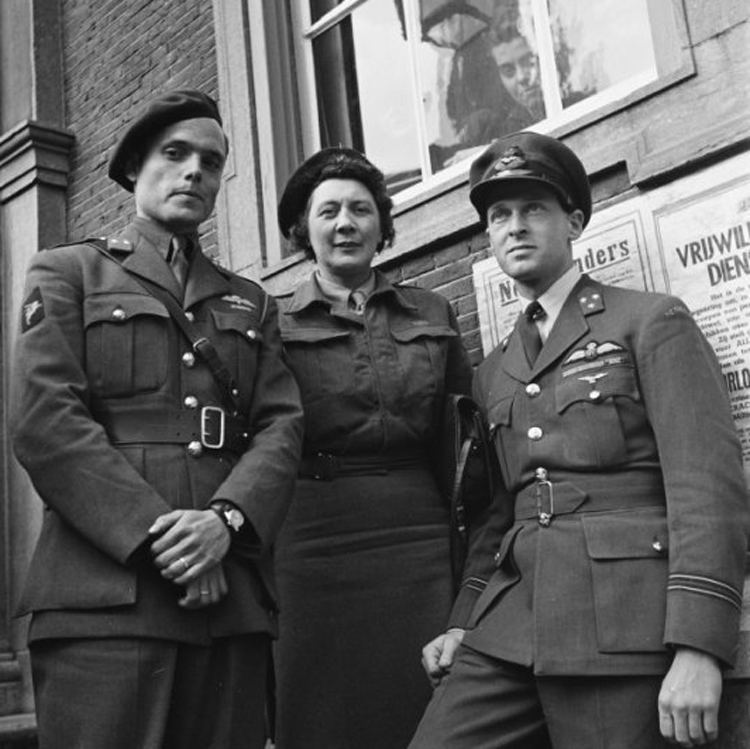
Only one female “Engelandvaarder” rose to become aide-de-camp to Queen Wilhelmina. Her name was Rie Knapper, also known as Rie Stokvis-Knapper after the man she married in 1944.
In this photograph, taken on 2 May 1945 outside Breda town hall, she poses with her two male fellow aides-de-camp, Peter Tazelaar (left) and Erik Hazelhoff Roelfzema (right). The three of them accompanied the Queen during the first weeks after her return to the Netherlands.
Hazelhoff became the best-known “Engelandvaarder” in the Netherlands thanks to his book Soldaat van Oranje (Soldier of Orange), which was made into a film in the 1970s and has been the subject of a musical for decades. Tazelaar, who performed many of the heroic deeds that Soldaat van Oranje attributes to Hazelhoff and to a fictional character, shunned publicity and long remained in the shadows. Since the publication in 2025 of Spion in smoking, the biography of Tazelaar by historian Victor Laurentius, he too has become a household name. But who was Rie Knapper?
Early years
Maria Knapper was born in Amsterdam on 14 May 1903. Her father was a doctor. She had two brothers: one also became a doctor, the other trained as an engineer. Marie, or Rie for short, leaned more towards the arts. After secondary school she studied at the Institute of Applied Arts, graduating in 1928. To round off her training she spent a year abroad, visiting England, France and Germany.
Back in Amsterdam she rented a studio on the Kerkstraat and devoted herself to art weaving, with considerable success. Some of her work was even exhibited at the Stedelijk Museum.
In 1932 Rie Knapper married G.J. van der Wal, an engineer, and moved with him to Wassenaar. In 1936 the couple decided to separate. Rie returned to Amsterdam and once again rented a studio, this time on the Zomerdijkstraat, for art weaving and interior furnishing. From then on she called herself an interior designer. Business, however, was not as good as before, so in April 1939 she became a tour guide for the Gesellschaft für akademische Reise, based in Zurich, leading a group of 30 people on a tour of Greece. From September 1939 she worked as an auxiliary nurse at the Burgerziekenhuis, the Amsterdam hospital where her brother was a surgeon.
The outbreak of war
At the end of April 1940 – although friends strongly advised against it, given the threat of war – she went abroad again, this time on holiday. The year before, while working as a tour guide, she had met a man on Corfu whom she was very keen to see again. She had been on Corfu for only four days when she heard that the Germans had invaded the Netherlands on 10 May 1940.
She decided to leave at once and, with great difficulty, travelled through Italy to Lyon in France. She hoped to join the French Red Cross, but was turned away because she was a foreigner. She then went on to Paris. The day after she arrived (14 June 1940), the Germans entered the city, which made her decide to head north. Cycling and hitching rides on German lorries, she reached Brussels and then The Hague. By the end of June 1940 she was back in Amsterdam.
Her interrogator in London evidently wanted to know why she had chosen to return to the Netherlands. Rie replied that she had believed the war would be over within a few months. Besides, she could not imagine England holding out on its own.
To England
In the autumn of 1940, when it became clear that England was indeed holding out alone, she resolved to get to England as soon as possible and do something there to help liberate the Netherlands.
Through an acquaintance from the party she had led around Greece in 1939, Rie obtained a false Belgian identity card and – crucially – contacts. On 19 October 1941 she set off the same way she had come back in June 1940: by bicycle. She crossed the border near Baarle-Nassau without difficulty and reached Brussels. From there a guide took her to Lille, across the demarcation line and on to Paris.
Along the way she was arrested several times and placed under “résidence forcée”: she had to stay put in a café or small hotel and was not allowed to travel on. On 3 January 1942 she was in Mâcon, where she was given permission to travel to Nice.
By the time she got there her money had run out, and she sold a gold tooth. In Monte Carlo a certain Dr Van Tricht, brother of General A.G. van Tricht, the military attaché in Bern, gave her a certificate stating that she needed treatment for a lung condition in Évian, Switzerland. At the end of February 1942 Knapper was in Annemasse, from where she walked across the Swiss border under cover of darkness.
As soon as she was on the Swiss side she was arrested and once again placed under “résidence forcée’. But General van Tricht in Bern had heard of her arrival through his brother and saw to it that she was quickly released and put up in a hotel. In Switzerland, too, she had to wait for months. The good news, though, was that she could join a convoy of Dutch refugees and “Engelandvaarders” that was permitted to travel legally from Geneva to Barcelona. This was the result of efforts by the Government Commissioner for Refugees, Van Lidth de Jeude, who had arranged for several hundred Dutch people – Jewish refugees as well as “Engelandvaarders” – to be evacuated legally from Vichy France and Switzerland to Spain.
On 2 July 1942 Rie Knapper left for Barcelona. From there the journey continued to Bilbao, where the members of the convoy boarded the SS Cabo de Hornos bound for Curaçao. They reached this Dutch overseas territory on 25 August 1942. Here, too, a long wait loomed, because the Dutch military authorities on Curaçao were not prepared for a woman in a convoy otherwise made up entirely of men (liable for military service). For a start, no hotel room had been arranged for her.
‘When I arrived on Curaçao,’ Rie says in her report, ‘…all the servicemen were looked after, but nobody bothered about me. No hotel room had been booked, and luckily I was allowed to leave the ship and ride into town in a car….’
She could not find a hotel room, however, so Rie spent her first night on Curaçao in a kind of seamen’s hostel. Later she did get a hotel room, but she discovered that it was being paid for by a few private individuals on the island (among them the director of Shell), whereas in her view the government should have been footing the bill.
Arrival in England
Knapper spoke to several senior military figures on the island about her passage to England, but nobody was willing to do anything for her and they treated her very rudely, as she later reported in London.
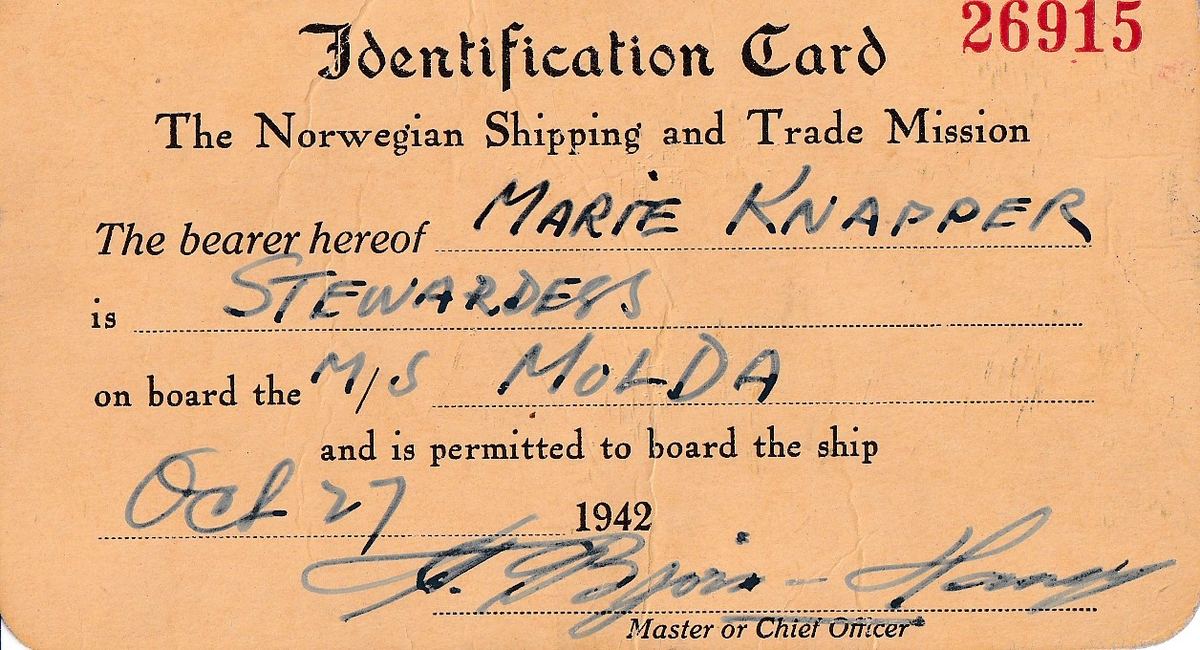
So she had to take matters into her own hands for the rest of the journey, which she did wholeheartedly. She signed on as a stewardess aboard a Norwegian tanker bound for New York, but the authorities took her off the ship because they considered it too dangerous for a woman. On 19 September 1942 she succeeded with another Norwegian ship, loaded with dynamite and grain. On it she arrived in Liverpool on 20 November, 13 months after leaving the occupied Netherlands.
Rie Knapper had evidently volunteered for training as a secret agent, because at the end of the interrogation report the interviewer assessed her suitability for the role. He considered her a lady of unquestionable political reliability, very energetic, not to say dynamic. In his view, however, she was not suited to be a secret agent, firstly because she talked rather a lot and secondly because ‘…she lacked – mainly on the sexual side – the perfect balance that such a mission requires’. Perhaps her story about the man on Corfu had given her interrogator the impression that she fell in love rather easily. Either way, it was a curious and rather misogynistic remark.
So Knapper did not become a secret agent. How she did serve the Allied war effort, you can read in the next instalment.