August 2021
By Sierk Plantinga
“Engelandvaarder” Leo Hendrikx died at his home in Heythuysen on Sunday 2 April 2023, aged 99. According to a press release from the Ministry of Defence, he was the last surviving air force pilot to have flown during the Second World War.
Born in Roermond on 21 September 1923, the grammar-school pupil (in his 5th year) set off by bicycle for Belgium on 14 May 1941 with three friends from his home town of Horn in Limburg, without his parents’ knowledge. In Belgium, Leo, Paul Barten, Jan Oyen and Harry Feyen sold their bicycles and continued by train via Charleroi and Maubeuge to Paris. Leo Hendrikx knew the name of Father W.J. Meuffels, chaplain to the Catholic Dutch in and around Paris. He put the four up in an orphanage and also gave them the name of a parish priest in Nevers, close to the Demarcation Line, the border between occupied France and Vichy France.
With the help of a resident of the village of Saint Pierre le Moutier, they managed to cross the Demarcation Line into Vichy France, but were then arrested by the French border guards and locked up in the local prison at Montluçon. There they faced trial and the standard sentence of one month’s imprisonment for being in France without valid papers. Thanks to Consul General Ate Sevenster in Vichy, Leo Hendrikx was not convicted and was released immediately, as he was not yet 18. The other three were sent back to prison but were pardoned after 18 days.
At the end of May 1941 Sevenster sent Leo Hendrikx to Toulouse, where there was a Dutch reception camp; the other three arrived there shortly afterwards.
The wait for an exit visa dragged on – too long for two of the boys, who returned to the Netherlands. Leo Hendrikx and his friend Paul Barten did what many other “Engelandvaarders” did and tried to get to Switzerland, believing they could reach Spain and Portugal faster from there. Unfortunately they were arrested at the Franco-Swiss border and sentenced to 40 days’ imprisonment in Annecy. After about a month, Barten was released through the intervention of Testers, director of the Office Néerlandais in Toulouse, and sent to Barcelona. Leo Hendrikx was allowed to travel via Barcelona to Bilbao on 24 July, and on 28 July 1942 he boarded the Cabo de Hornos; in Bilbao he had met up with Barten again.
The Cabo de Hornos called at Curaçao on 25 August 1942. There the two friends transferred to a British tanker that took them to New York. From there they continued to Canada, where they received their first military training in Stratford and then in Guelph. On 12 December 1942 they left Guelph with many other Dutchmen and sailed for England on the Queen Elizabeth, arriving in Scotland on 17 December 1942 and moving on to Wolverhampton, the base camp of the Princess Irene Brigade.
The Princess Irene Brigade was not quite what Leo had in mind, and the Brigade did not have a great reputation either. So Leo Hendrikx tried to find out in London whether there might be a more suitable place for him in the Dutch armed forces. In London he was invited to tea with Queen Wilhelmina, and he also found a branch of the forces that better suited his ambitions: he signed up with the RAF.
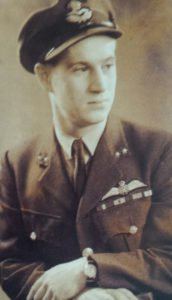
After an initial medical, he trained as a pilot in Canada. He received his ‘wings’ on 2 April 1944, followed by his commission as a second lieutenant. Back in England, further training followed. At the end of November he had the chance to pay a brief visit to his family in Horn, in recently liberated Limburg.
In March 1945 Leo Hendrikx was transferred from his British unit to 322 Squadron, a unit with Dutch personnel, which was then temporarily based at Schijndel.
He had already flown a number of sorties when, on 1 April – ‘a bizarre April Fool’s joke’ – he was hit by German anti-aircraft fire while flying low beneath the cloud cover and had to make an emergency landing. He survived but was badly injured, with burns and a broken arm. He was taken to a Kriegslazarett (German military hospital) in Apeldoorn to recover, and was there when Canadian troops liberated the town on 13 April. He was transferred to a hospital in England for further treatment. After his rehabilitation he was passed fit again in January 1946. In the Netherlands he flew a variety of missions; on one of them his passenger was the Minister of Education, Gielen. During that flight Leo Hendrikx asked him whether he could obtain his school diploma, as he had left for England in his 5th year. His request was granted, and so Leo obtained his grammar-school diploma.
A posting to the Dutch East Indies followed, and in 1948 he began his studies in Wageningen. After a while he had the opportunity to become a ‘monthly pilot’: pilots who had left the service could fly four days a month to keep their skills up, while the air force retained a pool of fully trained reserves. After the Spitfires came jet fighters, the Gloster Meteors. Leo Hendrikx kept flying until 1955. He was paid for it and, by his own account, this made him the richest student in Wageningen: it funded his studies. He graduated in January 1955 as an engineer in agricultural economics. A fine career at Heineken followed, which often took him to the brewing group’s operations abroad.
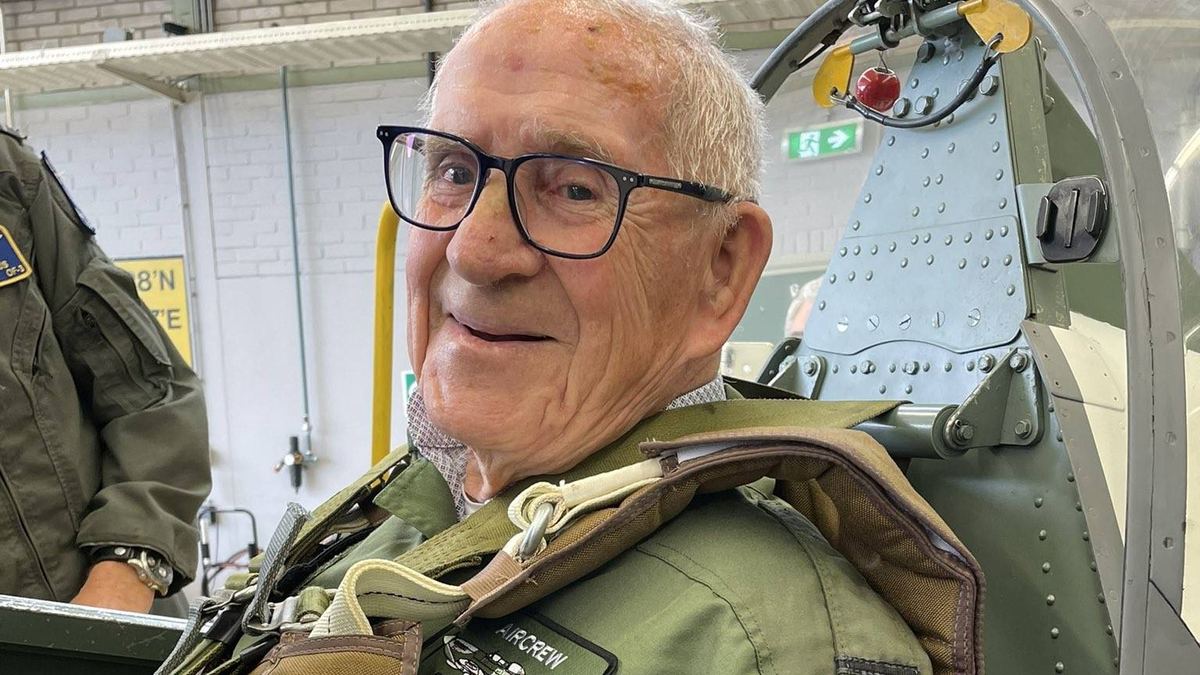
He retired from Heineken in 1987. But he regularly attended reunions of the Genootschap Engelandvaarders and, in old age, enjoyed several honours: in 2018 he was presented with the Wound Badge (Draaginsigne Gewonden), introduced after the war, and a highlight in 2021 was the invitation to fly once more in a Spitfire on a tour of the Netherlands. The flight passed over Horn, where he grew up, and Heythuysen, where he then lived, and also over the site of his 1945 crash. Photographs show a beaming Leo Hendrikx. And that is how I will remember him.