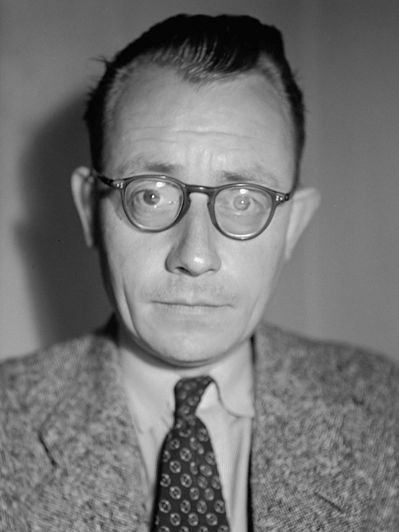
Havank (1942)
By Victor Laurentius
Especially in the 1950s and 1960s, Havank was a hugely popular detective writer. The adventures of his creation ‘De Schaduw’ (The Shadow) sold millions of copies in the Netherlands. Havank was the pseudonym of Hendrikus Frederikus (Hans) van der Kallen (Leeuwarden, 19 February 1904 – Leeuwarden, 22 June 1964). His first detective novel was brought out in 1935 by the Utrecht publisher A.W. Bruna & Zoon, and he went on to write another 29 crime novels. Thanks in part to the attractive covers by Dick Bruna, after the Second World War the series found its way to a wide readership as Zwarte Beertjes paperbacks. The little figure of De Schaduw – a black silhouette with headgear (usually a beret) and a cigar – became as iconic and recognisable as The Saint by the crime writer Leslie Charteris. That was no coincidence, incidentally, because even before the war Havank was the regular translator of Charteris’s work for the Dutch market. But although there is still a loyal following of Schaduw readers, the author seems to have faded somewhat into obscurity. During my recent search in charity shops and second-hand bookshops, I was told no fewer than three times that they had got rid of those old paperbacks for lack of interest. The copies I eventually managed to pick up feel dated, though that is mainly down to the old-fashioned language and the rather stale puns, because the themes are still quite modern: cocaine trafficking and the trade in women, international gangs, espionage… As you read, you cannot help wondering where he found his inspiration. According to the study by J.P.M. Passage, Havank. Schets van leven en werk1 (Havank: a sketch of his life and work), Havank’s books contain references to the author’s personal life, especially in the characters, and the stories are often set against a backdrop he knew well, such as the Côte d’Azur or Paris. Specifically about his experiences during the Second World War, so far I have only come across something in the December 1948 issue of the opinion magazine Mandril. Maandblad voor Mensen2. In it Havank describes his attempt to get away from the south of France to Portugal.
The main source of information about Havank’s “Engelandvaart” is the report of his interrogation in London3. On 20 October 1942 he was questioned by the well-known spycatcher Oreste Pinto. Pinto had just moved from MI5 to the Dutch Politie-Buitendienst (overseas police service). By Pinto’s standards it is a rather brief document, which gives the impression that Havank had already been adequately screened. It is remarkable, and quite exceptional, that after arriving in England he did not end up in the Royal Victorian Patriotic School. On how difficult it was to be admitted to England, the same Pinto once wrote: “In the war years, getting into England was rather like joining an exclusive club. It was always easier if you already knew someone who could introduce you.”4 The interrogation report sheds light on the matter:
By 1935 Havank was earning enough from his work to move to Paris. He settled in the Palace Hotel on the Boulevard St. Germain. In September 1936 the writer moved to Rome, where he stayed until July 1938, before returning to Paris. From June to September 1939 he settled for a while in the artists’ village of Cagnes-sur-Mer in the south of France, where, in the restaurant-guesthouse La Tourelle, he wrote ‘Hoofden op hol’5 (Heads in a whirl), published later that year. In this story, as in ‘De Schaduw grijpt in’, completed in 1940, Nazi espionage plays an important role, and both books can be described as anti-German. Meanwhile, in Cagnes-sur-Mer he had begun a relationship with Mrs Phyllis Townsend, who had just been deserted by her husband, and went to live with her in Paris at 96 Rue Cambronne. On 17 April 1940, just before the Blitzkrieg, the couple moved to Cassis-sur-Mer (4 Rue Pasteur), which, like Cagnes, lies on the sunny Riviera.
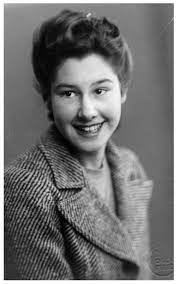
The occupation of a large part of France and the emergence of the pro-German Vichy regime soon made themselves felt when Phyllis Townsend, as a British subject, was no longer allowed to stay in Cassis. Forced to leave, she went with Havank to the spa town of Ussat-les-Bains, a ‘résidence forcée’ (place of compulsory residence) in the Pyrenees. On 19 November 1941 Mrs Townsend managed to obtain a visa and flew to Lisbon. According to Havank’s later wife, Cynthia van der Kallen-Vickers, however, Mrs Townsend travelled to Lisbon on a British warship6. With the help of D.F.W. van Lennep, the representative of the Hoge Commissariaat voor Nederlandse Vluchtelingen (High Commission for Dutch Refugees) in Marseille, Havank himself was put on a convoy list for the Dutch East Indies, with the aim of reaching Lisbon that way. The outbreak of war with Japan, however, put paid to that. In Lisbon Mrs Townsend did everything she could to arrange a British visa for him and, at her wits’ end, called in Consul-General A.W. Faulkner, apparently an uncle of hers. From his Portuguese home in Estoril, on 22 April 1942 Faulkner wrote to the delegate of the High Commissioner for Dutch Refugees in Lisbon, Mr B. Ph. Baron van Harinxma thoe Slooten: “My Dear Baron, in reference to Van der Kallen, two letters of him this morning made me realise so much the need of urgency. It is asking much these days for urgency in anything, let alone a case such as his, but I realise you are the type of man that if you could do anything quickly would do so for anyone. Formalities must of course be observed but the political situation is developing so fast that all the waiting and work done on his behalf by my cousin and me, will be intirely lost, unless, by cable, you can assure your legation in London of Van der Kallens identity and ask them to confirm this also by cable.” Two days later it was reported that a letter had arrived at the British Passport Control Office from the Dutch Legation in London, showing that nothing was known about a visa application either in London or at the Dutch legation in Lisbon. For that reason the application of 6 March 1942 for a British visa had been refused. In passing it was noted that the Dutch legation did not appreciate interference from ‘outsiders’, even when it came from the British side. No wonder Havank was so anxious. Phyllis Townsend, meanwhile, had arrived in England on 13 July 1942 and made fresh attempts to get Havank out of the south of France. D.W.F. van Lennep, for his part, did his best for him, writing from Marseille on 1 June 1942 to Van Harinxma thoe Slooten: “I can undoubtedly recommend Mr van der Kallen more highly than many others who have recently left for the destination he desires.” On 18 September 1942 came the long-awaited news from the Portuguese authorities: Havank was granted a transit visa for Portugal, followed by a visa for Curaçao. The end seemed in sight, but French regulations did not cooperate.
In the article ‘Permis de circulation’ in Mandril. Maandblad voor mensen, Havank describes the difficulties he ran into at the last moment: “Stuck to this page of our diary is a colourful picture postcard, postmarked Marseille, with the news that Lucie is doing very well and expects a happy delivery towards the end of the month. Lucie is an elderly gentleman with a flamboyant beard, and the expected baby merely a disguise for the message that we must come to Marseille soon to have our passport adorned with many stamps: a French exit visa, a Spanish and Portuguese transit visa, and the fantasy visa for Curaçao, to be issued by the Swedish consul. But the difficulty is that we are in the Département of the Ariège, high in the Pyrenees, and we may not travel without a “Permis de Circulation”.’ To get the Permis, Havank cycled to the gendarmerie in Foix and was at first shown the door, because the rules forbade issuing a Permis to ‘Hollandais’. But Havank was never at a loss: a few hours later he walked back into the office and declared that he was ‘Néerlandais’. That changed matters, because the term ‘Néerlandais’ did not appear in the regulations. Armed with the Permis, at the Spanish border town of Canfranc, an important rail link between France and Spain, he boarded the train for Portugal. One of his fellow travellers, the “Engelandvaarder” Hans Barnstijn, mentioned this during his interrogation in London7: “On 1 October I left by train for Canfranc, a station on the Franco-Spanish border, where I met H.F. van der Kallen. With him I travelled on from there to Madrid and further to Lisbon. A few days after arriving in Lisbon, Van der Kallen was given the opportunity to leave for England by plane.” Unlike his travelling companion, Havank did indeed obtain permission to go to England very quickly. After being lodged in the ‘Pension Londres’, Rua Pedro V, he was told by the representative of the Bureau Inlichtingen (Intelligence Bureau), Mr Maas Geesteranus, that he would be put to work at the Voorlichtingsdienst (information service) in London. With the British visa issued on 5 October, he flew to Whitchurch on 12 October 1942, where he was questioned and, on production of a document from the Dutch legation in Lisbon, admitted to England. In this document we read: “The Royal Netherland Legation herewith declares that the Netherland subject Mr. H.F. van der Kallen is going to England on behalf of the Royal Netherland Government, Lissabon 10th of October 1942.” But the role of Phyllis Townsend should not be underestimated either, according to a letter from the Ministerie voor Algemeene Oorlogvoering (Ministry for General Warfare) dated 19 October 1942: “Mr van der Kallen appears to have obtained his English visa through the intervention of his future wife; his future wife is English, and her influence also appears to have been at work in his reception and further handling by the Immigration Officer in Bristol.”
Without first having to pass through the Patriotic School, on 13 October Havank went to Stratton House in London, where he had lunch with Adriaan Pelt, head of the Regeerings Voorlichtingsdienst (Government Information Service) – and also his new boss – and with his deputy D.J.F. de Man and the head of the news department, J.A. van Houten. Havank eventually became chief editor of the London edition of Vrij Nederland8. In 1944, incidentally, he was presented with an unpaid bill for travel and accommodation costs during his “Engelandvaart”. He had signed an IOU for it in France. It concerned sums advanced by the Office Néerlandais Marseille, the Office Néerlandais Perpignan and the Commissariaat voor de Nederlandse Vluchtelingen in Marseille, totalling 680 pounds and 30 pence9. Revealing in this context is a remark in a note from the Centrale Inlichtingendienst (Central Intelligence Service) dated 29 March 1943: “It seems van der Kallen is living in rather high style. If he still wants to marry Mrs. Townsend, it is probable that she is giving the money. She is said to be rather well-to-do.” Havank never did marry Phyllis Townsend, however: the relationship ended and he married Cynthia Vickers, who was also English.
A curious detail is that after the war Havank ghostwrote the memoirs of his interrogator, Oreste Pinto10. These memoirs appeared in the Sunday paper The News Chronicle. Whether these articles formed the basis of the later famous and filmed Spycatcher books remains to be investigated.
Stichting Mateor, www.havank.org, kindly made photographs of Havank available for this article.
i Havank. Schets van leven en werk. J.P.M. Passage (Groningen, 1997).
ii ‘Permis de Circulation’, in: Mandri. Maandblad voor mensen, p. 7 (December 1948).
iii Nationaal Archief, Ministerie van Justitie te Londen, 2.09.06, inv. no. 10131.
iv De Fuik. Spionage contra spionage, Oreste Pinto (Amsterdam, 1964).
v Waar de mimosa bloeit. Nederlandse kunstenaars in Cagnes-sur-Mer, Paul Arnoldussen, p. 54 (Amsterdam, 2013); ‘Cagnes-sur-Merde’, C.J. Aarts, in: De Boekenwereld. Volume 29, 2012-2013, p. 61.
vi Havank. Schets van leven en werk, p. 102.
vii Nationaal Archief, Ministerie van Justitie te Londen, 2.09.06, inv. no. 11005.
viii Dr. M. van Blankenstein. Een Nederlands dagbladdiplomaat 1880-1964, Elisabeth van Blankenstein, pp. 254, 256, 290 (The Hague, 1999).
ix Nationaal Archief, Gezantschap in Portugal (Lissabon), 2.05.161, inv. no. 257.
x Havank. Schets van leven en werk. J.P.M. Passage, p. 121.