Zeister Nieuwsblad
By Sierk Plantinga
On 22 March, “Engelandvaarder” Ben Uiling died at his home town of Zeist, just short of his 101st birthday.
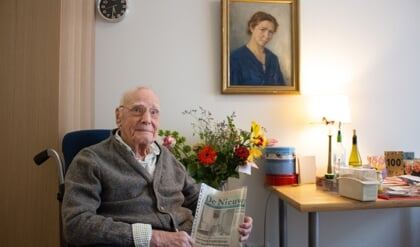
Only last year the local paper in Zeist, De Nieuwsbode, marked his hundredth birthday, with a photograph. On the wall of Ben Uiling’s room behind him hung a framed photograph of the reunion of the Genootschap Engelandvaarders in September 2014, taken on the steps of De Zwaluwenberg in the company of Princess Beatrix.
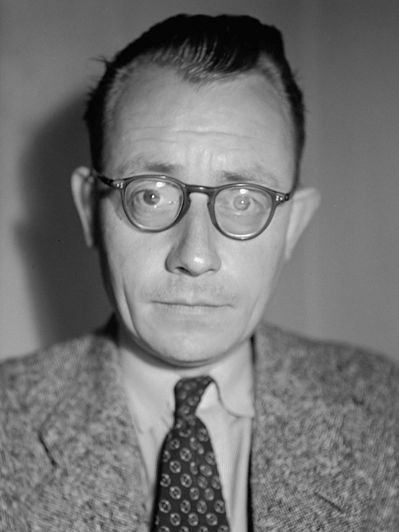
Bernard Karel Uiling was born in Beverwijk on 3 April 1922. His father ran a business in printing supplies there, and he grew up in a middle-class family. In 1940 he completed his HBS-B secondary school diploma at the state HBS in Velsen. On the morning of the German invasion he was sitting his mathematics exam. He was awarded the diploma all the same.
After leaving school he enrolled at the nautical college in Amsterdam. His studies there lasted until mid-1941, after which he took a follow-up course organised by the shipping line Rotterdamsche Lloyd. During that time he lived with twelve other students on a houseboat in Rotterdam’s Coolhaven. The course ended in January 1942, and he returned to Beverwijk.
To protect himself against possible forced labour for the Germans, from February 1942 he worked at the Kennemer Machinefabriek in Beverwijk; it helped that his parents knew the factory’s director.
Having trained as a ship’s officer, he could also go to sea. In June 1942 he signed on as an apprentice mate aboard the cargo ship ‘In Orde’ of the Carp shipping company in Amsterdam, and on 3 June 1942 he sailed with her for Sweden. He went to sea at the request of his mother’s brother, his uncle G.K. Fikkert. Uncle Guus Fikkert had asked him to take all kinds of intelligence reports with him on every voyage to Sweden and to post them in a Swedish port to a given address in Stockholm, from where the reports would find their way to the Allies.
In all, Uiling posted five such consignments in Swedish ports. Each time he was given the messages in the Netherlands by his uncle Fikkert or by Fikkert’s associates Westenberg and Braun. Often Uiling memorised the messages, wrote them down once in Sweden and addressed them to a Miss Endel in Stockholm, who was to arrange their onward transport. The fifth and last time, things went wrong. It later emerged that the third consignment, from mid-September 1942, had already landed with the Swedish police. After he had posted the fifth, the Swedish police came aboard the ‘In Orde’ at Öregrund on 17 December 1942. Uiling was taken to the police station and, after questioning, eventually arrested. On board the police found a range of incriminating documents. He was suspected of espionage ‘not directed against Sweden, to the detriment of a friendly power’. The case went to court. In March 1943 the appeal court in Stockholm sentenced Uiling to ten months’ hard labour in the prison at Falun, with only 14 days deducted for time on remand, although he had in fact been held for three months. It was the same sentence that had been handed down at first instance. During that first period he was not allowed to contact the Dutch Legation in Stockholm, and the trial was held behind closed doors. Only after his conviction at first instance was Uiling permitted to contact the Dutch diplomatic mission.
The Swedish authorities’ severity is less surprising once you know that Swedish neutrality was under heavy German pressure. In 1941–1942, Dutch seamen who deserted their (German) ships in Swedish ports were therefore handed back to their German owners despite Dutch protests, often ending up in a concentration camp as a result. In the Swedish view, deserters could not be regarded as political refugees under international law. There was also considerable Swedish–German cooperation in the economic sphere, as in the large Swedish group owned by the Wallenberg family.
With the support of the Dutch Legation in Stockholm, Uiling petitioned the King of Sweden on 7 May 1943 for a pardon, or at least a reduced sentence. The pardon was granted, and he was released in September 1943 rather than in February 1944.
After his release in September 1943 he was put to work in the legation’s press department until his departure, arranged by the legation, and his arrival in England on 29 March 1944.
As was customary, Uiling was questioned first in Stockholm and then in London to establish his ‘political reliability’. This proved no simple matter. His uncle Gustaaf Karel Fikkert (1906–1944) was well known in Dutch military circles in London. As a reserve first lieutenant, he had served with GS III, the intelligence section of the General Staff, in The Hague during the May days of 1940, and on his superiors’ orders had crossed from Hoek van Holland to England aboard the British destroyer Mohawk. After a while he concluded that the Dutch military in England were in chaos and that there was nothing useful for him to do. Several officers in London felt the same. They were offered the chance to resign or to go on extended leave, and a number took it up. One left for South Africa, another for America, and Fikkert was granted extended leave, with two months’ extra pay, to go to the Dutch East Indies. As a diplomatic courier he obtained a passage on a ship from Liverpool to Lisbon. He left on 19 August 1940 and arrived in Lisbon on 31 August. Having delivered his diplomatic bag in Lisbon, however, he found that travelling on was far from easy. Monetary restrictions of every kind meant he could not exchange his pounds sterling, and the Dutch Legation, too, refused him any further help: he would have to fend for himself. Among other things, this meant he could not pay for a passage to the Dutch East Indies. Partly because he had also received some disturbing news about his family in the Netherlands, he decided in desperation to return home, and the German consulate in Lisbon was only too willing to help, financially as well. The journey back took him through Berlin, where shortly after arriving on 4 October 1940 he withdrew money from the Commerzbank. From there he went on to the Netherlands. It has been suggested that Fikkert travelled back to the Netherlands together with the former prime minister Jonkheer D.J. de Geer. That is incorrect: De Geer left England for Lisbon by KLM on 5 November 1940, did not reach Berlin until 5 February 1941, and took the train to The Hague the following day.
Uiling always defended his uncle afterwards against the many insinuations in London: Fikkert was a member of the Dutch Nazi party NSB, said one; he was a deserter, claimed another; he was collaborating with the Germans, remarked a third. Somer, head of the Bureau Inlichtingen (intelligence bureau) in London, who had been in the Netherlands until March 1942 and had also served with GS III in May 1940, warned several ministers about Fikkert: ‘Very soon Fikkert was on the list of Gestapo spies in the Netherlands. (–) During my intelligence work in the Netherlands I was unable to find any proof that Fikkert worked for the Germans, yet he was generally regarded as untrustworthy.’ According to Somer, Uiling should be subjected to a special investigation after his arrival from Sweden. What is clear, at any rate, is that the rumour mill was running at full speed in both the Netherlands and London. Not everyone in the Netherlands who knew Fikkert believed the rumours. Lieutenant A.J. Braun, for instance, stated after the war that, having known Fikkert well since 1938, he refused to believe the accusations.
In reality Fikkert soon took up resistance work in the Netherlands, gathering all kinds of information about the Germans in the country that he believed would be of value to the Allied war effort. That was why he asked his nephew Uiling to go to sea, so that he could send his reports from Sweden to England.
In a statement Uiling made in Sweden, ‘Fikkert is a good Dutchman and cannot be thought capable of collaborating with the enemy. Fikkert himself deeply regrets having fled back to the Netherlands at the time, and since then he has made many attempts to return to England, but nothing has ever come of them.’ A joint journey via Liechtenstein, where relatives of Fikkert and Uiling lived, also fell through. In the end, on 24 July 1943, Fikkert and his companion Edzard Horrix were arrested by the SD at Roosendaal, on the express train to Antwerp, while on their way to England. His small resistance group had for some time been infiltrated by the informer (V-Mann) Martin Slagter, and the whole train journey from Rotterdam to Roosendaal, posing as Organisation Todt workers with Leo Poos as their OT leader, had been staged. On 29 June 1944 the Feldkriegsgericht (German field court martial) in Utrecht sentenced Fikkert to death together with several of his associates. On 25 July 1944 they were all executed by firing squad at Fort Rhijnauwen near Utrecht.
Uiling, meanwhile, had arrived in England on 29 March 1944. He was questioned at length by the British at the Patriotic School and on 22 May 1944 handed over to their colleagues in the Dutch Politie Buitendienst (PBD, the security service abroad). The PBD’s final verdict was favourable: ‘Uiling makes a particularly pleasant impression; he tells his story without any fuss.’ And on his attitude towards his uncle Fikkert: ‘…in my opinion there is no reason to doubt Uiling’s reliability; the undersigned has gained the impression that the person questioned (= Uiling) was misused by his uncle, who was trying, whether or not with good intentions, to rehabilitate himself in the eyes of the Dutch authorities in England.’
In England Uiling trained as a wireless operator with the RAF, but he did not see operational service. At the end of May 1945 he was promoted to reserve sergeant wireless operator in the Militaire Luchtvaart, the Dutch army air service. He stayed in England until 1946 to complete his training. He formally went on extended leave on 1 October 1947.
After demobilisation Uiling returned to Beverwijk, where with his father he set up a trading company in printing supplies and machinery for the graphic industry. He remained its director until he retired. In 1948 he was awarded the Cross of Merit (Royal Decree of 7 February 1948, no. 15) with the familiar citation: for ‘skilfully preparing and carrying out a plan to escape from the occupied Netherlands, after which, having overcome many difficulties, England was reached’. He was later also authorised to wear the Resistance Commemorative Cross.
Last year he celebrated his hundredth birthday in Zeist surrounded by his children, grandchildren and great-grandchildren. He was mostly confined to a wheelchair, having broken a leg and a hip in the year of his 95th birthday; his wife had died earlier that year, which led him to remark in his interview with De Nieuwsbode that being so old was not easy. In his final years he was often tormented by memories of the war; in death he found the peace he so longed for, his daughter-in-law said.
Sources:
Nationaal Archief, The Hague (Dutch National Archives):
Archief Ministerie van Justitie te Londen 1940-1945 (2.09.06), 10587;
Archief Ministerie van Justitie, Afdeling Politie, bureaus Kabinet en Juridische Zaken 1945-1952 (Ministry of Justice, Police Department, 1945–1952) (2.09.107),1130;
Archief Ministerie van Oorlog Londen 1940-1945 (2.13.71), 189, 2526, 2548, 2563;
Archief Gezantschap Zweden 1910-1946 (2.05.219) 516;
Archief Consulaat-Generaal Stockholm 1896-1946 (2.05.219), 221;
Centraal Archief Bijzondere Rechtspleging (2.09.09), 76954 VI (files on Poos and Slagter);
Archief Ministerie van Defensie, Collectie Zuiveringen (2.13.99), 682, file 1748;
Archief Oorlogsgravenstichting, Persoonsdossiers (2.19.255.01), file on G.F. Fikkert;
Archief F.A.C. Kluiters (2.21.424), 186 (file on G.K. Fikkert; copies from the National Archives, Washington DC);
Nederlands Instituut voor Militaire Historie NIMH (Netherlands Institute of Military History):
Database of airmen serving with the RAF and FAA 1940–1945;
Nederlands Instituut voor Oorlogsdocumentatie (NIOD Institute for War, Holocaust and Genocide Studies):
Archief Wehrmachtsbefehlhaber in den Niederlanden, 1-554 (Fikkert group);
Archief Verwaltung und Justiz, 5362;
Collection Doc-II, 1139-11;
Erelijst van Gevallenen 1940-1945 (Roll of Honour of the Fallen);
Juultje Verhaaren, Bernard Karel Uiling, “Engelandvaarder”. Een vernieuwend perspectief op de historiografie van de “Engelandvaarders”, bachelor’s thesis, Utrecht University, 2014.
De Nieuwsbode, Zeist, 15 April 2022.
P. Brijnen van Houten, Brandwacht in de coulissen (Fire watch in the wings), De Haan/Unieboek 1988;
F.A.C. Kluiters, De Nederlandse inlichtingen- en veiligheidsdiensten (The Dutch intelligence and security services), SDU 1993;
J.G. Kikkert, De zeven levens van ‘The Cat’, Aspekt 2003;
Henk van Osch, Jonkheer D.J. de Geer. De teloorgang van een minister-president (The downfall of a prime minister), Boom 2007;
Hugo Pos and Jan Kuijk, Het averechts handelen. De Geer in Lissabon, naïef, wereldvreemd, eigengereid, In den Knipscheer 1997;
Meindert van der Kaaij, Een eenzaam staatsman, Dirk de Geer 1870-1960 (A lonely statesman), Verloren 2012;