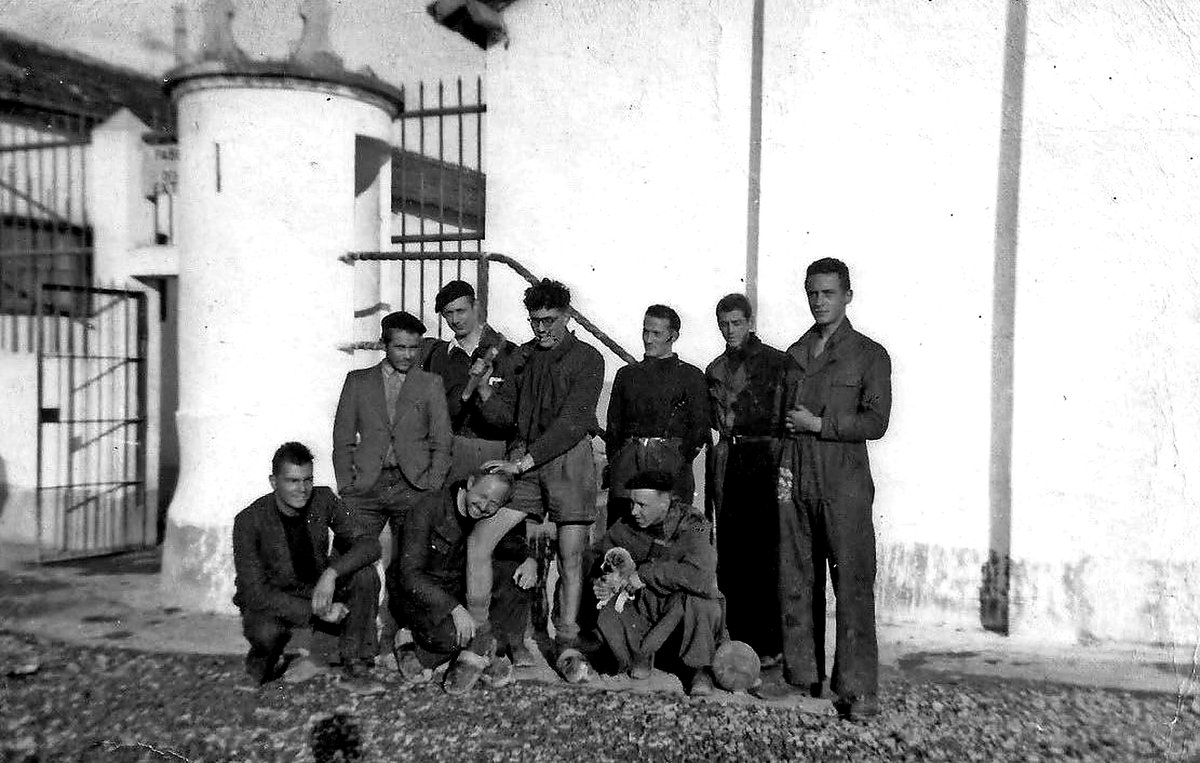
Bernard Tabben was a carpenter with a small building firm of his own. He became involved in resistance work soon after the capitulation. He made contact with the Geuzen group from Vlaardingen but felt it took too many risks, so he formed a small resistance group of his own. Its members were Bert Timmers, Cees Kamstra, Koos Riedijk, Koos Jansen and Wim de Bruin. Together with De Bruin, Tabben kept in touch with, among others, the Stijkel group from The Hague, which in turn was in contact with various other resistance groups that exchanged information.
Because Hoek van Holland was full of German troops from the start of the war, there was always something to be done. The group stole weapons from Germans while they were enjoying themselves at café 'De Harmonie' in the Harmoniestraat, for example, or carried out sabotage. Because of his work, Tabben had an Ausweis, a special pass that gave him access to German sites. He sometimes played chess with a Luftwaffe soldier in a room where military maps hung on the walls, and photographed them whenever the opportunity arose. As well as the photographs, the men also passed on details of German defensive positions.
In the spring of 1941 both the Geuzen group and the Stijkel group were rounded up by the Germans. The Hoek van Holland group felt things were becoming too dangerous and decided to escape to England.
On the night of 2 to 3 August 1941 the six set off from the Krimsloot in a small sailing boat, with documents on the defensive positions in a suitcase. They also had a pistol that they had stolen from a soldier in a café in Hoek van Holland. On the Nieuwe Waterweg they passed a Kriegsmarine vessel. A door opened and light fell on them, but they were not spotted. The weather was bad and they quickly tired from rowing. When day broke they had not got very far – they could even still see the lighthouse at Ouddorp. They were soon sighted by a vessel of the Hafenschutzflotille (harbour defence flotilla); carefully, they lowered the pistol and the suitcase of incriminating material over the side.
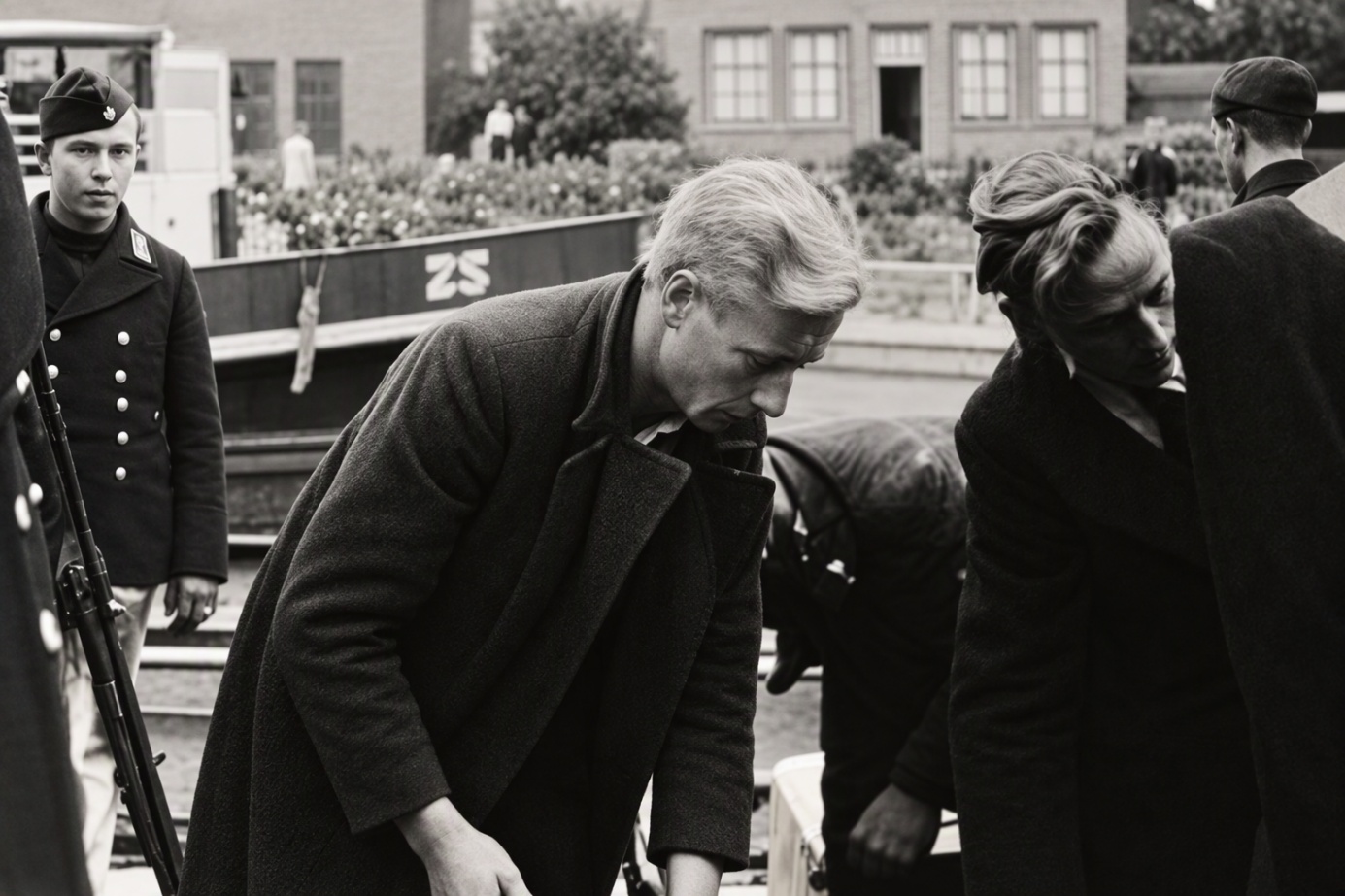
On board, one of the sailors, Karl Hinterkopf, recognised Kamstra. In the bakery where Kamstra worked, people often listened to English radio when there were no customers, and because Hinterkopf was a communist and opposed to Hitler, he sometimes listened in. Now he said: "Sadly, there’s nothing I can do for you". He did, however, take a series of photographs of the men as they were made to lie on the deck. He later gave these to Kamstra’s parents.
The men were briefly held for questioning in the Fort aan den Hoek van Holland and were then taken to the Oranjehotel prison in Scheveningen. Their trial before the Kriegsmarinegericht (naval court martial) followed in September, where they heard their sentences. For leaving the country without permission and theft, Bernard Tabben was sentenced to four years’ penal servitude; the others received shorter sentences.
These sentences were reviewed on 30 April 1942. It had emerged that shortly after Tabben’s last game of chess with the Luftwaffe soldier, military maps had disappeared from the room in question. Suspicion for the theft fell on Tabben. He and De Bruin were now sentenced to death for aiding the enemy and theft, while the others were given heavier sentences.
Timmers’s sister then took 4,000 guilders, given to her by Tabben’s mother, to the office of the Wehrmachtbefehlshaber in den Niederlanden (Wehrmacht commander in the Netherlands), General der Flieger Christiansen. It is not known whether she spoke to Christiansen in person, but in June he commuted the death sentences of Tabben and De Bruin to life imprisonment with penal servitude.
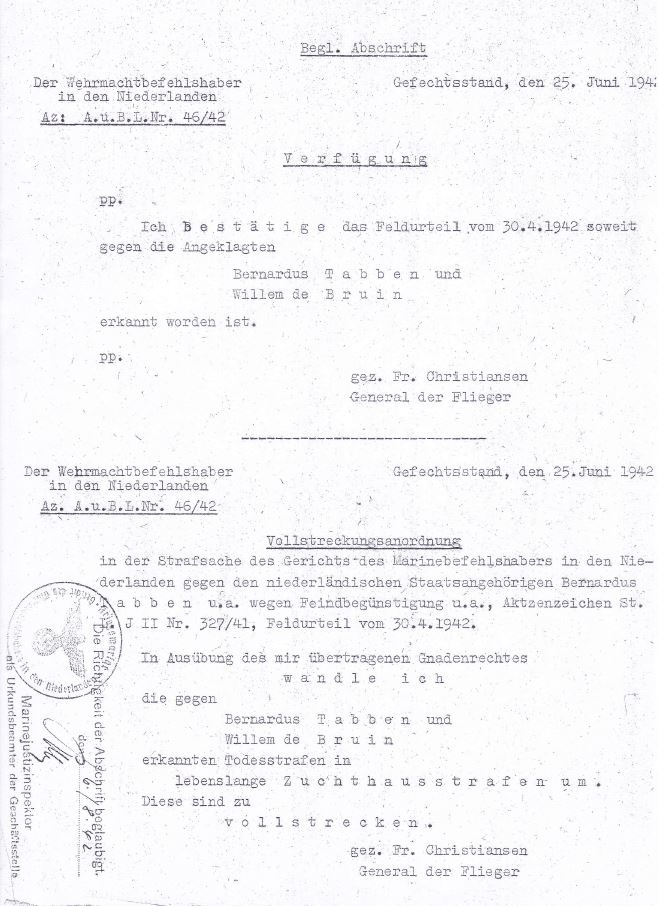
Tabben and De Bruin were sent to Zuchthaus Rheinbach prison, where De Bruin died in 1943. The others were sent to various camps and prisons. After the war only Tabben, Kamstra and Timmers came home. Riedijk died in Auschwitz in 1944, and Jansen in Neuengamme that same year.
After the German capitulation, Tabben made his way back to the Netherlands via France. He resumed his carpentry business, married and had seven children. In 1959 illness forced him to stop working, and he and his wife moved to Rucphen, where he died at the age of 63. Shortly before his death he was awarded the Resistance Memorial Cross. He was buried in Rucphen. When his wife died in 2016 and was buried in Hoek van Holland, his remains were transferred and laid to rest beside her in the Catholic section of the cemetery.
Sources
Photographs and information were provided by Cees Kamstra and M. Tabben-Mol
Article in BN de Stem
Dirk van den Burg, manuscript Hoek van Holland gedurende de Tweede Wereldoorlog.
H.J. Nijland and L. van Ooijen, Van Niet tot Iet
Judgment of the Gericht des Marinebefehlshabers in den Niederlanden in Utrecht
This story is reproduced with the authors’ permission from the website Hoek van Holland in oorlogstijd.