April 2026 saw the publication of De Soldaat van Oranje ontmaskerd. Leugens, slachtoffers en geheimen (The Soldier of Orange unmasked: lies, victims and secrets), a critical book about “Engelandvaarder” Erik Hazelhoff Roelfzema by forensic investigator Petra Alkema. The expected uproar duly followed: full-page articles in several national newspapers and a storm of reactions on social media drove sales, yet the institutions remained conspicuously silent.
In an interview with NPO Radio 1, historian Wim Berkelaar observed that bodies such as the NIOD, the Dutch Institute for War, Holocaust and Genocide Studies, seemed to duck out of sight when asked to comment. That was striking, given that this concerns the national epic of the resistance. Surely enough is known about the Soldier of Orange, suddenly a stumbling block, to give him the benefit of the doubt. Critical voices had been heard for some time, but they never dented his standing as a war hero and writer. It was the writing that had now proved his undoing, at least if we take Petra Alkema’s closing line seriously: ‘One of Erik H.R.’s better stories was that when a little boy told him he wanted to be a war hero and asked how to become one, he replied: “you have to become a good writer.”’ It reminded me of a book I recently read by the French writer Jean-Noël Orengo, You Are the Führer’s Unrequited Love (I read it in English), which clearly shows how Albert Speer successfully presented himself after the war as a naive artist who knew little of politics, with such aplomb that everyone came to see him as a victim. It made me think of Erik Hazelhoff Roelfzema, whose book suddenly made him the foremost war hero. It is all about image building.
The two most famous stories about the Netherlands in the Second World War are The Diary of Anne Frank and Soldier of Orange. But while the first lies under the scholarly microscope, making and breaking the reputations of ambitious researchers, fiction seems to have free rein with Soldier of Orange; think of the film and the musical of the same name. The result is a story cut loose from historical reality that has been able to take root unhindered in the collective memory. But is that Erik Hazelhoff Roelfzema’s fault? De Soldaat van Oranje ontmaskerd neither asks nor answers that question. Nor is it a biography that dwells at length on its subject’s development and asks who Erik really was. The book’s significance lies in the blind spots in Soldier of Orange, quite apart from the inconsistencies between the versions rewritten under different titles. That leaves the reader with a problem: which version is true?
Hanging De Soldaat van Oranje ontmaskerd on a handful of rightly critical questions unintentionally gives it the air of a witch-hunt, but that does the book an injustice. Petra Alkema was so puzzled by the inconsistencies in Erik’s story that she drew on her experience as a detective to launch an investigation, and reached damning conclusions. At key moments in Soldier of Orange, such as Professor Cleveringa’s famous speech and the writing and distribution of the Leiden Manifesto, Erik manages to claim the events for himself and bend the narrative to his will time and again. And what of his resistance work? According to the author he never truly belonged to a group, although he did seek to join in, more or less forcing himself on others whenever a crossing to England was being prepared. What is convincingly exposed as a lie is the length of his imprisonment in the Oranjehotel: Erik manages to stretch it to a month, when in reality it was three days at most. In passing, Alkema plays down the very notion of “resistance”. In her view the various failed attempts to cross to England were not real acts of resistance, though many a self-respecting “Engelandvaarder” would disagree: they wanted to join the Allies in order to fight, which is not the same as fleeing.
Less innocent is the suggestion that Erik Hazelhoff Roelfzema worked for the Abwehr, German military intelligence. According to one “Engelandvaarder”, he left aboard the St. Cergue, bound for New York, ‘with consent’ from the Germans. The same was true of Peter Tazelaar, by the way, because like Erik he held a seaman’s book and was therefore allowed to sail, and the United States was not yet at war with Germany. In my view too much weight is placed on that ‘with consent’, and nowhere in the book is it shown that Erik worked for the Abwehr, though that need not stop you from keeping an open mind about such a reading. Alkema argues sharply that appearances were against Erik.
On rereading, I did put some of the sources to the test. I recently requested an MI9 report cited in the book from the National Archives in London: contrary to what Alkema writes, Erik did provide valuable information when questioned at the Royal Victoria Patriotic School, including on German troop strength around Leiden and military manoeuvres in the dunes between Wassenaar and The Hague. I also recently found interesting information about Erik in a file on one of his acquaintances, the Hague restaurateur and film-maker Henk Alsem. Alsem claimed to have known Erik before the war and does seem to count him as a member of a resistance group, namely the small group Alsem himself set up in November 1940 after the arrest of Lodo van Hamel. A mutual friend, the resistance man Jean Mesritz, had told Alsem all about Lodo’s arrest when they met in the Oranjehotel. According to Alsem, Erik also knew that he had been friends since before May 1940 with a British secret agent living in Wassenaar, Captain Jerry Wright, who was later hunted by the Gestapo. Alsem further claims that it was he who pointed Erik to the ship St. Cergue in the port of Schiedam. I believe there is much more to discover about Erik’s first months of the war, but that would mean bringing the run-up to the occupation into the research and analysing his social network in greater depth. On closer inspection, I also noticed that Erik’s statement is missing from the CABR file on Poos and Slagter (the archive of post-war collaboration cases): it has been torn out. That might bear out Alkema’s suggestion that Erik tried to erase certain traces after the war, old-fashioned sanitising. If so, it failed, as the passage Alkema quotes comes from a duplicate that is open to the public.
After his arrival in London the story deepens. Erik finds his way to Queen Wilhelmina and, having wheedled the original plan out of its author, fellow “Engelandvaarder” Bob van der Stok, embarks on the secret landing operation Contact Holland. That wheedling caused quite a stir, and it seems very likely that Erik was guilty of it. Alkema describes the cooperation between the Queen, Prince Bernhard, her private secretary Van ’t Sant and the young “Engelandvaarders” as an anti-democratic “kongsi”, an Indies word for a gang. That idea runs like a thread through the rest of the book: Erik is no longer the possible Abwehr agent but a hyper-nationalist, colonial-minded right-wing diehard with his own idea of freedom. A fascinating notion in itself, which calls for closer psychological interpretation: what drove him? As it is, he comes across as a grandiose narcissist or a fantasist. The book never says so in as many words, as it lacks a thorough analysis of his childhood and upbringing. Personally, I find the idea of a kongsi quietly settling all kinds of important military matters outside parliament overdone, not least because the outlook in 1941 was far too bleak for fantasies of power in the near future. The Dutch in London had little say and were glad enough to be able to contribute at all. Operation Contact Holland would never have got off the ground without the British, let alone that they would hand control to a 23-year-old Dutch lad. That Erik was allowed to carry a document stating that he was responsible for carrying it out mattered for getting things done in the lower reaches of the bureaucracy; I find that understandable and typical of the rather experimental nature of the operation. Typical of MI6, too: when you work with foreigners, you keep things loose, no strings attached if it goes wrong, as with Claude Dansey’s pre-war Z Organisation.
The book extends the line to Erik’s post-war work with the CIA, and here too the tone is accusatory, as if it were something he should not have done. Yet you can also see it as an understandable step: the Cold War had begun and the threat of a Russian occupation was real. The Netherlands came out of the war badly damaged and needed every bit of help to get back on its feet, and it was thanks to the Americans that it did. I agree with the author that it fitted Erik’s colonial agenda: he was a fierce opponent of the Indonesian president Sukarno and would gladly have kept part of the archipelago. In the long run, the CIA’s operations in Indonesia led to Sukarno’s fall and regime change in favour of Suharto, which ultimately cost hundreds of thousands of lives. It would be interesting to find out what Erik thought of the massacres ordered by the CIA’s puppet Suharto.
I was irritated, incidentally, by the label “victims” for the people who lost their lives directly or indirectly as a result of Contact Holland. They were victims not of Erik but of the Germans, and they knew in advance the risks of resistance work, so portraying them as helpless victims is somewhat disrespectful. The claim that Erik, in London, could have known the consequences of the arrest of Schimmelpenninck, head of the OD resistance organisation, and should therefore have called off the operation rests on a doubtful assumption: it ignores the widely felt need for intelligence from the Netherlands, the only country in occupied Europe that was a blind spot for MI6. Alkema holds Erik personally responsible for the failure of Contact Holland and believes he did not deserve the Military William Order, the highest Dutch decoration for bravery. There too I disagree. Early in the war most intelligence operations in occupied territory ended badly, but they laid the foundations for an ever more effective network that hastened the liberation. Such operations are long-term by definition, with losses and gains constantly weighed against each other. That was possible thanks to the boundless energy and tenacity of people who, like Erik, were only small links in the chain but who, groping in the dark, did what they could to end the occupation. So it was with Contact Holland: it laid the groundwork for the widely acknowledged successes of later intelligence groups such as Groep Kees and Packard. Doing nothing was not an option.
I am glad there is finally a debate about the Soldier of Orange. He is a sacred cow, and you should be able to take a kick at one, especially when there are doubts about how true the story is. I find it telling that Petra Alkema was refused access to his personal archive: it betrays a defensiveness among those who manage it. Here Erik’s own message is still relevant: never be discouraged; if one way fails, try another. We now await the authorised biography of Erik Hazelhoff Roelfzema, announced years ago. 2027 marks twenty years since his death, perhaps a good moment to set the record straight.
De Soldaat van Oranje ontmaskerd. Leugens, slachtoffers en geheimen, by Petra Alkema. Bertram + De Leeuw Uitgevers (2026), ISBN 9789461563545. In Dutch.
Photos: private archive of E. Taylor-Tazelaar
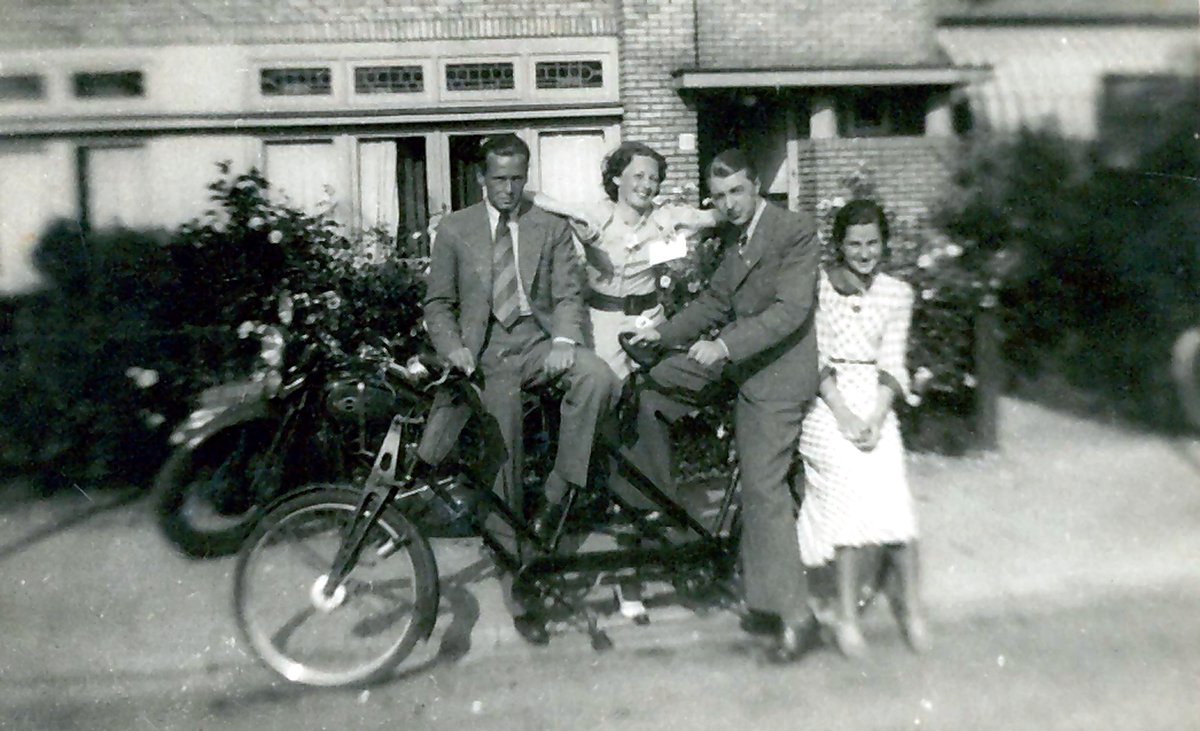
Unknown photos of Erik Hazelhoff Roelfzema come to light
Resistance heroine Sabine Zuur (1918-2012) was already friends with “Soldier of Orange” Erik Hazelhoff Roelfzema before the war. They belonged to a circle of friends from The Hague and Wassenaar who often went sailing and cycling together and enjoyed the nightlife of Scheveningen. That went on for a short while after war broke out, but one by one they were soon drawn into early resistance work. The album also contains photos of Jean Mesritz, Gerard Vinkesteijn and Broer Moonen, resistance members who were later arrested and executed. Sabine herself survived the Ravensbrück and Mauthausen concentration camps and after the war married “Engelandvaarder” and secret agent Peter Tazelaar. Her daughter Eva wrote about her war experiences in the book Sabines oorlog (Sabine’s War).