Once in England, some “Engelandvaarders” ended up in highly unusual roles. One of them was Bubi Gelissen, whom the US Army sent to Austria as an agent and wireless operator.
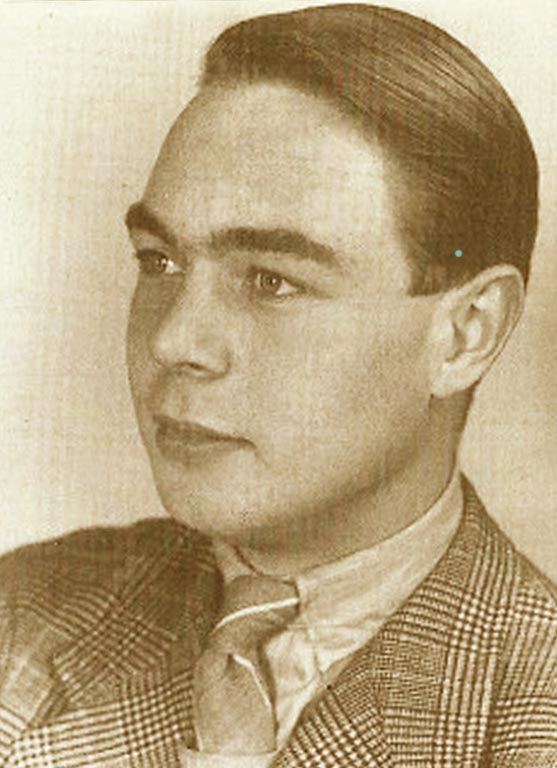
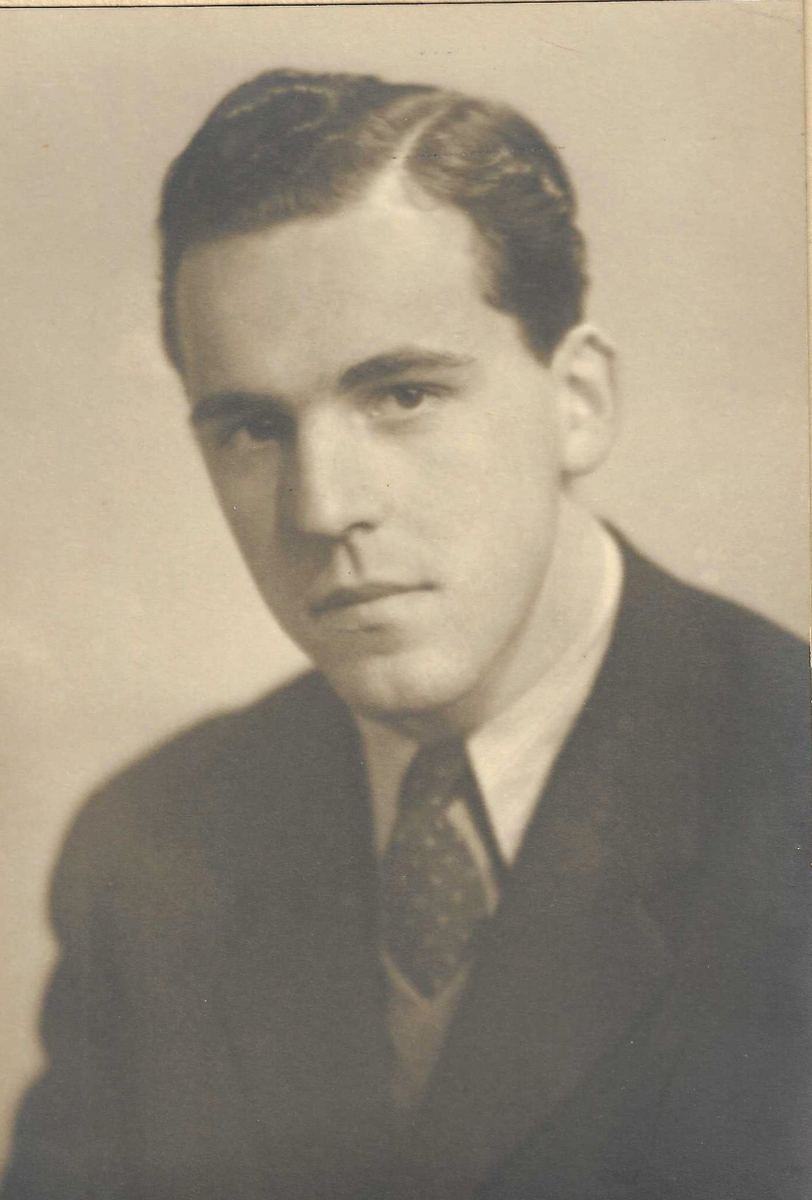
Gerard Bernard Henri ‘Bubi’ Gelissen was born in Voorst in 1922, the son of a Minister of Economic Affairs in the second Colijn cabinet. He owed his nickname, Bubi, to his German nanny. After passing his HBS-A school-leaving exams in 1941 he went to university in Amsterdam. He refused to sign the declaration of loyalty to the occupier and from around March 1943 went out to work instead; thanks to his father, he soon found a job.
As rumours of compulsory labour in Germany grew ever louder, he decided to make his way to England via Sweden. Having initially been turned down for lack of experience, he eventually managed to obtain a seaman’s book, which allowed him to sign on with the SS Rijn for a voyage to Finland.
The ship left Delfzijl on 2 August 1943. Together with fellow crew member F.T. Stuvel, he had already made up his mind to jump overboard after the change of pilot off Dalarö on the Swedish coast and swim to Sweden.
Deserting ship in Sweden
In the end, at around one in the morning, six young men jumped from the ship: Gelissen, Stuvel, J.W. Kreumer, J.L. van der Weyden, J. van Dijken and Menne Mulder. The others had refused to take Mulder along because he could not swim, but with a stoker’s help he threw a few of the ship’s hatch covers overboard with his clothes on top and then leapt in after them wearing a life jacket. A Swedish yachtsman later picked him up from his makeshift raft and transferred him to a pilot boat, which brought him ashore.
After swimming for about a quarter of an hour, the five swimmers came ashore near Dalarö, where they found a summer cottage with its door open. They stripped off their wet clothes and hung them up to dry, at which point a 15-year-old occupant woke up; he was startled but let them be. They stayed until six in the morning. At half past five they saw the Rijn sailing back, and the sight alarmed them so much that all five tried to get away as fast as they could, Gelissen first.
They eventually managed to call a taxi to take them to Stockholm, but some 20 kilometres short of the city a police patrol spotted them and arrested them. They were questioned at the police station and held in a cell for three days. Mulder, the non-swimmer, turned up at the same police station a day after their arrest. On 12 August 1943 all six finally reached the Dutch Consulate General in Stockholm. There they were all thoroughly interrogated and then put to work in the Swedish forests.
Agent and parachutist
In October 1943 Gelissen was posted to the press department of the Dutch Legation. Through this work he got to know the tasks of the Bureau Inlichtingen (Intelligence Bureau). They appealed to him, so he volunteered to serve as an agent and parachutist. Soon afterwards he was able to fly to England, arriving on 11 August 1944.
There followed the usual interrogations, first by the British security service and then by the Dutch Politie Buitendienst.
The Bureau Inlichtingen in London lent him and a few others to the US Army’s ‘Secret Intelligence Branch of the Office of Strategic Services’. The Americans trained him and his comrades as agent-parachutists. Their commanding officer was Jan Laverge, an American captain of Dutch descent.
The original plan was to drop Gelissen near Kassel. That fell through, as did drops at several other locations, for a variety of reasons: the weather was unsuitable, or the situation at the front would not allow it. In the end, on 24 April 1945, Gelissen, alias Bernard Gerritsen, and his comrades W.G. ‘Bill’ Visser, alias Schepers, A.N.A. ‘Anton’ Puntman, alias Pompe, and C. ‘Kees’ de Vries, alias Kees van Daalen, were dropped onto an Alpine meadow at an altitude of 1,200–1,300 metres near Kufstein in Austria. All four were in civilian clothes.
About a month earlier a few Belgians had been dropped at the same spot. They had made contact with a number of Austrian deserters and formed a small group with them. The area to be covered was too large for the Belgians, however, so they had asked for reinforcements.
Intelligence work in Austria
The plan was for Gelissen and Visser to operate as one team (Operation Virginia) and Puntman and De Vries as another (Operation Georgia). Gelissen and Visser had orders to go to Innsbruck, from where they were to radio back what they learned about the remaining German troops: their strength and armament, the positions of anti-aircraft units, which bridges had or had not been blown, and any other information of military value.
Gelissen and Visser could not reach Innsbruck, however: there was no transport, and going on foot was too dangerous with so many German soldiers in retreat. They got only as far as Kufstein, with the help of the ‘Belgian group’, which also found them lodgings with a butcher. Their American superiors gave them permission to carry out their tasks from there.
In this work they were helped by various German and Austrian deserters and ‘partisans’. One supplied information on the Brenner Pass, another on the bridges over the River Inn. Their powers of persuasion also enabled them, for example, to dissuade the partisans from attacking German troops; with liberation so close, they were convinced it would only provoke vengeful German soldiers into a massacre of the local population.
Gelissen sent the messages to London, while Visser acted as the ‘observer’ who gathered the information; he did not know Gelissen’s codes. They transmitted twice a day for some 15 to 20 minutes. In Kufstein they passed themselves off as foreign workers (Fremdarbeiter), with the papers to match. It must have been largely due to the chaos of the German retreat that they were never caught transmitting or arrested for any other reason.
Puntman and De Vries were likewise unable to reach their assigned destination, Zell am See, and settled instead in Kitzbühel, where they too set about their tasks.
After the Americans occupied Kufstein on 5 May 1945, Gelissen and Visser reported to the divisional intelligence section. After an initial debriefing they were able to pass on several further items of importance and hand over a range of weapons. Once an armistice had finally been concluded, Gelissen tried to drive to Maastricht, where his parents lived, in a requisitioned German car. Near Aachen, however, he was stopped and taken back to Wiesbaden, where he was put in a camp with German prisoners of war and interrogated by the Americans. He gave his American interrogators his password, and after they had checked with the OSS he was released and could continue his journey home to Maastricht. He then travelled to London to report on Mission Virginia and to sign off. His colleague Bill Visser had also set out for the Netherlands, separately from Bubi Gelissen, but at first got no further than Heidelberg; with the help of the OSS he flew to London.
After the war
In mid-June 1945 Gelissen was honourably discharged from the Bureau Inlichtingen. His American commanding officer, Jan Laverge, wrote of him: “He has volunteered for hazerdous missions in the fulfilment of which he demonstrated exceptional courage, resourcefulness, and integrity”. He died in Oosterbeek on 29 December 2004.
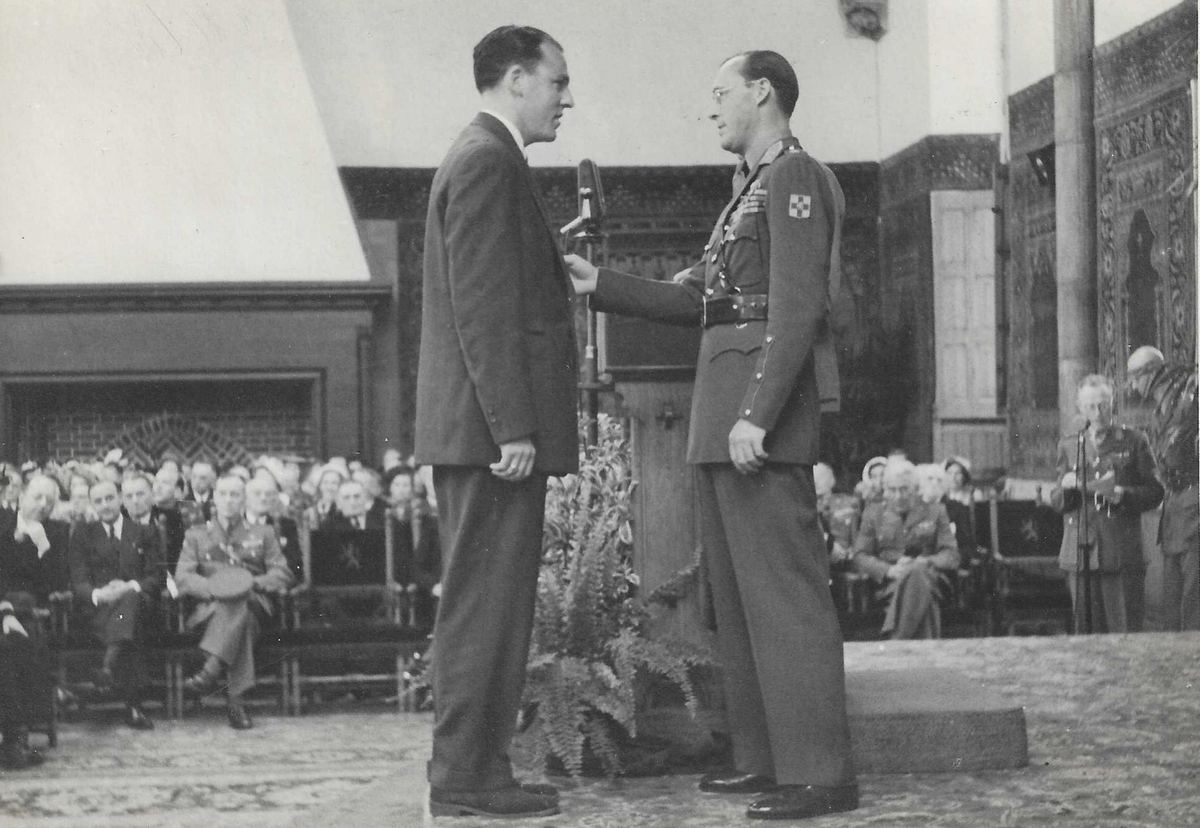
After the war Bubi Gelissen was awarded the Cross of Merit, the Bronze Cross and the US Bronze Star Medal.
Sources:
- Museum Engelandvaarders: file on G.B.H. Gelissen.
- Nationaal Archief, The Hague: archives of the Ministerie van Justitie Londen (2.09.06); archives of the Ministerie van Justitie, afdeling Politie – Kabinet en Juridische Zaken (2.09.107); archives of the Ministerie van Oorlog Londen (2.13.71); archives of the Bureau Nationale Veiligheid 1945-1946 (2.04.80); archives of the Commissie Militaire Onderscheidingen (2.13.184); archives of the Gezantschap Zweden (2.05.219) and the Consulaat-generaal Stockholm (2.05.221).
- National Archives, College Park, MD, USA: OSS archives; with thanks to Harold Jansen.
- F.A.C. Kluiters, De Nederlandse inlichtingen- en veiligheidsdiensten, The Hague 1993; idem, Dutch Agents 1940-1945, version 2008-2, at: www.nisa-intelligence.nl