The Regeringsvoorlichtingsdienst (Government Information Service)
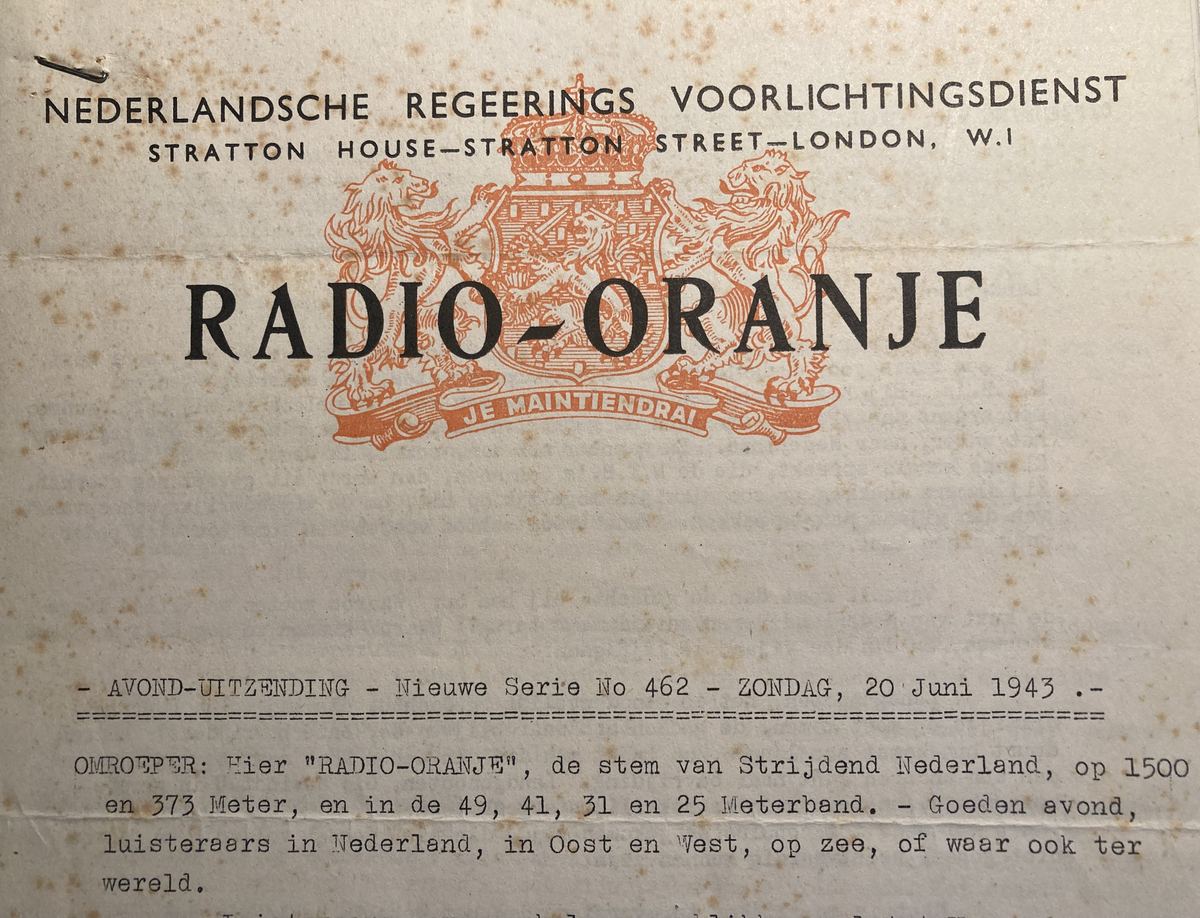
Bierens de Haan would have preferred to make himself useful in England as a soldier, but shortly before he left, doctors had told him that his heart was in very poor condition. The army was therefore ruled out for him. As a result he had – gnashing his teeth – to work as a civilian. Because of his experience with economic propaganda, a place was found for him at the Regeringsvoorlichtingsdienst (RVD, Government Information Service), which, like many ministries, was based in Stratton House.
The RVD, set up in May 1940, had – as its name suggests – the task of providing information about the Dutch government in London (including the Royal House), which was no longer neutral but had sided with the Allies. The RVD, headed by Adriaan Pelt, was responsible for, among other things, Radio Oranje.(1)
The government broadcaster had a threefold task:
1. To restore contact between the Dutch government in exile and the Dutch people
2. To counter German propaganda
3. To strengthen the morale of their compatriots
When the Dutch government then asked the BBC for airtime, the corporation was not very forthcoming at first. In June 1940, however, the Netherlands was nevertheless allocated airtime, the only one of the foreign governments in London to receive it, probably because the Netherlands had a colony (the Dutch East Indies) that supplied raw materials important to the war effort. The Netherlands was given a quarter of an hour of airtime a week.
When Bierens de Haan arrived in England in August 1941, Radio Oranje was headed by Jan Willem Lebon of the SDAP (the Social Democratic Workers’ Party), one of the founders of the broadcaster VARA and an important broadcasting executive. The broadcasts in this period were not of an exceptionally high standard. There were several reasons for this. For one, Radio Oranje’s supply of information was downright poor. Because there was no contact with the occupied territory, people did not really know what was happening there and were cut off from current news.
Another reason was that the texts of the broadcasts were strictly checked by four ministers, who saw them as a kind of government statement. This made the language stilted, dull and uninspired. Typical of this was, for example, the rather tame sentence that closed every broadcast: “Until tomorrow evening, listeners; all tune in again at a quarter past 8 Dutch time to Radio Oranje”. The closing line for the French-speaking Belgians, by contrast, was: “ Et chaque soir notre voix dit tout proche: Courage, on les aura les Boches!” (And every evening our voice says close by: Courage, we’ll get the Boches!)
A third reason for the poor quality of the broadcasts was that the people who had to make the radio programmes ( Lebon and Louis (Lou) de Jong) had no experience of it whatsoever. Lebon knew a lot about management, but not about making radio. Lou de Jong, who had escaped to England in the May days of 1940 and would later become known as the author of Het Koninkrijk der Nederlanden in de Tweede Wereldoorlog (The Kingdom of the Netherlands in the Second World War), had been a journalist at the Groene Amsterdammer. But he was not a real radio maker either.
Bierens de Haan was deployed as an announcer and made his first “broadcast” on 3 September 1941. From that day on, criticism of Radio Oranje’s broadcasts appeared regularly in his diary. He found the tone at Radio Oranje forcedly optimistic, for instance. That was a criticism many in London (and no doubt in the occupied territory too) shared with him. Germany had the upper hand in this period. To keep listeners’ spirits up, German military successes were set against Allied victories (even if these were on an entirely different front). In this way the bad news was strenuously “explained away”.
Bierens de Haan also wondered why the achievements of, for example, the merchant navy and the escape stories of “Engelandvaarders” could not be mentioned in Radio Oranje’s broadcasts. In his view, it was precisely stories like these that had great publicity value. Another grievance of Bierens de Haan’s was that the request from “Engelandvaarders” to have a kind of agreed code read out during the broadcast, so that they could let their families know they had arrived safely, had still not been granted.
Antisemitism
But his greatest objection to Radio Oranje was personal in nature and shows a truly abject side of Bierens de Haan. It was the fact that many Jews worked at Radio Oranje. Antisemitic remarks run all through his diary. On 10 September 1941, for example, he calls a lunch with his colleague Marcus van Blankensteijn “a tiresome Jews’ lunch” in his diary. He goes on to write: ‘How careful we must be that our entire apparatus is not swallowed up by the Jews. The entire press service has many Jewish staff, a great danger, but because there is nothing better …. They are each clever fellows, but a Jew remains a Jew.’
In November 1941 Vrij Nederland organised a Dutch afternoon, in which Radio Oranje was also included in the programme, without having been asked, incidentally. Pelt, head of the RVD, asked Bierens de Haan to attend and act as announcer. Bierens de Haan refused, because he had no wish to stand on stage with that “Jewish clique”. He did not say this to Pelt, however, because Pelt was married to a Jewish woman.(2)
In the spring of 1942, when “Engelandvaarder” Louis Tas arrived in London and came to strengthen the ranks of the RVD, Bierens de Haan wrote: ‘Tas, who has come from Holland, is also being taken into the RVD. Another Jew.’ These are shocking remarks. They are also surprising, because Bierens de Haan certainly did not get this from home. His mother, for example, did a great deal to help Jews who returned from the concentration camps after the war. Bierens de Haan’s (Protestant) faith may have played a part. Whenever his diary turns to Jews, he consistently sets himself against them as a Christian. But that is of course no excuse.
At any rate, all this shows that antisemitism was widespread among the Dutch, including among those who fought against the Nazis. That too, of course, is no excuse.
The Secret Intelligence Service (SIS)
Without being aware of it, Bierens de Haan had meanwhile attracted the attention of British intelligence. This happened within the space of a few weeks in October 1941, in 2 ways:
1. A conversation between Barthold and several other people in the lobby of his hotel was overheard.
2. A letter from Barthold to his wife Monique was intercepted.
The overheard conversation took place in the lobby of Browns Hotel, where Bierens de Haan was staying. Those taking part were two Dutch ladies, Bierens de Haan and an “Engelandvaarder”, Armand Maassen. Maassen, a student at the Technische Hogeschool Delft (Delft University of Technology), had crossed from the occupied Netherlands to England by canoe with a fellow student on 25 September 1941.
Indignantly, the SIS officer writes: ‘The conversation turned to how Maassen had escaped and full details were given in quite loud voices: the arrival on the beach and how they had to look for someone to report to. The arrival of Dutchmen by plane in England was also freely and loudly described.’ After that there was talk of all sorts of rules on travel and the like, which Bierens de Haan called “stupid nonsens”.
Conclusion:
– Maassen had spoken far too freely about his escape
– The ladies had asked too many questions
– Bierens de Haan had tried to ridicule all the rules and so turn people against the SIS‘.
In the letter to his wife (in French) dated 1-11-1941, Bierens de Haan makes all sorts of antisemitic remarks, just as in his diary. The SIS agent quotes him word for word: ‘My work continues along the same lines. There is a great deal to do. The only thing that is beginning to get on my nerves is that they are all Jews at Stratton House.[….] It is nothing but a Synagogue.
Finally, in his letter to Monique, Bierens de Haan sighed that he regretted coming to England: ‘Up until now, I am sorry I came here. There were a thousand things I could have done for our Cause in Holland, which I can’t do now’ These observations by the SIS were probably discussed with Bierens de Haan. A few weeks later he complained in his diary about the strict censorship and ‘that you can’t say anything at all any more’.
1942: new prospects
In February 1942 Bierens de Haan had a meeting with the new head of the Dutch intelligence service, Colonel De Bruyne. To him Barthold declared himself willing to return to the occupied Netherlands as a secret agent. “Engelandvaarder” and former resistance man W. den Boer, who was also involved with the intelligence service, hinted that he considered Bierens de Haan suitable for this role. On 22 February 1942 Barthold wrote in his diary:
I will now do everything I can to get away from the Press Service. I can no longer reconcile it with myself to pocket the fatherland’s money in Stratton House without really doing anything for it…[….}
To his wife Monique, Bierens de Haan wrote a moving letter in French, in which he tried to explain why, as the father of three children, he had volunteered for the dangerous work of a secret agent:
‘ [….] This war can only be won if everyone involved gives everything for the cause. If you do that, you and your children will have a life of peace and quiet ahead of you. […] Stratton House will go down in history as an example of individual passivity and the centre of intrigue by groups trying to secure a nice job after the war. The upbringing my dear father gave me does not allow me to work with any of them.
[…] When I think of the photographs you sent me, my heart breaks because I know I may never see them (the children, ed.) again. If it is Eric (Monique’s brother, ed.) who brings you the news, tell yourself: He fell for his country in battle, facing the enemy, with you in his heart until his last breath.’
Bierens de Haan matched his words with action and applied for a new medical examination. A month later, on 21 March 1942, came the fateful result: rejected on account of high blood pressure. An additional reason why he was not admitted to secret-agent training was – so he was told – that he had allegedly given away intelligence secrets. This accusation almost certainly referred to the incident of the overheard conversation in October 1941.
It was a bitter disappointment for Bierens de Haan. In the spring of 1942 it was compounded by an enormous sense of guilt, when alarming reports came from the occupied Netherlands about the so-called First OD Trial, in which 72 of the 86 captured resistance members had been sentenced to death. Among them were people Barthold had known. ‘The organisation, all those people we fired up for this work,’ he wrote regretfully in his diary, ‘And here, here people are fighting each other to the death ….’
In early June 1942 there was a glimmer of light. Queen Wilhelmina was well disposed towards the “Engelandvaarders” and wanted to open a clubhouse for these compatriots. She made money available for it from her own funds. A suitable space was found on the ground floor of 23 Hyde Park Place. The flat on the first floor had just been taken by “Engelandvaarders” Peter Tazelaar and Erik Hazelhoff Roelfzema.
On 2 June 1942 (and not on 6 June, as some literature states) (3) Oranjehaven, as the club came to be called, was opened by Queen Wilhelmina together with Prince Bernhard. In his diary Bierens de Haan called the queen “incredible”, because she spoke briefly to everyone with a pleasant informality. He (Bierens de Haan) was later elected to the board of Oranjehaven, incidentally.
Exhibitions
Meanwhile Bierens de Haan was still working, with great reluctance, at the RVD and Radio Oranje in Stratton House. He still found the situation there hopeless. It was whispered that a merger was imminent between Radio Oranje and the very popular seamen’s station Brandaris, which had been launched in May 1941 by the journalist H.J. Broekman (nicknamed ‘de Rotterdammer’, the Rotterdammer) and the writer A. (Bob) den Doolaard (pseudonym of C. J. G. Spoelstra). But for the time being the merger did not happen, according to Bierens de Haan because Pelt, head of the RVD, was not forceful enough to take the decision.
Bierens de Haan did not think himself suited to radio work, nor did he feel like a real journalist.
His heart lay in economic propaganda. He was worried about the Netherlands’ trade contacts that had been lost because of the war. Goodwill had to be built up so that new contacts could be made after the war.
With this vision in mind, he had worked hard to make a name for himself within the RVD in another field, namely exhibitions and lectures. It had begun in the autumn of 1941, when Bolkestein, the Minister of Education, had called in Bierens de Haan’s help with a temporary exhibition about the Netherlands at Harrods in London. In April 1942 he was commissioned to organise an exhibition about the Netherlands in Edinburgh, Scotland. His partners in the preparations were the British Council and the Scottish National Gallery.
To be continued
(1) The following information about Radio Oranje is based on the book by O. SINKE, Verzet vanuit de verte: de behoedzame koers van Radio Oranje (Resistance from afar: the cautious course of Radio Oranje). Amsterdam, 2009
(2) Diary of Bierens de Haan, dated 1-11-1941
(3) H. van der ZEE, R.KOK, E. SOMERS, Londen in oorlogstijd: wandelingen in de voetsporen van Wilhelmina (London in wartime: walks in the footsteps of Wilhelmina). The Hague, 2006, p.51