by Jos Teunissen
Dutch people who reached England during the Second World War could have the cost of their journey reimbursed through the so-called ‘Zeemanspot’ (seamen’s fund).
However, this scheme applied only to those serving in the navy or the merchant navy. The Dutch government in London set it up in 1941, after the British government ruled that Dutch seamen were eligible for payment only if they were in British service or served on a ship ‘sailing in the interests of England’. The scheme was abolished after the liberation.
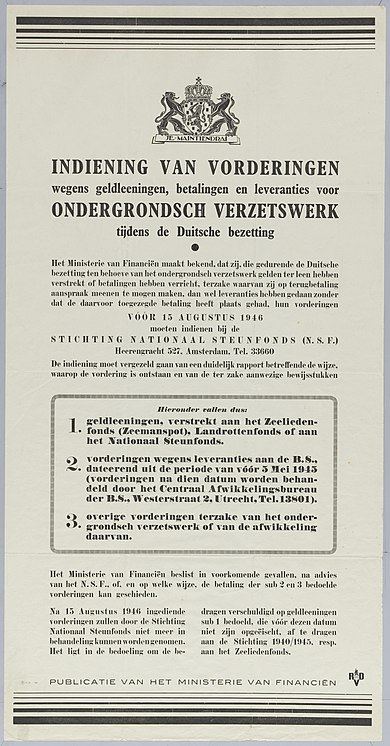
No such scheme existed for those serving in the other branches of the armed forces. In 1947 the government decided to put this right retrospectively through the Nationaal Steunfonds (National Support Fund, NSF). Expenses were in any case reimbursed for all Dutch people who had resisted the German occupier and could show they had incurred costs in doing so, but the “Engelandvaarders” were regarded as a ‘special group’. On 27 February that year the NSF therefore issued a ‘separate appeal’, which read:
‘The Chief of Staff of the Inspector General of the Royal Netherlands Army announces: in order to obtain an overview of the costs incurred by “Engelandvaarders” for their crossing which have not yet been reimbursed, those concerned are requested to send a statement of these costs before 31 March 1947 to the Nationaal Steunfonds, Oosteinde 13, Amsterdam. Efforts will be made to have these costs refunded to them after all.’
Applications had to be accompanied by a ‘detailed report, if possible with statements from persons who can confirm its accuracy, together with a statement of the obligations entered into in connection with the journey’. Because funds were still limited at the time, the scheme was restricted to “Engelandvaarders” who stayed in military service after the liberation and took on new duties in Indonesia or elsewhere.
In all, 162 applications were submitted. Many were investigated, sometimes as far as abroad. According to the fund, the reports gave ‘a remarkable picture of the obstacles those concerned had encountered on their way to the free world’. In the end, a total of 189,853 guilders and 19 cents was paid out.
Source: P. Sanders, Het Nationaal Steunfonds – Bijdrage tot de geschiedenis van de financiering van het verzet 1940-1945. Published by Martinus Nijhoff, The Hague, 1960. Sanders was then a professor at the Economische Hogeschool (School of Economics) in Rotterdam.