Museum Engelandvaarders in Noordwijk recently acquired the diary of the “Engelandvaarder” Barthold Bierens de Haan. Barthold arrived in England in August 1941 and kept a diary from the time he left for England until the end of 1943. The diary is interesting because it sheds a special light on the Dutch community in London, and in particular on the circle around Radio Oranje, where Barthold worked for some time as an announcer.
Before the war
Barthold Willem Floris Bierens de Haan was born in Amsterdam on 10 December 1909. He was born into a well-to-do family: his father was a banker, and his mother was a daughter of B.W.F. van Riemsdijk, director of the Rijksmuseum.
The family counted many merchants and academics. But Barthold had no ambition for an academic career, nor did he become a merchant, although he did take a particular interest in economic propaganda. After his military service he became a tea expert and worked as such in England and in the Dutch East Indies.
After that – and this is where the economic propaganda comes in – in 1937 he was director of the Dutch East Indies section of the World Exhibition in Paris. In 1938 we find him back in the Dutch East Indies as secretary to Governor-General A.C.D. de Graeff, responsible for economic propaganda in the United States.
This no doubt led to his next post, in 1939-1940, when Barthold was general manager of the Dutch pavilion at the World’s Fair in New York.
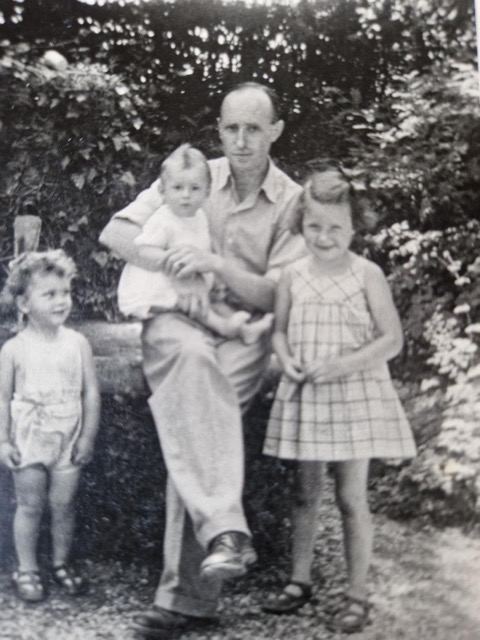
Meanwhile Barthold’s personal life had also prospered. In 1933 he had become engaged to the Swiss Monique Alice Barbey. They married a year later, which gave Monique Dutch nationality. Three children followed: Valérie (1935), Jack (1938) and Barthold (1940).
“Engelandvaart”
When the Netherlands was occupied by the Germans in May 1940, Barthold was working at the Ministry of Economic Affairs in The Hague. His wife was staying with the children in Switzerland at the time, where her parents lived.
Barthold became involved in the early resistance. It is not entirely clear which organisation he had joined. Given his military background it could well have been the Ordedienst (OD), an organisation of (former) professional soldiers and conscripts whose aim was to keep order in the power vacuum that would arise after the liberation. But this is not certain.
Later, in London, Barthold stated that it had become increasingly clear to him and other resistance people that contact with the Dutch government in London was essential to carry out their plans.
Together with three other leading resistance figures of the time, Barthold formed the so-called Commissie van Vier (Committee of Four). This little group decided that one of the four should go to London. As Barthold had a wife living in neutral Switzerland, he was seen as the obvious person to escape to England.
Monique pretended to be ‘seriously ill’, and soon doctors’ certificates arrived from Switzerland to back this up. On that basis the Germans gave Barthold permission to go to Switzerland for ten days to visit his “sick wife”.
He left the Netherlands on 20 June 1941 and arrived in Switzerland without any trouble on 22 June. There Barthold went underground, while the Dutch envoy in Bern passed information about him on to England and arranged his papers for onward travel to Portugal. Someone who no doubt helped with this very gladly was Barthold’s brother-in-law, Eric Barbey, who worked at the Swiss legation in London and regularly travelled back and forth between London, Switzerland and Portugal.
On 13 August 1941 Barthold said goodbye to his wife and children and began his journey to England. He carried a diplomatic passport with the title “Sécretaire de Légation” and had grown a moustache to look older than his 31 years. He had been urged not to let the passport out of his hands, so that it could not be examined more closely, because then he might be found out.
From Annemasse he managed to get a place in an escorted convoy of German Jews bound for Portugal. At the French border the passports were checked by Germans in plain clothes. Barthold went off to smoke a cigarette with a customs officer and deliberately kept his distance. Being last, he was no longer paid any attention, and his passport was stamped without further German checks.
From there he went by train to Cerbère and then on to Port Bou, on the Spanish border. Here all passports were taken in.
Barthold, however, held on tight to his diplomatic passport and, together with a few other travellers who had such passports, managed to get onto the express train to Barcelona in time. After a long journey he arrived in Madrid the next day. From there he took the night train to Portugal.
The Venezuelan diplomat with whom Barthold had been travelling for some days came to his aid at the passport check by slipping the Dutchman’s passport between his own and his wife’s. As a result all the passports were taken to be fully diplomatic and were stamped without further checks.
While other “Engelandvaarders” had to wait months in Lisbon for onward transport, Barthold’s stay there lasted only two days. Then, through the intervention of the Dutch envoy, F.C.A. Baron van Pallandt, who gave him priority, he was able to leave by plane. On 20 August 1941 Barthold Bierens de Haan arrived in England. His entire “Engelandvaart” had taken exactly two months.
Disappointment
From the start of the war it was customary for people arriving in the United Kingdom from outside to be questioned, first by the British security service and then by the security service of the Dutch government in London. This was done to unmask any German spies among them.
Strangely enough, no such interrogation of Barthold can be found in the archives. There are, however, handwritten notes showing that he was indeed questioned closely. They also show that he reported at length on the underground organisations that had sent him to London. That, after all, was the purpose of his journey to England!
Barthold talked at length about the Ordedienst (OD) (although the group was not yet known by that name), the Legioen Oud-Frontstrijders (LOF), which had merged into the OD after most of its members were arrested, the Geuzen (described by Barthold as poorly and naively organised) and the relatively new, small group Vrij Nederland. Naturally he pressed hard for the absolute necessity of radio contact with the occupied Netherlands. In fact the Dutch security service was convinced of this too.
The group Contact Holland (made up of Hazelhoff Roelfzema, Tazelaar and Krediet), which was in close touch with Queen Wilhelmina and her secretary Van ’t Sant, was at that very moment (autumn 1941) even preparing a raid on the Dutch coast in which secret agents with transmitters would be landed.i But that was secret information and was of course not shared with Barthold. He was therefore left feeling somewhat dissatisfied with the interview. On 22 August 1941 he wrote in his diary:
‘I have the feeling that the cause of our organisations is only half taken seriously. I begged to be allowed to make contact. In Holland everything depends solely and entirely on having contact with England [….]’
A little over a week later, Barthold’s frustration with the official sluggishness and bureaucracy in London, which in his view killed off every initiative there, had grown so much that he wondered whether he had been right to come to England at all:
‘Again and again I have to ask myself: what are you actually doing here? Wouldn’t I have been much better off staying in the homeland, where the fighting is? A dreadful feeling creeps over me. A feeling of having betrayed and abandoned my friends in the organisation.
These feelings prompted Barthold to send a letter to Vrij Nederland, the weekly published in London. It was a hard-hitting letter, published on 6 September 1941 under the headline “Een manende stem van een uit het vaderland gevluchte” (A voice of warning from one who fled the homeland).
In an introduction, the editors wrote that a ‘peculiar mood’ prevailed among those who had come over from the Netherlands. Burning feelings, it said, had led them to decide to make a dangerous journey to England. And then in London there was much to disappoint them. That was why the paper had decided to publish the letter. The men who had risked their lives for the good cause were entitled to that.
Barthold begins his letter by describing the sense of solidarity ‘that gives our people the strength to brave everything’, which also helps them leave behind the petty past of feeling slighted or passed over. Is that also the case in London? The answer is clear: no.
He denounces the feeble attitude of some in the Dutch community in London, the pre-war indolence, and the disastrous tendency always to find excuses for German crimes.
What the people in Holland sorely miss, he argues,
‘[ …] is a radiating strength from London, showing us that more is happening than just general housekeeping matters. How is it that so many who risk their lives to come to England curse the day they came, after a while? Why do those young men feel their enthusiasm has been betrayed? [….] How is it possible that Dutch flying officers who have arrived here wander about at their wits’ end after five weeks of waiting, without anyone having been able to offer them suitable work?’
The criticism in this article did not win Barthold any thanks. In official circles especially, people felt he had washed the dirty linen in public. But he himself was pleased with it – all the more so when, on 15 September 1941, he was invited for coffee with Queen Wilhelmina and discovered that Her Majesty thought the same about her government as he did. That evening Barthold wrote in his diary:
‘ [….] She (the Queen, ed.) senses so well what is going on here, she senses so well the feebleness and selfishness of those who now sit in their chairs and look forward longingly to the moment when they will go down in history as the liberators of the homeland. How little spirit of sacrifice there is in those men.’
In those first weeks Barthold regularly writes in his diary that he has been brainstorming in the pub with friends and that they agreed that, for lack of good, combative ministers, ‘people would just have to be brought over from the occupied Netherlands’. Great, then, was his surprise when, on 19 September 1941, Barthold was summoned by the Queen’s secretary, Van ’t Sant, and asked whether he would draw up a list of politicians who, in his view, ought to come over.
‘My first thought’, Barthold writes in his diary that evening,
[.…] goes to Wiardi Beckman. Then, if possible, Colijn, though he is already old, and third, the commander of the marines, Freitag Drabbe. [….] Trip is also a man of authority.
To be continued.
i: See Archive of the Ministry of Justice, London. inv. 2.09.06-1468 Letter from the head of the CID to Rabagliati dated 23-8-1941.