Book review by Agnes Dessing
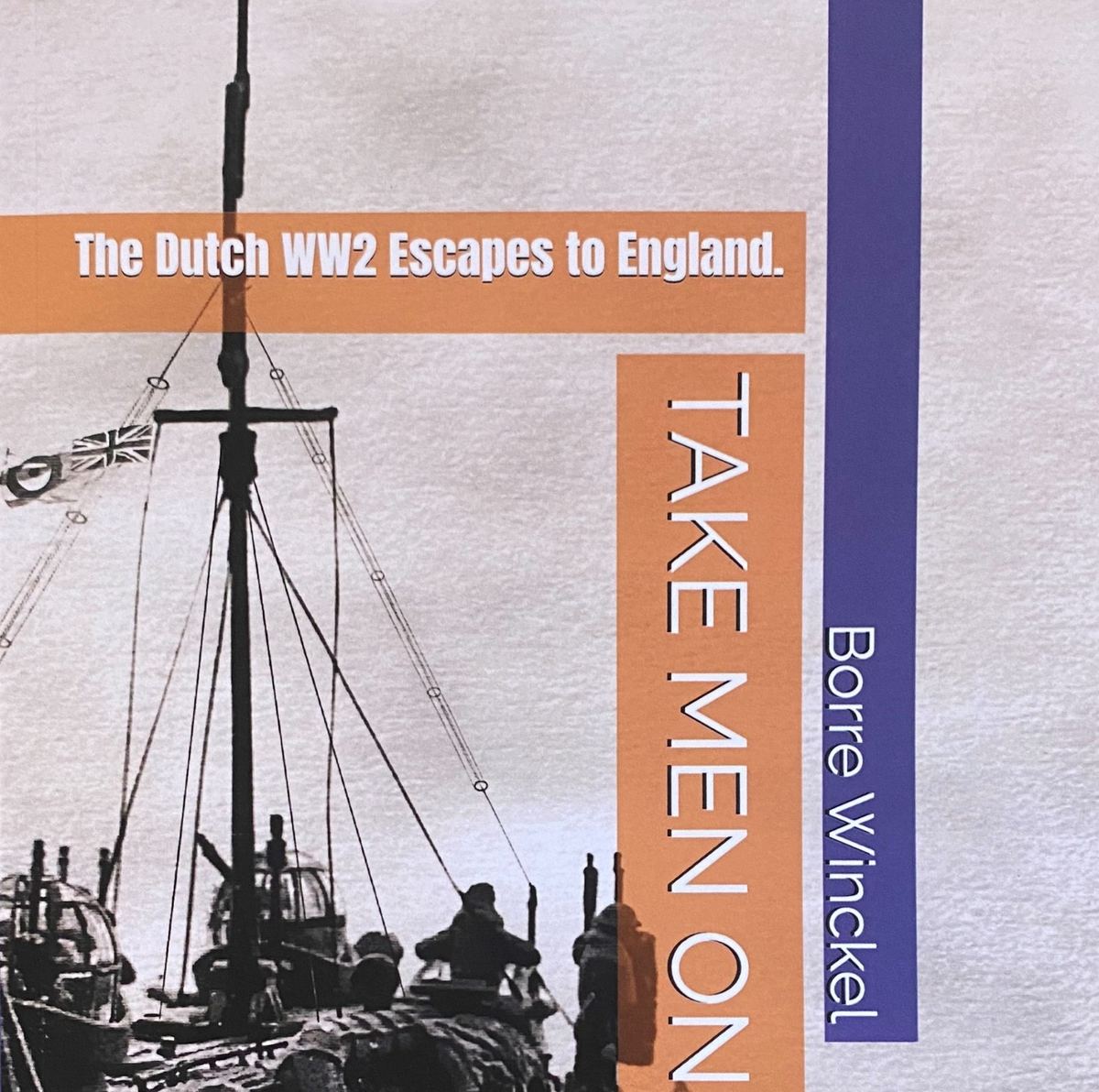
This book tells the story of the only successful escape across the North Sea in 1944. On 23 February that year, after several failed attempts, five young Dutchmen set out for England from Zuidland (Voorne-Putten) in a small open boat with an inboard engine. Their crossing took just one day. Around midday on 24 February they were spotted and picked up by RAF High Speed Rescue Launch (HSL) 185.
Remarkably, an American on board the rescue launch filmed the entire rescue. This unique footage has survived and can be seen at Museum Engelandvaarders. The opening shots made a particularly deep impression on me. You see a vast expanse of water with a tiny boat on it, and in that boat five overjoyed, relieved men who realise they have made it!
The five men were John Osten (1920–2010), Hein Fuchter (1921–2016), Henk Baxmeier (1920–2008), Edzard Moddemeier (1916–1998) and Flip Winckel (1919–2009). The first three were geology students at Leiden, Moddemeier was a radio and electrical engineer, and Winckel had just qualified as a lawyer in Dutch East Indies law.
The author of this book is one of Flip Winckel’s sons. In 2021 Borre Winckel had already published a Dutch version, entitled Recht door zee: over de laatste “Engelandvaart” en het einde van Nederlands-Indië. The title of the English edition no longer mentions ‘the end of the Dutch East Indies’, but the subject is certainly covered. For this review I read both versions.
I have never read such a detailed account of an “Engelandvaart”. Everything – and I mean everything – is covered: the months of preparation, the help of as many as 100 resistance members from the Hoeksche Waard and elsewhere, the earlier failed attempts (on 29 September 1943 and 17 February 1944), the contrasting personalities and the resulting tensions among the five “Engelandvaarders”, and so on. It is all meticulously described, checked and based on archival material and/or interviews. On top of that, it is well written and highly readable!
One example of Borre Winckel’s meticulousness is that his account of the rescue includes the radio traffic between HSL 185 and Coastal Command. Boats like HSL 185 were deployed by the RAF Sea Rescue Service, which existed to rescue British and Allied aircrews forced to ditch in the sea. These aircrews had to be saved at all costs, because so much time and money had been invested in their training.
HSL 185 was on its way to a so-called rendezvous position, where it was to remain on standby all day. After the captain reported that they had intercepted a small boat carrying five Dutchmen, Coastal Command in Great Yarmouth sent the following instructions: ‘Take men on board, strip boat and sink by gunfire. HSL [is] then to proceed to rendezvous position.’
And that is exactly what happened. The “Engelandvaarders” were given the choice of sailing on to the coast in their rickety boat or sinking it themselves by gunfire. Only John Osten wanted to carry on. The men then used the launch’s guns to shoot the boat to pieces and send it to the bottom.
After arriving in London, the five were questioned and found to be reliable. Each then chose a branch of the armed forces: Osten joined the Princess Irene Brigade, Baxmeier the air arm of the KNIL (Royal Netherlands East Indies Army). To his great disappointment, Moddemeier was declared unfit for military service, but as a radio and electrical engineer he made himself useful at the RAF Radio School in Bristol.
Interestingly, Fuchter and Winckel, both born in the Dutch East Indies, were offered jobs by the Dutch government in London with NICA, the Netherlands Indies Civil Administration. NICA had been set up in April 1944 to restore Dutch civil colonial government once the Japanese occupiers had surrendered. Fuchter turned the job down, as he had no wish to become a civil servant, and joined the RAF. Winckel accepted. The very reason he had wanted to reach England was to help liberate the Dutch East Indies, where his elder brother was held in a Japanese camp.
Winckel was not alone. Of the 1,700 “Engelandvaarders” I studied at the time, 11% had been born in “the East”. Many still had family living there or had served in the region as KNIL soldiers.
In August 1944 Winckel left England and travelled with the KNIL via Australia to New Guinea, from which the Americans had driven the Japanese in April 1944. By the end of 1944 he was thus back in the Indies, which he had left in 1932 as a 12-year-old. Winckel was put to work as a lawyer in both civil and military justice, the latter administered by courts martial in the field.
Only in September 1945 – after the Japanese surrender that followed the American atomic bombs on Hiroshima and Nagasaki – did Winckel set foot on Java. There he was reunited with his brother Frits, who had fortunately survived the Japanese camps. He also lived through the violent Bersiap period, which began after Sukarno proclaimed the Republic of Indonesia on 17 August 1945. Bersiap means “be ready”. It was the battle cry of paramilitary groups (known as pemudas) who used extreme violence against (Indo-)Dutch people and other non-natives such as the Chinese, Moluccans (who were accused of collaborating with the Dutch authorities) and the Japanese.
In early 1946 Flip Winckel said a final farewell to the Indies. He sailed from Tandjong Priok, the port of Jakarta, back to the Netherlands, arriving on 28 February 1946 – two years after setting out from Zuidland.
(i) See A. Dessing, Tulpen voor Wilhelmina: de geschiedenis van de “Engelandvaarders” (Tulips for Wilhelmina). Amsterdam, 2004, p. 29.