By Anke Ter Doest
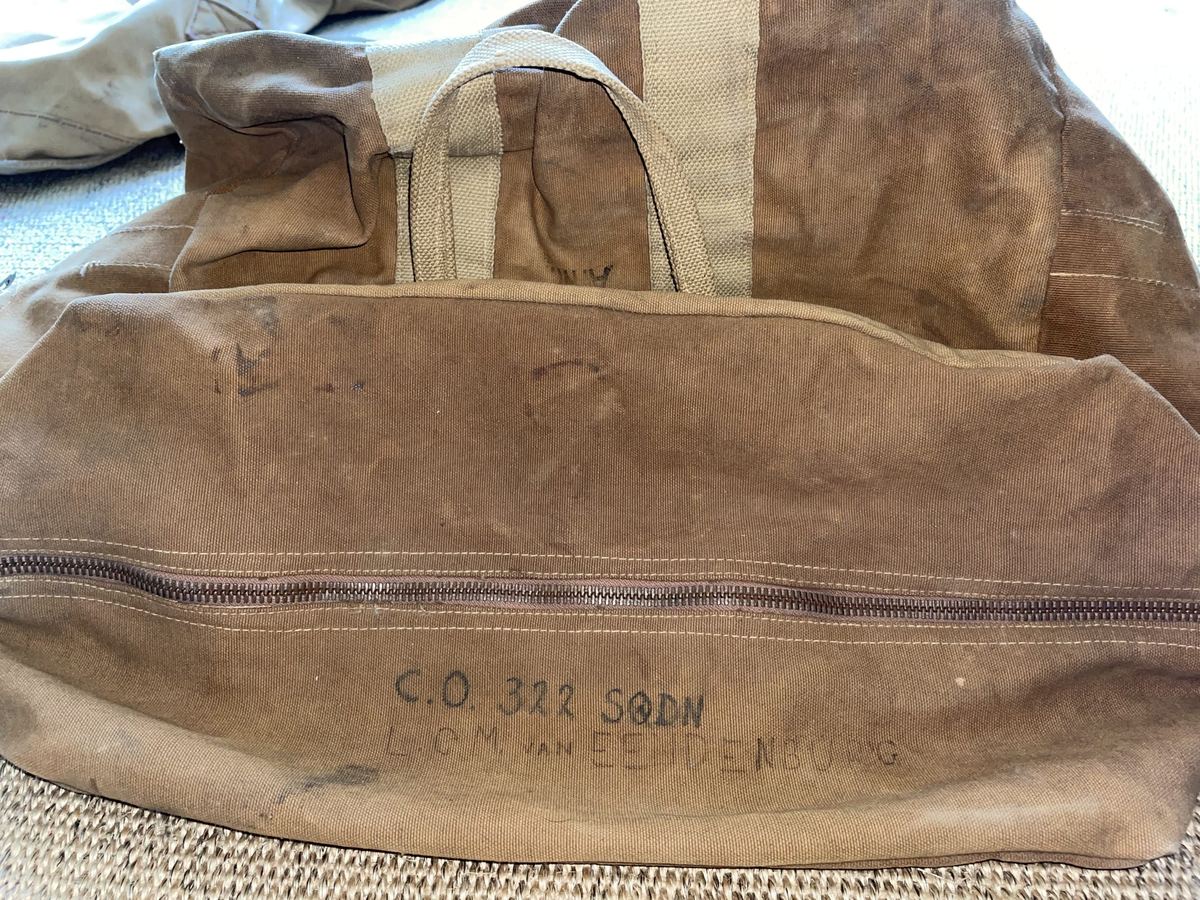
New in the museum collection are two canvas bags, donated by the family of Kees van Eendenburg, one of the very first “Engelandvaarders”. The bags themselves may not be all that colourful, but their owner and their history more than make up for it.
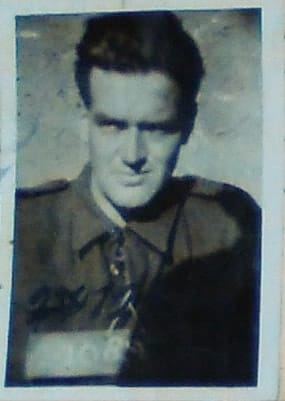
Having no intention of sitting out the war in the Netherlands and ‘having to look on idly, as a useless civilian, while Holland is subjugated day after day by our oppressors’, the 25-year-old Leiden law student decided soon after the occupation began to escape to England. With two friends from university, on 5 July 1940 he was the first to make the daring crossing of the North Sea in a small sailing boat, to join the fight against the Nazis.
Kees hoped to train as a pilot with the RAF in England, but at first his wish to fly was thwarted by a lack of training places for foreign students. He was assigned to the Royal Navy as a seaman, and the light-brown kitbag, which looks very like the duffle bags the Navy issued, probably dates from this time. The bag will have gone with him on the battleship HMS Nelson as she patrolled the waters between Iceland and Norway.
But in February 1941 Seaman Kees was given the chance after all to train as a pilot with the RAF. The threat of a German invasion had receded, freeing up places at the English flying schools. After service with several English squadrons he was posted to the Dutch 322 Squadron, formed under the RAF flag on 12 June 1943 (exactly eighty years ago!). It would be another six months, however, before the brand-new Spitfire unit was ready to become operational. The squadron was made up of experienced and inexperienced personnel, and until the time was right the senior pilots in particular, such as Kees and Jan Plesman, had to swallow their impatience to get back into the fight. But once the moment came, each of them commanded one of the squadron’s two flights . As Kees rose in rank, so did his moustache grow, and like its owner it often brought a cheerful note to squadron life.
The unit was one of the first fighter squadrons to be equipped with the latest version of the Spitfire, the Mark XIV, which was also one of the fastest fighters of the day. For that reason the Dutch squadron was soon deployed when, a week after the invasion, Germany began its V-1 attacks on London. With great enthusiasm, and under difficult conditions, the pilots mastered the technique of intercepting the new weapon, the unmanned flying bomb. Of all the foreign units, 322 Squadron had the highest number of kills. Typical of the ferocity with which the low-flying V-1s were fought, often at great personal risk, was so-called ‘wing tipping’. The Spitfire would fly alongside the V-1 and carefully flip up the flying bomb’s wing with its own, knocking it off course and sending it diving to the ground. The trick was usually only used once all the ammunition had been spent, but Kees wouldn’t have been Kees if he hadn’t tried this daring feat too – even twice in a row on the same V-1.
After this successful but very intense period, a new chapter began for the squadron, this time in an offensive role. Flying first from RAF Deanland, the unit carried out missions over occupied European territory, and losses quickly mounted. 1 September 1944 proved a catastrophic day, when the squadron lost its entire leadership in a single day to German anti-aircraft fire over French territory. First squadron leader Keith Kuhlmann was shot down, but he managed to bail out in time and spent the rest of the war as a German prisoner. Later that morning flight commander Jan Plesman crashed near Hazebrouck in northern France, and the other flight commander, Kees, had to make a belly landing in the same area. He did manage to stay out of German hands, and with the help of the French resistance he returned to England after a highly eventful week. The squadron now needed a new leader, and with the aftershocks of those dramatic events still fresh, Kees was handed that responsibility.
The dark-brown parachute bag dates from this period, as its inscription C.O. (Commanding Officer, ed.) 322 Squadron shows. The bag accompanied the newly appointed squadron leader during the Battle of Arnhem, which took place shortly after his return from France. Fortunately Kees never had to use his parachute, as the disastrous events of recent weeks had already left their mark on him. On the first day in his new post, one of his pilots had also been killed at the start of a mission. Not long afterwards, to the great disappointment of his men, the popular commander left the squadron at his own request. He had no choice but to leave the honour of leading the unit during the liberation of the Netherlands to a new commander, Bob van der Stok.
Sources consulted:
• Frank Visser, ‘De Schakel. De geschiedenis van de “Engelandvaarders”’, 1976
• Erwin van Loo, ‘Eenige Wakkere Jongens’, 2013
• Agnes Dessing, ‘Tulpen voor Wilhelmina’, 2004
• Logbook of Kees van Eendenburg
• Email correspondence with Gijs van Eendenburg, June 2023
• Summaries 322 Squadron
Photo credits:
Photo 1 – Museum Engelandvaarders
Photo 2 – Nationaal Archief
Photo 3 – Netherlands Institute of Military History
Photo 4 – Private collection of the Van Eendenburg family. With permission of Gijs van Eendenburg
Photo 5 – Nationaal Archief
Anke ter Doest is an art historian who lives in England. Together with her twin sister Ineke, she is digging into the remarkable past of their father, Jan ter Doest (an “Engelandvaarder” who set off for England at the age of 16), to reconstruct the missing pieces of his life-changing journey during the Second World War.
For more information www.theroadtoengland.com