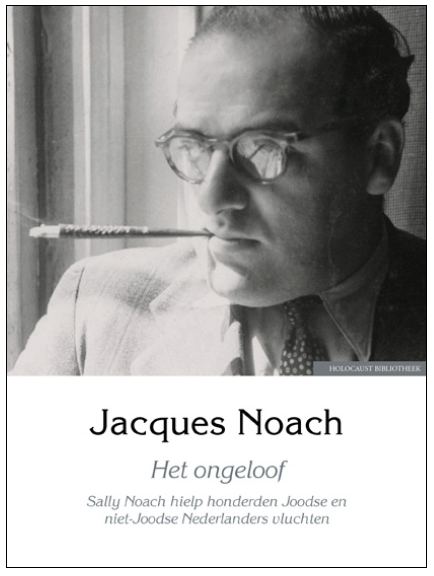
Het ongeloof. Sally Noach helped hundreds of Jewish and non-Jewish Dutch people to escape.
Author: Jacques Noach (Uitgeverij Verbum). ISBN 9789493028555
The book is available from the museum.
The “Engelandvaarder” Sally Noach (1909-1980) belongs in the same category as Jan Zwartendijk: in breach of consular rules he saved hundreds of lives, but instead of recognition he could count on a reprimand. That is where the similarity with Zwartendijk ends, because in Noach’s case two other things came into play: he was a Jew, and he also openly criticised members of the Dutch diplomatic service who, in his eyes, failed to do their best for refugees from the Netherlands. A down-to-earth carpet dealer from Zutphen telling the fine gentlemen the truth – the chutzpah!
The book Het ongeloof, written by Sally’s son Jacques Noach, is an attempt to restore his father’s good name. The title reveals an important aspect of that injustice: not being believed or, worse still, being dismissed as a liar and a charlatan. This is not, incidentally, the first time his story has been written down. In 1971 Sally Noach’s war memoirs, recorded by Max Haringman, appeared under the title Het moest gedaan worden (It Had to Be Done). The full text of this out-of-print book is included in Het ongeloof, together with two reports Sally wrote during the war about his difficult dealings with representatives of the Dutch diplomatic service. It may seem like duplication, but Jacques Noach’s approach is well considered: in ‘Part 1’ he supports his father’s story with archival material. In doing so he meets the wish expressed by the researcher Sierk Plantinga for evidence to be produced. Until now, after all, it had been Sally’s word against that of – above all – the diplomats Ate Sevenster and Binnert Philip, Baron Van Harinxma thoe Slooten.
The picture Jacques Noach paints is of a travelling carpet dealer who, out of inner conviction, decides to lend a hand to the growing army of refugees and “Engelandvaarders” in the south of France. When war breaks out, Sally is living with his parents in Brussels, but unlike them he chooses to go to Paris, which is not yet occupied at that point. As a dealer in carpets and fabrics he knows his way around France, he knows how to deal with the French, and with his gift of the gab he is used to getting things done. On his way south, however, he runs into his first real obstacle in Toulouse: the Dutch consulate. He reports to the honorary consul, A.J. van Dobben, asking to be allowed to go to England to join the Dutch armed forces. Van Dobben cannot help him, though, because his powers are ‘not designed for a state of war’. Sally returns to Paris, but there too he finds doors closed, and with the Germans advancing he leaves for Toulouse a second time. By now the city is filling up with refugees from the north. He then decides to go to Lyon, east of Toulouse. The author rightly asks why Lyon, and why not Spain: Sally speaks no Spanish and distrusts the Franco regime, whereas Lyon is familiar territory and, the author explains, Sally has heard that many Dutch people there are in need of help. That last argument of course applied to Toulouse as well, so it is not entirely convincing, but it is not implausible if you assume Sally thought he could be more useful in Lyon than in Toulouse. That might suggest he already knew about the situation at the Dutch consulate there: the honorary consul, Léopold Lambotte, was a Frenchman who spoke not a word of Dutch and was, understandably, in no position to tackle the refugee problem on his own. Sally reports to Lambotte and manages to get himself appointed as the consul’s unpaid assistant. Proof of this is a letter dated 5 May 1941, in which Lambotte states that Sally is attached as interpreter-translator to the consulate, which has by then been downgraded to an Office Néerlandais. Lambotte writes, word for word, that ‘ses services nous sont indispensables’ – in short, indispensable.
At first some 10 to 20 “Engelandvaarders” a week reported in Lyon, which, as part of Vichy France, was at that point still unoccupied by the Germans. Meanwhile the onward flow through the newly established Nederlands Centrum voor Vluchtelingen (Dutch Centre for Refugees) in Toulouse was stalling, and Sally must soon have realised that regular help that kept to the consular rules was utterly pointless. A person in need must be helped, and necessity knows no law: that is how you might sum up his attitude. His unorthodox approach combined an enormous dose of bluff with great skill at ‘fixing’ things – forging travel documents, for example, or making his consular status out to be weightier than it really was. All this rubbed the diplomatic service up the wrong way and goes a long way to explaining the dislike of him that grew within it. That is the context in which the label ‘charlatan’ should be seen, while demonstrable antisemitism also echoes in the criticism of Sally. He was also accused of being a black marketeer, which in the eyes of the mostly aristocratic diplomats was something contemptible. It should be noted, however, that under his French residence permit Sally was not allowed to practise a trade, and his work at the Office Néerlandais was unpaid, while he had to meet high costs to be able to do it. When he later asked in London to be reimbursed for his expenses, he was refused on the grounds that the Ministry of Foreign Affairs had never asked for his services.
In September 1942 things became too hot for him and Sally fled to Lisbon. Just in time, because in November the free part of France was absorbed into the occupied part. On 25 September he writes a report on his experiences in which he tears into certain members of the diplomatic service. Shortly afterwards he tells his story once more, to the interrogator Oreste Pinto, and in 1943 he writes a critical report that goes straight to Queen Wilhelmina. These critical reports lead to Sally Noach being labelled ‘uncivilised’ and ‘ill-bred’ in government circles. One possible consequence is that he did not receive the Cross of Merit – although one condition was that you had to have left occupied territory, and he had not. That condition did not apply to the Medal of Recognition, but he was not awarded that either. He did receive recognition from the “Engelandvaarders”, who made him an honorary member of their London club, Oranjehaven, and from Queen Wilhelmina, who was charmed by his unabashed honesty. The only decoration he received in his lifetime was the Cross of Honour in the Order of Orange-Nassau, awarded for services to the Royal House. From the government there was silence.
As many letters of thanks and reports bear witness, Sally helped hundreds of Jewish refugees and “Engelandvaarders” to stay out of German hands. Reading the book, I can only feel deep admiration for the brave and resourceful Sally Noach, for whom no effort was too great to get people out of a tight spot.