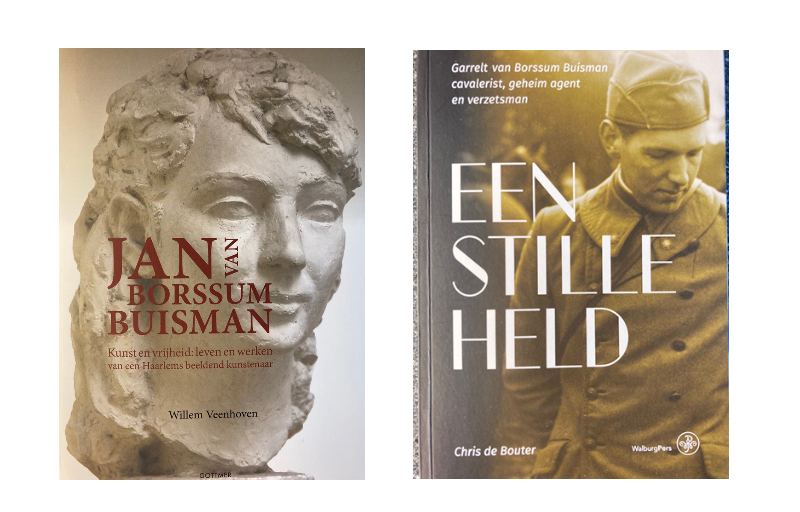
It is not often that biographies of two brothers appear within a single year. Yet that is what happened with Garrelt (1915-1991) and Jan van Borssum Buisman (1919-2012). In the course of 2020 Chris de Bouter published his biography of the career officer Garrelt van Borssum Buisman (ISBN 9789462494725), and in 2021 Willem Veenhoven published his book on the visual artist Jan van Borssum Buisman (ISBN 9789462494725). Because of the coronavirus pandemic, both books came out without much fanfare.
The two brothers grew up in Haarlem, where their father was ‘kasteleyn’ of the Teyler Foundation – a post best described today as director-curator of the museum attached to the foundation. The kastelein lived with his family in the building next to the museum, to which the house was connected. In his will, Teyler had stipulated that the kastelein should preferably be an artist. Their father, Hendrik van Borssum Buisman, was a painter and had also taught at the Academie van Beeldende Kunsten en Technische Wetenschappen in Rotterdam. Their mother, Jeanette Sleeswijk, had grown up in a family of doctors and belonged to the Église Wallonne (the Walloon Church). Thanks to this French background, the brothers acquired a good command of French, which would stand them in good stead much later, during the war. There was also a daughter, Johanna ‘Hansje’, the eldest of the three children; she later studied theology and married a minister.
Garrelt obtained his HBS-B diploma (a secondary-school certificate with a science focus) without much effort; according to his brother he was a born scientist and sporty too. Jan was more of a dreamer, with an eye for the arts, though at times he was also interested in technology. Like Garrelt, he switched from grammar school to the HBS and likewise gained the B diploma. During his secondary-school years Jan had to spend several months taking a cure in Davos, Switzerland, because of asthma. He also stayed regularly with the family of an uncle Sleeswijk in Mannheim, Germany, and came away with a thorough knowledge of German (he scored a perfect 10 in his final exam), which would serve him well in his dealings with the occupier after the German invasion in 1940.
Garrelt did his military service with the field artillery. He was selected for reserve-officer training with the Horse Artillery, which included thorough riding instruction. Although no one in the family had any particular feeling for horses, this training gave birth to his love of them. After completing his service in 1936, Garrelt wanted to go into the wool trade. De Bouter’s book suggests that this was not a happy choice. So when it became known in 1938 that the Cavalry was short of officers, he chose to become a regular cavalry officer. One of the attractions of that choice was the opportunity
to ride a great deal in that arm of the service – riding being his great passion. According to his brother Jan, Garrelt liked working within a system, and because he was good with people he functioned well in an organisation such as the army. After his specialist cavalry training he was appointed platoon commander.
Jan’s inclinations were different from his brother’s. He took a keen interest in art; he read widely and had art all around him at home. He explored the historic centre of Haarlem with its fine old buildings and façades. And he had many discussions with his father about what to do after his final exams. Because his father felt that ‘a life in art’ would not offer the most secure existence, he advised him to choose a course of study with some affinity to ‘art’ that would nevertheless provide a decent living. So in 1939 Jan began studying architecture at the Technische Hogeschool in Delft. He joined the Delftsch Studenten Corps and ended up in a year club that became a circle of friends for life; their experiences in the Second World War would also contribute to that close bond.
To his family’s great relief, Garrelt came through the May days of 1940 unscathed, even though he had fought at the heart of the battle, in the area around the Grebbeberg. After being placed on non-active status following the capitulation, he went to work at Huize Kareol in Aerdenhout, a rehabilitation centre for wounded servicemen run by cavalry captain C.F. Pahud de Mortanges (known from the Olympic Games). This convalescent home had been set up with the help of the Red Cross. He soon joined a resistance organisation, the Orde Dienst.
His brother Jan, meanwhile, had run into trouble with the occupier in Delft in his own way and, despite his excellent German, could not avoid a spell in the Oranjehotel prison in Scheveningen. After his release, his urge to fight the occupier from elsewhere must have grown; fellow students in Delft were also looking for ways to escape to England and fight the Nazis from there. Similar aspirations could be seen at the time in another university town, Leiden.
While the narrative runs more or less in parallel in both books up to the war, from that point on the two biographies differ fundamentally in approach. The book about Garrelt deals at great length with the war years and the part he played in them, whereas the book about Jan touches on the war only briefly. This is understandable and defensible, since a book about Jan’s war years and his work as an ‘agent of the Swiss Road’ was already written in 2000.
Chris de Bouter follows Garrelt closely and chronologically: first the fighting in the May days, then his role at Huize Kareol.
Garrelt had been taken on there as secretary, responsible for organisational and administrative tasks. It was through Kareol that Garrelt came into contact with the Orde Dienst, the resistance group O.D. But fairly soon he began to feel that he could fight the Nazis better from England. And although he had discussed leaving the Netherlands with his brother Jan, the two left separately. Jan set off for Switzerland on 23 March 1942; Garrelt decided it was time to go after the Germans declared all regular servicemen prisoners of war on 15 May 1942. Sensing danger, Garrelt had ignored the summons to report and so escaped captivity. He had wanted to begin the journey to England together with cavalry captain Pahud de Mortanges, but the captain’s wife persuaded her husband not to go: their son Willem Pahud had recently been executed by firing squad in Dijon on his way to Switzerland. In the end Garrelt left for Belgium on 9 May 1942 with Herman Friedhoff. Friedhoff turned back there, but in Namur Garrelt met the Jewish student Philip Jacobs, who was also on his way to England. They travelled on together, swam across the river Cher near Amboise and so managed to cross the
demarcation line. In Limoges they went their separate ways, Buisman heading for Switzerland and Jacobs for Spain.
This is not the place to recount the at times breathtaking stories about Garrelt: his activities in the Netherlands after being parachuted in as a secret agent, his arrest, the Dauervernehmung (continuous interrogation), his death sentence and the subsequent transport to Germany with his colleague Tonnet, and their joint escape by jumping from the train, in which Garrelt was badly injured. With great ingenuity, intelligence, coolness and a good deal of luck, he eventually made it back to the Netherlands, where he carried on working until the liberation. In 1948 Garrelt was made a Knight of the Military William Order for all his resistance work. As an epilogue, the book has a short chapter on his post-war work for the top-secret Dutch stay-behind organisation, later also compared to the Italian Gladio. He became head of this so-called Sectie Algemene Zaken (General Affairs Section), with the rank of colonel.
Willem Veenhoven’s book about Jan van Borssum Buisman is of a different character, focusing on his artistic achievements. Jan became assistant to the Reverend Visser ’t Hooft at the World Council of Churches in Geneva, which played a leading part in the ‘Swiss Road’. In his spare time he took sculpture lessons from a well-known sculptor and also attended classes at the Geneva art academy. Once the south of the Netherlands had been liberated, the ‘Swiss Road’, through which all kinds of reports had been channelled to the government in London, was no longer needed – and neither was Jan. He put the archive of the Swiss Road organisation in order and then volunteered for military service. In January 1945, after basic training as a private, he was assigned to an infantry regiment. Finally, in 1946, he worked as a cartographer at the Ministry of War and as a writer and illustrator on the editorial staff of the Pen Gun, a magazine for servicemen. In May 1946 he was honourably discharged from military service.
Back in Delft, lessons in art and artistic techniques soon took precedence over his architecture studies. The sculptor and professor Oswald Wenckebach became his mentor. He was appointed assistant curator at a museum in Delft, and the Nederlandse Studentenraad (Dutch Students’ Council) sent him as its delegate to the Commissie voor Oorlogsgedenktekens (Committee for War Memorials), of which he became a member. The committee’s main task was to advise on a national monument in Amsterdam. In 1947 the French government awarded him a grant to develop his skills as a sculptor in Paris. Jan enrolled at the École nationale supérieure des beaux-arts in Paris, where he studied under the sculptors M. Gaumont and G. Saupique, the latter having a strong influence on his work. In 1948 Jan exhibited for the first time, at the Salon de la Jeune Sculpture, an exhibition of work by young non-French artists.
In September 1948 he returned to Haarlem, where he went to work as his father’s assistant at Teylers Museum. After his father – still formally the kastelein – died in 1951, the board appointed him assistant curator and kastelein of the museum; Prof. J.Q. van Regteren Altena was appointed curator of the art collections, including the drawings and prints. His new post allowed him to pursue his ideal: to occupy himself with art and the running of the museum, and to develop the museum further through lectures, exhibitions and the occasional new acquisition. He was also able to continue sculpting.
Jan Buisman also became increasingly involved in Haarlem’s artistic life: he joined the artists’ society Kunst Zij Ons Doel, the artists’ circle De Groep, the well-known Sociëteit Teisterbant, the Round Table, the Rotary Club and the Stichting Jacobus van Looy.
The book provides a wealth of information about his life as an artist and his various teachers. A large part of it is devoted to descriptions of his works – often with photographs – along with a list of works, an overview of the exhibitions he took part in and several pages explaining the techniques he used. It thus serves as an excellent guide to and catalogue of his work. The book is richly illustrated, which greatly adds to its readability and to our understanding of him as an artist.
I read both books with great pleasure.