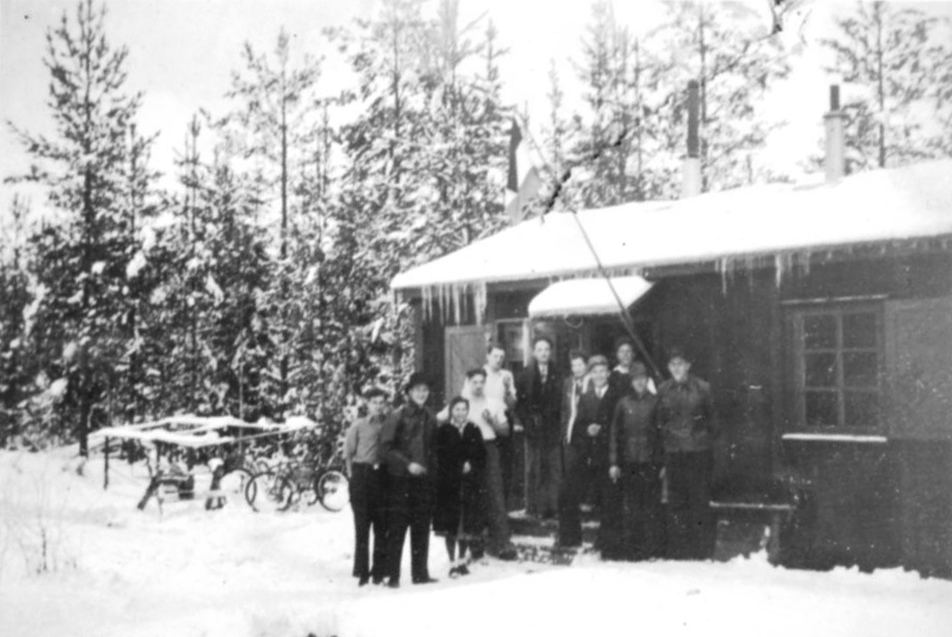
In December 2022 the granddaughter of “Engelandvaarder” Henk Zeelenberg delighted the museum with a large number of scanned photographs of her grandfather, along with his memoirs. The photographs, some 50 in all, were all taken in Switzerland, mainly at the Cossonay labour camp above Lausanne and in the village of Arosa in the east of the country. Arosa was home to Piet Kerdel, a Dutchman of independent means, who had built a large chalet there as a training lodge for Dutch skiers. As the war had left it empty, Kerdel persuaded the Swiss authorities to let the ski lodge be treated as an annexe of the Cossonay camp. “Engelandvaarders” could go there for a while to recuperate.
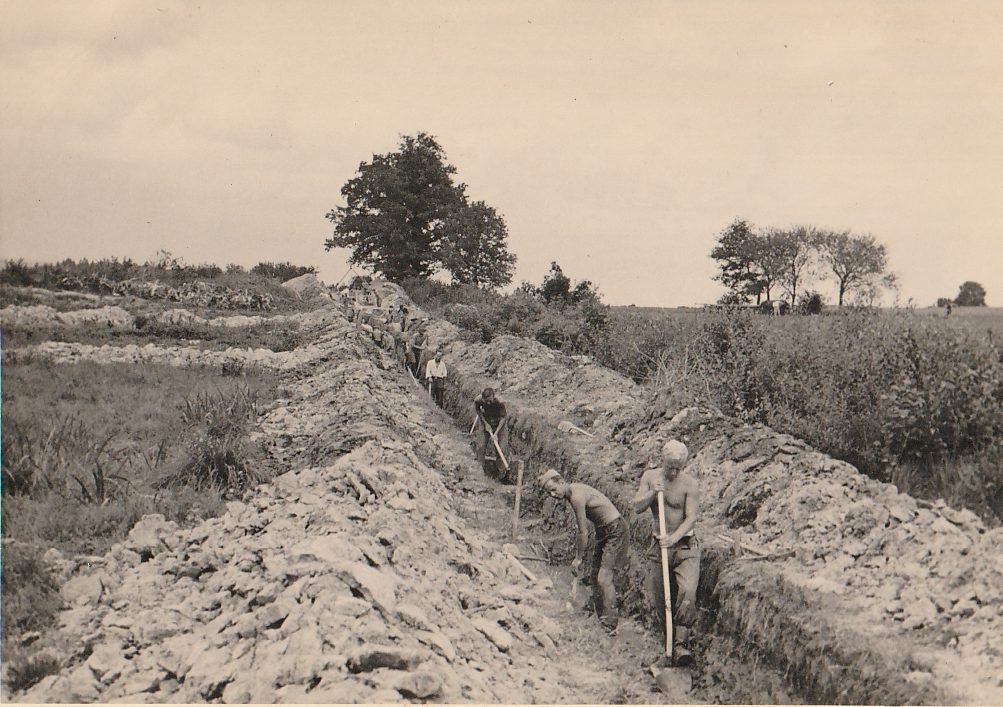
The Swiss government had set up the labour camp at Cossonay in consultation with the Dutch Legation in Bern, chiefly for Dutch refugees. The marshy land there was to be made usable by digging irrigation channels. The camp came about in 1942 as a compromise between the canton of Vaud and the federal government in Bern: it was not to house Jews, and so at first only Dutch servicemen were accommodated there. According to Jan Staal’s thesis on Dutch refugees in Switzerland, Cossonay was accordingly financed by the Dutch Legation. Putting the Dutch to work would make them useful to the Swiss community, keep them largely out of contact with Swiss citizens and so cause less annoyance among the Swiss through their ‘loafing about’ in villages and cafés. Camp Cossonay opened on 26 May 1942 and remained in use for a year, until the irrigation work was finished. Most of the remaining inmates were then transferred to Les Verrières, where there was another labour camp.
“Engelandvaarder” Henk Zeelenberg had volunteered for the Netherlands Marine Corps in 1939 and was in Rotterdam when the Germans invaded in May 1940. After demobilisation he went, by way of the Opbouwdienst (a labour service), to work as a fire watchman for the railways in Utrecht. There he met a fellow marine, L.J. van den Bossche. After a failed attempt to cross the North Sea to England in a small boat, the two of them, together with F.M. Boluyt, a soldier of the Royal Netherlands East Indies Army (KNIL), left Amsterdam on 17 March 1942 hidden in the wheel housings beneath the train to Paris. After a while in Paris they managed to escape to Switzerland with the guide Olivier Giran and four other Dutchmen, and eventually ended up at the Cossonay camp. Disappointed that they could not leave Switzerland legally, however, they crossed the Swiss-French border near Geneva with L.J. Henfling on 12 November 1942, the day after the Germans occupied Vichy France. On the way to Annecy they lost each other. Zeelenberg was arrested by a French gendarme but bought his freedom with a packet of cigarettes and went on by train via Lyon to Toulouse, where he reported to J.C.A.M. Testers of the Office Néerlandais. Together with the Dutchmen A.J. Legerstee and H. Buenink and the Belgian IJzewijer, they left Toulouse for Perpignan, where J.W. Kolkman, Testers’s colleague there, showed them a route across the Pyrenees. On reaching Spain they were stopped by the Spanish Guardia Civil, who sent them back across the border into France. They tried again a little further along and reached Figueras, but were arrested there too and once more expelled from Spain into France. Nor did they escape arrest in France: for the usual tariff of one month’s imprisonment they disappeared into the filthy prison of Perpignan. After serving their sentence they reported to Kolkman again, who put them up in the safe house at Le Soler. On 23 December 1942 they set off for Spain once more, with three other Dutchmen and a guide arranged by Kolkman. This time they arrived safely in Barcelona, and on the last day of the year Zeelenberg travelled on to Madrid. From there he went to Lisbon and then by ship via Ireland to England, where he arrived on 13 May 1943. In England Zeelenberg, a marine, opted for commando training. By way of Canada, the United States and Indonesia, Henk Zeelenberg eventually returned to the Netherlands in 1950.
Sources:
-Nationaal Archief, The Hague: interrogations of H. Zeelenberg and L.J. van den Bossche by the Politie Buitendienst in London;
-Museum Engelandvaarders: memoirs of H. Zeelenberg;
G.J. Staal, De Nederlandse Vluchtelingen in Zwitserland tijdens de Tweede Wereldoorlog. Een overzicht (thesis).
-Bundesarchiv Bern: files of the Swiss aliens police;
André Lasserre, Laurent Droz and Nathalie Gardiol, La politique vaudoise envers les réfugiés victimes du nazisme 1933-à 1945. Rapport présenté en juin 2000 au Conseil d’Etat du canton de Vaud en exécution de son mandat du 18 juin 1997.