By the spring of 1941 Rudi van Daalen Wetters had had enough. He was determined to get to England and join the Allies. In his good friend Jaap van Hamel, a student in Delft, he found a kindred spirit. The only question was: how? There were roughly three routes: across the North Sea, via Sweden, or via the southern route through Belgium, France and Spain. The two young men from The Hague chose the sea route. It was the shortest, but also the most dangerous.
The danger began before they had even set off. How could they get hold of a boat without attracting attention? An outboard motor? Fuel? And how could they get the craft to the coast unseen? As early as the summer of 1940 the Germans had banned sailing at sea. Boats were no longer allowed close behind the coastline either, and large parts of the western Netherlands were declared a ‘Sperrgebiet’ (restricted zone). In fact, only the North Sea coast of South and North Holland remained freely accessible for a while.
One result of the German restrictions was that in 1941 and 1942 a number of “Engelandvaarders” attempted the crossing in a folding canoe. Although not seaworthy, it had its advantages. The price was relatively low. And because of its small size a canoe could be taken apart and was light, so it was relatively easy to transport. But the chances of crossing the North Sea unscathed in such a tiny craft were slim. Currents, heavy seas and strong winds could end the journey in no time. So could discovery by patrolling ships or aircraft of the Kriegsmarine or the Luftwaffe.
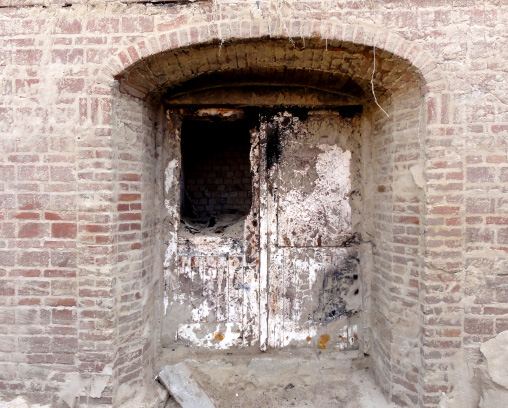
Van Daalen Wetters and Van Hamel also took their chances in a folding canoe. They bought one in Warmond and fitted it with a small sail. They chose Katwijk as their departure point. Why there? One of the main reasons was undoubtedly that a small tunnel ran from the Zeehospitium (a seaside sanatorium) under the promenade to the beach. That made it possible to reach the surf with a canoe or small boat almost unseen. In early February 1941 Johannes Kerkhoff and Aad Oosters were the first to try via the tunnel. The attempt failed, and both men drowned.
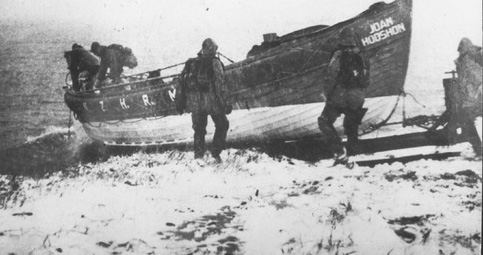
The second attempt, in mid-April, also failed. But the two men on board, Pim van Doorn and Tolo Makowski, a Polish diplomat, were rescued in a heavy storm by a Katwijk fishing lugger just in time.
In mid-June conditions seemed ideal for a try. There was little moonlight, an easterly wind and a calm sea. On the evening of 19 June Rudi and Jaap took the canoe and the outboard motor by carrier tricycle to the Zeehos tunnel. They returned the next evening and assembled the canoe. ‘Then we had to wait until the German patrol on the road above us had passed’, Van Daalen Wetters recalled. Then they opened the door and crept onto the beach. At half past two in the morning they pushed the canoe into the water.
At first they dared only to raise the little sail, because paddling made the water glow with phosphorescence. Once out of earshot, they tried to start the motor – in vain. After trying for a long time, they had no choice but to throw it overboard. On the first
Zeehos tunnel
Jaap van Hamel
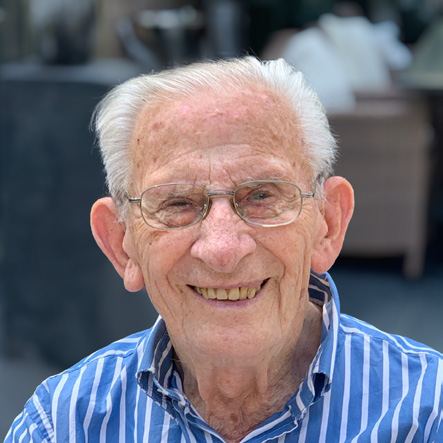
Rudi van Daalen Wetters12
day the two still had the benefit of an easterly wind. On the second day, however, the wind veered to the west and they had no option but to tack with the heavily laden canoe. For the next three days the two Dutchmen had almost no wind at all, so they had to paddle. The hopeless situation, the lack of drinking water and deathly fatigue took a particular toll on Van Hamel. Van Daalen Wetters said in 1997: ‘He kept claiming he could see the English coast, which sadly wasn’t true. I myself thought we had passed England and should now be looking out for the Statue of Liberty in New York.’
On the morning of 25 June hope dawned. As Van Daalen Wetters and Van Hamel slumped exhausted in their canoe, a bluebottle landed on the mast. That could mean only one thing: land was near. When a few curious seagulls came to take a look shortly afterwards, the two Dutchmen knew rescue was close. A few hours later an Australian destroyer picked them up, some 30 kilometres off the British coast. Van Daalen Wetters and Van Hamel both became fighter pilots in the RAF. Van Hamel was killed in an accident in the spring of 1944. Van Daalen Wetters survived the war.
At least eleven attempts were made from the beach at Katwijk, probably involving 33 young men. Only 8 of them reached the other side, and only 3 of them survived the war. The story of the Katwijk “Engelandvaarders” is a story of determination, extraordinary daring, love of country and self-sacrifice. Freedom is a precious thing. The monument to the “Engelandvaarders” in Katwijk helps keep us aware of that, every single day.
Erwin van Loo delivered this text on 8 June at the monument to the “Engelandvaarders” in Katwijk.
‘Remembering places an obligation on us’
‘The stories behind this monument give us a picture of the enormous risks the “Engelandvaarders” took, and of what must have befallen the many of whom nothing was ever heard again. They risked their lives, knowing that the loss of freedom is the worst thing that can happen to a person.’ So said Lieutenant Colonel Richard Badoux at the commemoration on 9 June at the monument to the “Engelandvaarders” on the Katwijk promenade, unveiled five years ago.
The memory of the people who resisted the German dictatorship is part of our national heritage, said Badoux. ‘This heritage places an obligation on us to keep standing up for freedom, even when it demands a personal sacrifice. Because today, too, threats to our freedom are visible. Threats from within, through indifference to the achievements that define our freedom. And threats from outside, in an increasingly turbulent world. We cannot and must never accept that people who made such sacrifices, often the ultimate sacrifice, are forgotten.’
One of the “Engelandvaarders” who tried to escape to England from Katwijk was the Polish diplomat Saryusz (‘Tolo’) Makowski. His son George told the story of his father, who was in the Netherlands as Polish vice-consul when the German army invaded. When the Netherlands too had been overrun, he decided to flee to England. On the night of 18 to 19 April 1941 he and Pim van Doorn put to sea in a folding canoe, bound for England. The men had hidden the canoe in the tunnel that ran from the Zeehospitium under the promenade to the beach. The attempt failed when a storm blew up; they were rescued by the Katwijk fishing boat ‘Sakina’. Van Doorn was arrested in France during a new attempt and sentenced to death; Tolo eventually reached England via France after all, and joined the Allied forces there. ‘This monument shows how close bad luck and good luck lie together’, said Makowski.
On behalf of the Polish Embassy, deputy ambassador Pjotr Samerek reflected on the attempt by Tolo and Pim. ‘I hope it inspires passers-by to resist the threats to freedom that we experience in our own time too.’