Documents that tell us something about the “Engelandvaarders” turn up in all sorts of places in the Nationaal Archief (National Archives). So my advice to fellow researchers is usually to ‘search widely’, because if you rely only on the description in the inventory you can miss a great deal of information. Take the archives of diplomats or legations: many an “Engelandvaarder” at their wits’ end turned for help to a Dutch legation abroad. That this did not always produce the help they hoped for is by now well known. While reading Albert Kersten’s biography of the former foreign minister Joseph Luns, my attention was drawn to his work at the legations in Bern and Lisbon during the
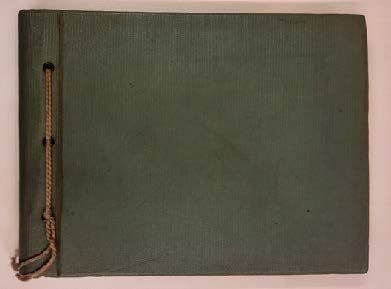
Second World War1. Luns stood out favourably from older diplomats, who considered intelligence work for the Dutch government at odds with their idea of their profession. He also worked actively on behalf of the “Engelandvaarders”. My curiosity aroused, I requested Luns’s personal archive and found in it two extremely interesting private albums with photographs taken in Switzerland, Spain and Portugal during the war.
Bern was his first diplomatic posting. In early January 1940 he and his wife, E.C. (‘Lia’) Luns-van Heemstra, drove to Switzerland, where he and the envoy, J.J.B. ridder Bosch van Rosenthal, were to make up the mission. As the envoy’s only member of staff, Luns was responsible for enciphering and decoding secret telegrams, building up files and reporting on developments in Switzerland: in short, the usual diplomatic craft. Bern was not an important post, but the outbreak of war changed that. As a neutral, unoccupied country in the middle of a Europe largely occupied by Germany, Switzerland became the playground of various foreign intelligence services, all trying to outwit one another. A stream of Jewish refugees and “Engelandvaarders” also began to arrive, and shelter and transit papers had to be arranged for them. Forced by these circumstances, the Dutch government in exile decided to expand the legation, among other things by transferring the military attaché in Rome, Major General A.G. van Tricht, to Bern. With Luns’s help, Van Tricht laid the foundations of an escape route for “Engelandvaarders” through still unoccupied Vichy France to Spain and Portugal. Luns was also approached from London to pass on intelligence from occupied territory, without the knowledge of the Ministry of Foreign Affairs. This request came indirectly from François van ’t Sant, private secretary to Queen Wilhelmina and at that time still head of the Centrale Inlichtingendienst (Central Intelligence Service)2. To that end Luns successfully made contact with Dr W.A. Visser ’t Hooft, general secretary of the World Council of Churches in Geneva, whose reports he forwarded to London. This did not last long, because in April 1941 Luns was transferred to the legation in Lisbon, the capital of Portugal, which was likewise unoccupied and neutral.
At that point the Lisbon legation had no envoy, because the previous one, J.G. Sillem, had been dismissed by the Foreign Ministry. Under German pressure, however, Portugal refused to approve the appointment of a new envoy, so F.C.A. van Pallandt was appointed temporary chargé d’affaires. Luns was to
assist him as legation secretary. The work was much the same as in Bern, but the emphasis shifted towards obtaining Portuguese visas for “Engelandvaarders” and looking after Dutch seamen whose ships called at Portugal. He also continued to deal with the flow of “Engelandvaarders” arriving from Switzerland, drawing on his private correspondence with Van Tricht in Bern. His time in Lisbon ended in November 1943 with a transfer to the Diplomatic Affairs department in London, which meant a promotion.
The photo albums give a pleasant picture of the couple’s time in Bern and Lisbon3. Alongside snapshots of their private life, we see Luns at work, sitting in his office or in full regalia at official occasions. It was probably his wife Lia who kept the albums and wrote the captions. Most of the photographs show informal moments: picnics, or sailing with friends or colleagues. A favourite subject is their black dog, Peps. There are also photographs of a simple but tastefully furnished flat in Lisbon, so all in all their stay there was certainly not unpleasant. Striking are the pictures of a bare-chested Luns hiking in the Portuguese mountains. Some photographs show “Engelandvaarders” passing through, such as Eddie and Eleonore Hertzberger, with whom Luns and his wife spent a day out near Lisbon. Or Cees van Brink, sitting relaxed in the grass, who after his secret MI6 operation in the occupied Netherlands was taken on at the legation in Lisbon. Another “Engelandvaarder” whom Luns knew from Lisbon was Gerard Dogger, who even stood in for him for a while as legation secretary4. They kept in touch: one photograph shows that Mr and Mrs Luns attended Dogger’s wedding in England in November 1945.
(1) Albert Kersten, Luns. Een politieke biografie (2010), pp. 61–67
(2) Jhr. Mr. G. Beelaerts van Blokland, Belevenissen te Londen 1940–1945 (1997), p. 35
(3) Nationaal Archief, collection 2.21.351 J.M.A.H. Luns [lived 1911–2002], inventory nos. 98 and 99.
(4) Gerard Dogger, De vierkante maan (1979), p. 211