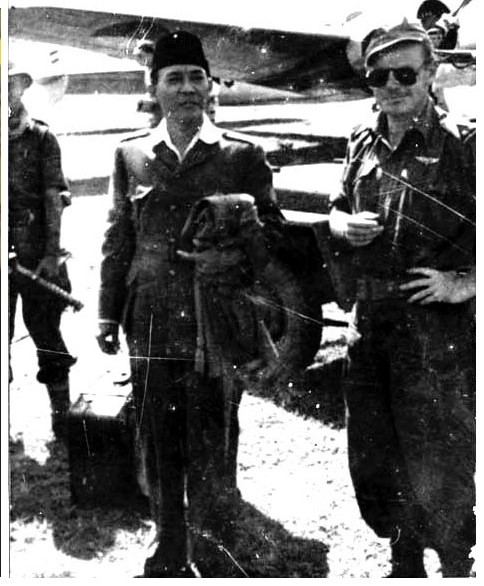
Jan Bakker next to Sukarno.
By Maurits Huijbrechtse
The attentive television viewer may not notice it, but the “Engelandvaarders” run like a common thread through my viewing and my studies. As a researcher at the museum, that should hardly come as a surprise, and yet. Here are a few examples from TV over the past few weeks.
In the three-part series “Hoog spel in de Oost”, about the end of the Dutch presence in West Papua/Irian, part of the second episode is devoted to the “Engelandvaarder” and master spy Jan Bakker. Thanks to a highly placed Indonesian contact, he managed to get hold of the Indonesian attack plan for the planned invasion of Dutch New Guinea.
In the first episode of the RTL 4 programme “De Erfgenaam”, in which Ruben Nicolai tracks down heirs to estates that never reached their rightful owners because the heirs could not be traced, the first segment is about a family photo album that turns out to belong to an Amsterdam family called De Jong, with Zeeland roots and links to the armed forces. By coincidence, the photographs are of the family in which the father of the “Engelandvaarder” Gijs de Jong grew up – a man I had researched earlier for my bachelor’s thesis. When the Second World War broke out, De Jong and his brother were cadets of the Royal Netherlands East Indies Army at the Royal Military Academy in Breda. He soon became involved in the resistance that grew up among the cadets, before he, like many of his comrades, fled to England. His brother was taken prisoner of war by the Germans in May 1942.
Several cadets had already been taken prisoner by the Germans in 1940, after refusing to sign the so-called declaration of honour. In this declaration, which the Germans put to all regular personnel of the Dutch armed forces, the soldiers had to state that they would not resist Germany. Only sixty officers refused, most of them KNIL officers. Among them was the grandfather of the historian Hans Goedkoop, who has made a television series retracing the footsteps of his grandfather Rein van Langen. The best-known prisoner-of-war camp, where many of the Dutch refusers ended up, was Colditz Castle. A few of the cadets managed to escape from the castle and reach England. Van Langen also tried to escape from Germany, but was caught close to the Dutch border.
The Academy in Breda is a common thread in my interest in the Netherlands during the Second World War. My master’s thesis, for example, is about the morally complex history of the KNIL soldier and resistance man Jan Baptist Vermeulen. When the war broke out, this non-commissioned officer was an instructor to the cadets. Like many of them, he was soon involved in resistance work, in which he worked closely and often with the future “Engelandvaarder” Jan Marginus Somer (in England, Somer would later become Gijs de Jong’s superior at the Bureau Inlichtingen, the Dutch intelligence service). Indeed, Vermeulen was the man who took over Somer’s work after Somer left in 1942.
That is not the only link with the “Engelandvaarders”: one of Vermeulen’s closest associates was Willem Jan ‘Rudi’ Schreinemacher, who went to Sweden, escaped from there to England and eventually returned to the Netherlands as a secret agent of the Bureau Inlichtingen.
Vermeulen wanted to go to England too – so badly, in fact, that thanks to the traitor Anton van der Waals he was caught and disappeared into German prisons.
After the end of the Second World War, Vermeulen was sent to Indonesia. There he served under the far better known, and perhaps notorious, Captain Westerling in the Depot Speciale Troepen (Special Forces Depot). The DST was tasked with ‘cleaning up’ South Sulawesi/Celebes so that the plans of the highest Dutch authorities could go ahead. In the north of the island Vermeulen claimed even more victims than his immediate superior, yet he remains the great unknown in the story of South Celebes. In my thesis I consider how a ‘hero’ can become a ‘villain’, and trace the course of Vermeulen’s life. In this account not only Schreinemacher appears, but also Harry van der Zeep, who, like Gijs de Jong, was a cadet at the Academy in Breda before leaving for Allied territory.
All these examples show how the history of the “Engelandvaarders” runs like a common thread through the history of the Netherlands during and after the Second World War. I hope to go on untangling and opening up networks like these for a long time to come, because I believe they are the driving force of history.