In my book Het ongeloof 1, in which, after extensive archival research, I describe how my father Sally Noach helped hundreds of Jewish and non-Jewish Dutch people to escape, I tell of his flight from Brussels in May 1940 with his friend and half-brother Armand Eismann. Naturally I was very curious to know what had become of Armand after the war. Sadly, despite searches on various social media, I had lost track of Armand Eismann in January 1946. At least, that was the situation when I presented my book at the Verzetsmuseum (Resistance Museum) in Amsterdam on 30 March 2022. My daughter Nathalie then made another attempt to find him through social media, and she succeeded. On 10 April she managed to make contact with Armand’s daughter, Yetty Buisseret. Yetty lives in Normandy, not far from the invasion beaches, and I visited her there in early September 2022. Using the limited file she had from her father about his wartime experiences, supplemented by my own research, I have written the story of Armand Eismann below.
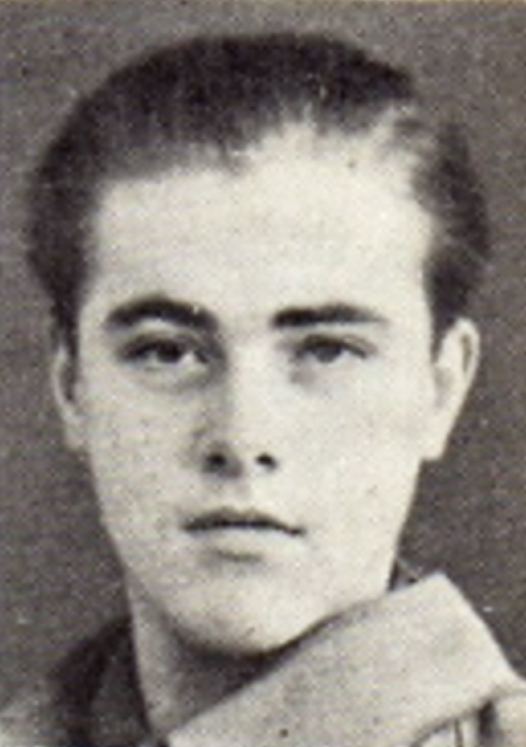
Armand Eismann2 was born in Scheveningen on 6 July 1915; he had two older sisters, both born in Anderlecht (Brussels, Belgium). His father, Mozes, came from Venlo, and his mother, Henriette Konijn, from Liège (Belgium). Mozes (also known as Moise and Maurice) traded in textiles, and Armand went to work for his father as a travelling salesman at a young age. In early 1918 the family moved to Brussels. There, in quick succession, his eldest sister Johanna (in 1932) and his mother (in 1935) died. After his mother’s death Armand went to live with my grandparents, Jacob and Sophia Noach, who had moved from Zutphen to Brussels in 1928, followed by their five sons. I do not know how the two families knew each other. No doubt a few things in common played a part: Dutch nationality, a trade in fabrics, and being Jewish.
In February 1934 Armand took a job at a menswear shop, and in November of that year he applied to the municipality of Rotterdam to be registered for military service. The application was turned down because he did not live in the Netherlands – in other words, because his place of residence, Brussels, was more than 15 kilometres from the Dutch border.
When the Germans invaded Belgium on 10 May 1940 (at the same time as the attack on the Netherlands and Luxembourg), Armand went to the Dutch consul in Brussels to volunteer for the army. The consul advised him to leave for France and join the Dutch Legion that was yet to be formed there. Together with my father, Sally Noach, whom he called his half-brother because they were so close, he left Brussels by train for Paris from the Gare du Midi on 13 May. In the chaos of those first days of the war the train never reached Paris; instead, after five long days, it arrived in Revel, a small town not far from Toulouse. At the end of May (in Toulouse) and in early June (in Paris) the two men tried again to join the Dutch army. Each time in vain.
On 23 September 1940 my father decided to go to Lyon, while Armand stayed in Toulouse. Until early 1941 he lived in a hotel at his own expense. When his savings ran out, he was placed in the Centre d’Acceuil in Saint Simon3. There seems to have been a lively ‘club life’ in Saint Simon. A ‘magazine’ was published, edited by Max Appelboom and S. Carvalho, with the telling name ‘Je Maintiendrai’. A sports club, ‘OZO’4, was founded. John Willem van Aalten (Dutch gymnastics champion) took charge of physical training. On 27 April 1941 a Franco-Dutch sports day was held, with gymnastics, athletics, exercises and a football match on the programme.
On 2 December 1941 Armand applied to join a convoy to Spain. After all, crossing the Pyrenees alone was a dangerous undertaking. The Nederlands Commissariaat voor Vluchtelingen in Frankrijk (Dutch Commission for Refugees in France) organised convoys, together with others, which often had an international make-up. On 19 December 1941 Armand received a refusal: the list of participants for the second convoy was more than full, and the convoy would also be postponed. On 15 April 1942 he applied again. Five days later came another refusal: Armand could not be included in the group of 30 people who might soon be leaving for overseas territories. He would, however, be considered for a possible second group. By then Armand had already seen the inside of several labour camps around Toulouse: Clairfont, Roquerlan and finally Muret.
On 21 July 1942 Armand Eismann was informed that from that date he no longer fell under the law introduced by the Vichy government requiring all foreigners in France to work in camps set up for that purpose. On 27 July he travelled from Muret to Toulouse, and the following day to Lyon, where he registered at my father’s home address, 58 avenue de Lacassagne.
In Lyon my father had for some time been buying the release of Dutch refugees and “Engelandvaarders”, providing money, shelter and food, and also forging travel papers. Also in Lyon at that time were Armand’s sister Rosine and their cousin Sarah van Straten5. My father gave them money to support themselves.
On the day he left Toulouse for Lyon, Armand had himself examined by Dr Louis Castaing. It will be clear that, with all the ailments attributed to Armand – bronchitis, congested lungs, shortness of breath and breathing difficulties – he would not be fit for military service. That would make it easier for him to leave France and travel through Spain to Portugal. On 17 September both Maurice Jacquet, director of the Office Néerlandaise in Lyon, and the Swedish consul, who represented Dutch interests, confirmed that Armand Eismann was on the list for the next convoy, with Curaçao as its final destination. On 22 September 1942 Armand travelled from Lyon back to Toulouse to join the convoy. On 1 October he was in Madrid and on 4 October in Cádiz, ready to board the Cabo de Buena Esperanza two days later. After a three-week voyage the Cabo arrived in Curaçao.
While Armand was on his way from Spain to Curaçao, his father Mozes was deported from Dossin (Mechelen, Belgium) on Transport XIII on 10 October 1942 and murdered in Auschwitz on 12 October.
In Willemstad, on 2 December, Armand attended a service of mourning at the Portuguese Synagogue following reports of mass killings of Jews in occupied Europe.
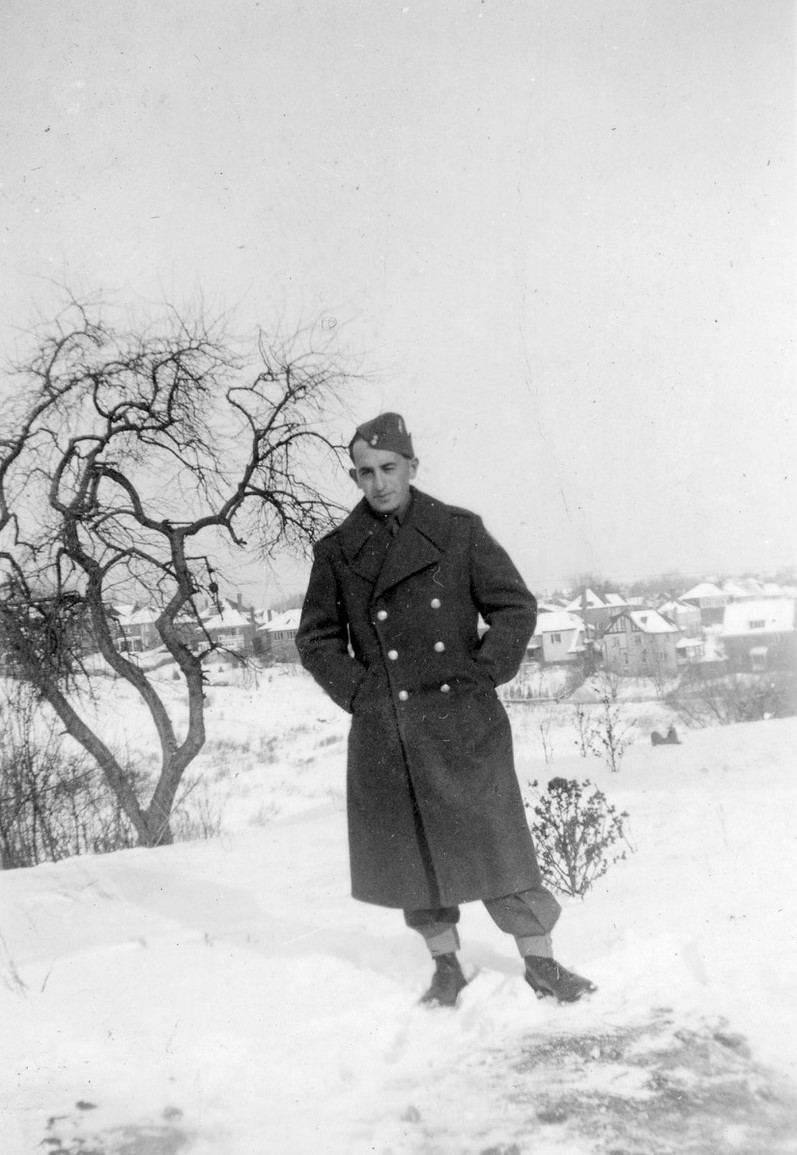
On 3 January 1943 Armand sailed on the Nortind to New York, and from there on 13 January to Guelph in Canada, where training took place in a Dutch battalion. After six weeks of training, on 10 March 1943 Armand was taken to the United Kingdom on the Queen Elisabeth, together with many fellow passengers from the Cabo and the Nortind, for further training with the regular army, the Prinses Irene Brigade. On 17 March he arrived in Gourock (Scotland). He was given army number 3411 and stationed at Dovercourt, a small suburb of the port of Harwich. As the clasp ‘Normandy 1944’ awarded to him shows, from 7 August Armand took part in the fighting in Normandy. On leave, Armand sought entertainment in London clubs. Here too he gave my father’s home address, 50 Lancaster Gate.
On 26 April 1945 Armand went on extended leave; his service ended on 15 May 1945, after exactly two years.
Armand went back to live in Brussels, where on 8 November 1947 he married Liliane Delongueville. Their daughter Yetty (Henriette, named after her grandmother) was born on 26 August 1948. After a short period in Morocco in the 1950s, the family settled in Brussels again. Armand worked as a travelling salesman in fabrics and Persian carpets. In 1965 Armand and Liliane separated.
Armand Eismann died on 27 October 1981 and is buried in the Jewish section of the cemetery in Etterbeek (Brussels).
But my story does not end there.
Above, I wrote that my father gave Armand, and many others, money to support themselves. This comes up several times in my book Het ongeloof . On the advice of Queen Wilhelmina, my father applied in London for reimbursement of the costs he had incurred during his stay in Lyon and his journey to Spain and Portugal. He submitted the application together with statements from a number of the “Engelandvaarders” he had helped. At the Ministry of War, however, he was told that nobody had asked him to help the “Engelandvaarders”. The hopelessly failing consul-general in France, Ate Sevenster, went one better after the war by writing that Dutch servicemen in London had handed over part of their pay to my father.
In my book I suggest that the opposite was true: the government, never very generous when it came to supporting refugees, had deducted the sums my father had provided from the servicemen’s pay.
I found the proof of this in the file I received from Yetty Buisseret in early September this year. On 25 May 1944 the Minister of War wrote to Armand Eismann that on the basis of money lent to you by Mr S. Noach on Your journey from the Netherlands to England, you owe the sum of Fr.frs. 3000 = £17.1. A month later Armand confirmed this amount and asked for it to be settled.
And with that, this slanderous accusation against my father by the Dutch consul-general in France, Ate Sevenster, is also completely demolished.
(1) Uitgeverij Verbum, Almere, 2022.
(2) His surname is sometimes written with one n, Eisman; I follow the spelling in the civil register.
(3) Just south-west of Toulouse, now a suburb (banlieue).
(4) Oranje Zal Overwinnen (Orange Will Prevail).
(5) Rosine was deported from Drancy (France) to Auschwitz on 3 February 1944 and murdered there on 2 March. Sarah, deported from Lyon to Auschwitz five months later, survived the extermination camp.