“The flowers never arrived”
by Jos Teunissen
Standing on a dune and gazing out over the North Sea, the writer Martin Hendriksma bound himself to the fate of the missing “Engelandvaarders” Ernst Moltzer, Dick van der Flier and Kees Kolff. The result is astonishing.
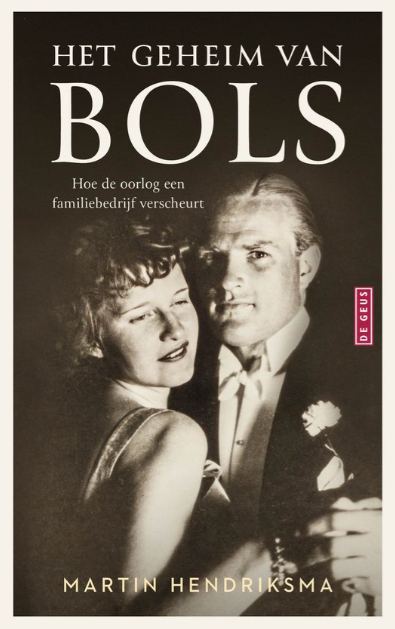
Hendriksma takes us on a search that at times leaves you breathless. The outcome is almost unbelievable: how is it possible that, on the 750,000 square kilometres of the North Sea floor, it was Ernst Moltzer’s jaw of all things that snagged in a fishing net in the spring of 2003! Rightly, his recently presented book ‘Het geheim van Bols‘ (The secret of Bols) received a great deal of media attention for this spectacular fact alone.
The book traces the development of the gin company Bols, starting from the question of whether the firm was ‘fout’ – on the wrong side – during the German occupation of the Netherlands. With the German army and the Waffen-SS as its main customers, and the excellent business Bols did with and in Nazi Germany, it certainly looks that way. Fortunately, Hendriksma does not wag a moralising finger, but leaves that to the reflections of others.
Yes, Bols’s turnover increased sixfold during the war, the Bols management wrote ‘friendly little letters’ to the occupier that helped prise extra orders out of Germany, and there were other activities you could label ‘questionable’. But the judges, magistrates and public prosecutors of the post-war Bijzondere Rechtspleging (special tribunals for collaboration cases) could not reach a verdict. The ‘rivers of gin’ Bols supplied to the Germans will probably have had a negative rather than a positive effect on the performance of the Wehrmacht.
Moreover, there was simply no avoiding deliveries to the occupier. Refusing or stopping production would not have meant shutting the company down, because the Germans would undoubtedly have continued production as a wholly German company working exclusively for the enemy. The centuries-old family business and its secret recipes would then have been lost. The management also protested repeatedly against all German orders being placed with Bols, and argued for passing part of the German orders on to other firms.
The judges’ verdict on Bernard Carp (a cousin of Ernst Moltzer by marriage, who together with Ernst and Ernst’s uncle Chris formed the Bols management) is harsh, however. With his brother Joop, Bernard founded the Dietsche Handel Maatschappij to make trade with the German occupier easier. ‘While the Dutch people suffered horribly under the ruthless German yoke’, the verdict reads, Bernard Carp ‘during a large part of the past occupation enriched himself considerably, precisely because of that occupation’.
Joop too is interned for this reason. The four years’ imprisonment demanded by the Bijzonder Gerechtshof (Special Court) in October 1948 is eventually reduced to three. Bernard must also pay a fine of fifty thousand guilders and is barred for ten years from being director of a drinks company. After a few years the brothers were able to ‘return to their villas with chestnut trees, swimming pool and tennis court.’ The Zuiveringsraad (purge board) is the only body that, a year after the war, still cares about Bols’s wartime past. Jan Moltzer, Ernst’s father, joined the new management.
During 1946 ‘a flood of orders’ was already pouring into Bols again, for which the Dutch government ‘is glad to make raw materials available, since for it this means a welcome gain in foreign currency’.
Soon after the occupation began, Ernst Moltzer watched Bols’s rapidly rising turnover with dismay. In the 1930s he had felt some sympathy for Adolf Hitler, but by 1940 the scales had long since fallen from his eyes.
He believes no extra gin should be supplied voluntarily to the German occupier. Bols agents who come to the office on the Rozengracht to place Wehrmacht orders get a dressing-down from him. It leads to friction with his fellow directors, uncle Chris and Bernard Carp.
Carp in particular finds Ernst’s anti-German attitude untenable. With a German Verwalter (administrator) installed at Bols, there is a threat of German reprisals or perhaps even a temporary closure of the company.
In December 1940 the Germans oust him from the management of the Bols branch in Emmerich. Uncle Chris and Bernard Carp put him on reduced pay: half his salary plus two bottles of gin a month.
Ernst – a Draufgänger (daredevil), according to Hendriksma – feels it as a defeat. He withdraws to the villa at Anton Mauvelaan 6 in Heemstede, where his wife, the Austrian countess Traut Sarnthein, ten years his junior, is going through a difficult pregnancy.
In the spring and summer of ’41 he takes part in sailing races at a sailing club in Aalsmeer, and on 28 May his daughter Maya is born, but that does not stop him being depressed. His marriage to Traut is not a success and in the occupied Netherlands he has no prospects. In Dick van der Flier, 15 years his senior, he finds someone who also wants to go to England. Van der Flier sees the 31-year-old Ernst as ‘a man with whom you could safely cross the North Sea in the dark’, writes Hendriksma.
Kees Kolff, in his late twenties, a banker who had served as a soldier during the German invasion, joins them. By the end of August ’41 they are ready to leave. Ernst buys a ‘Spaarnejol’ (a small Spaarne-type sailing dinghy) from the Koninklijke De Vries Scheepsbouw shipyard in Aalsmeer. They name the boat ‘Ozo’ (Oranje Zal Overwinnen – Orange Will Prevail).
Dick and Ernst rent a holiday home in Noordwijk aan Zee. So as not to attract attention, Traut, little Maya and Dick’s wife come too. Everything has to look like a pleasant family holiday at the coast. Kees stays in a hotel with his family. The author shows snapshots from the family album of the men lounging in their wicker beach chairs, a cigarette in the corner of the mouth. Or strolling, apparently carefree, in their swimming trunks along the beach and, with the pram, along the Noordwijk promenade, meanwhile studying the patterns of the German patrols. Further off, the Ozo lies in a garage, with the petrol and food for a few days at sea.
They want to leave at the end of October, but there are too many German soldiers about. Ernst Moltzer goes into hiding, probably in the villa ‘Stormhoek’ on the Zandvoort promenade, where members of Traut’s family live. The Ozo stays in the garage. A further escape attempt, this time from the dunes somewhere near Bloemendaal aan Zee, is called off in time; there are signs that the Germans are on to the three men. They now have to cross the North Sea as soon as possible.
It is to happen on the evening of 14 November. In the morning Ernst sends his wife and child back to Heemstede. The boat has to be driven to the departure point; the chances of arrest are growing. That day the temperature barely rises above freezing. Conditions seem perfect: a moderate easterly wind, a calm sea, plenty of cloud. Together they load the Ozo onto the cart. Shortly after ten the three men, accompanied by Hopman, begin their trek through the dunes. It is a kilometre and a half from Egmond-Binnen via the Oude Schulpweg to the sea. Three steep slopes, and then the final dune with the foredune ridge. At around eleven the Ozo drifts away on the first wave. For hours Engel Hopman gazes out over the water from the top of his dune. Nothing alarms him: not a German in sight, new waves rolling up the beach. Otherwise all is quiet.
Ernst had to promise Traut that he would send word as soon as he reached London, and that the same evening Radio Oranje would broadcast the message that ‘the flowers have arrived safely’. But no message comes from London. Even after two weeks there is still no news. The realisation begins to dawn that they will never see the men again.
To explain the failure, Hendriksma consulted experienced offshore sailors. They unanimously reached this conclusion: the Ozo was completely unsuitable for going to sea, even though Ernst Moltzer had made improvements to it. The dinghy was built for trips on the Westeinderplassen lakes, not for rough water, and designed for one person. With the weight of three men and a quantity of petrol, the Ozo sat too low in the water. With a strong wave, seawater would pour into the boat. The men did not stand a chance.
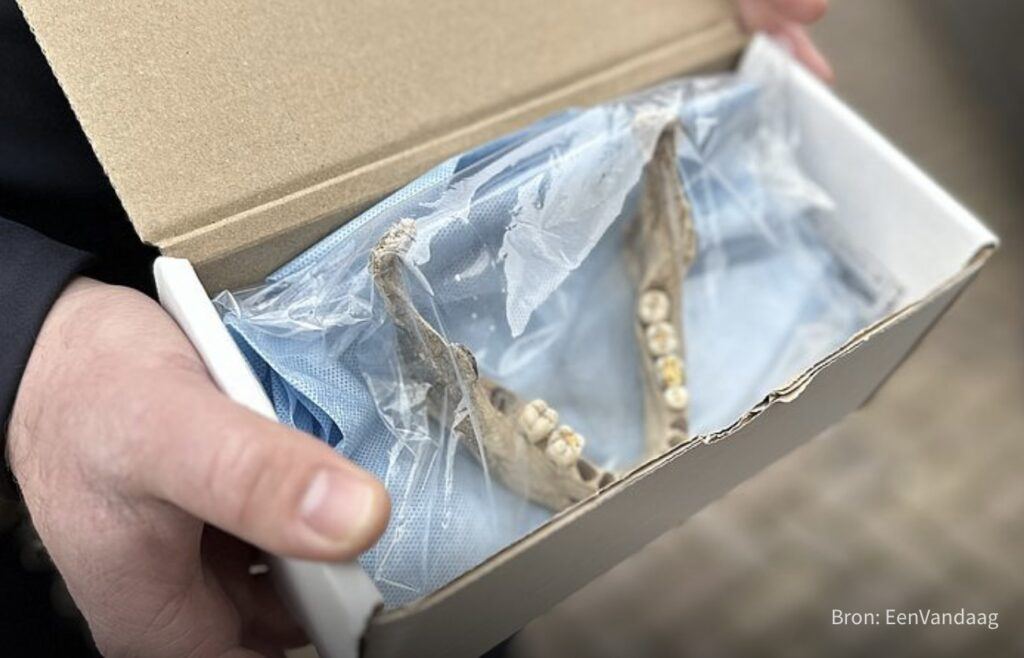
For sixty years the remains of Ernst, Dick and Kees drifted around the North Sea. Until Thursday 24 April 2003, when the Texel fishing cutter TX45 cast its nets about five kilometres off the coast at Petten. When the TX45 hauls in its nets, there is something other than fish in them: a bone. That happens quite often on the North Sea. Trawling churns up the seabed, exposing bones, some of them very old. Many fishermen throw such bones back overboard almost without looking; it saves paperwork. But the crew of the TX45 see that this is no ordinary bone; it is a human lower jaw. The jaw is handed over to the maritime police and then to the Netherlands Forensic Institute for DNA testing.
In early 2009 the ‘Petten jaw’ is entered in the Missing Persons Databank. For fourteen years there is no match, but in early 2023 staff member Ger Sperling is moved by the story Hendriksma tells him about the three men lost at sea in 1941.
Looking for a match, he takes DNA samples from their families, who cooperate fully. And lo and behold: the jaw turns out to belong to the remains of Ernst Moltzer! On 17 February this year the bone was buried at the Nationaal Ereveld (national war cemetery) in Loenen.
Research by Museum Engelandvaarders shows that the number of “Engelandvaarders” lost on the North Sea must be revised upwards. Finds such as Moltzer’s jaw make the picture of Dutch people escaping from the coast to the free world more complete.
Martin Hendriksma: Het geheim van Bols – Hoe de oorlog een familiebedrijf verscheurt (The secret of Bols – How the war tore a family business apart). Published by De Geus, 352 pages. € 24.99. The book is on sale in the museum.
On Thursday 6 June Hendriksma will give a talk about his research at the museum. Starts: 19.30. More information will follow soon on the website and in the newsletter. Not signed up yet?
EenVandaag report on Ernst Moltzer and his identification after 82 years (in Dutch)