Over to the Royal Air Force
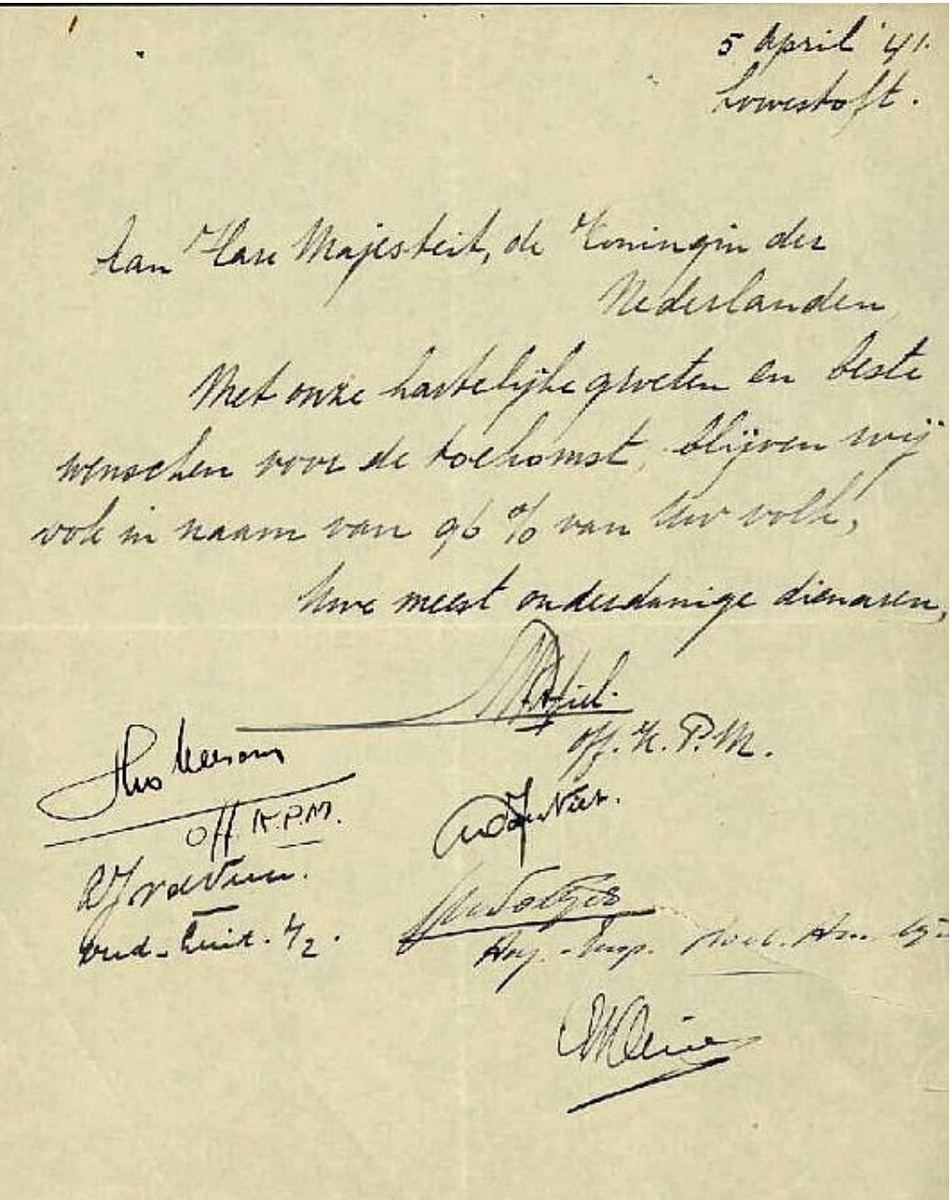
When Albert (Ab) Roessingh sets foot ashore in Glasgow in early October 1941, he already more or less knows what he wants: to become a pilot. That way he can play an active part in the liberation of the Netherlands and in ending the Second World War. On arriving in London, Roessingh therefore lets it be known that he wants to join the RAF. There are opportunities to do so, because from the spring of 1941 the Dutch government-in-exile is allowed to second groups of volunteers to the British air force at regular intervals.
As an “Engelandvaarder”, Roessingh has good credentials to back up his preference for a flying role. The medical poses no obstacle: Roessingh is welcome. On 24 November 1941 the moment comes and he is enrolled in the RAF Volunteer Reserve as a pupil pilot with the service number 113895. Because he had risen to reserve first lieutenant during his national service in the Netherlands, he is also commissioned in the RAF, though in the slightly lower rank of pilot officer (second lieutenant).
The training takes place entirely within the framework of the British Commonwealth Air Training Plan (BCATP), set up in 1939, under which thousands of wartime volunteers from the Commonwealth and the occupied European countries are trained in a uniform way – mainly in New Zealand, Australia, South Africa and Canada – as pilots, navigators, bomb aimers, wireless operators, air gunners or other aircrew. At the end of November Ab Roessingh reports with a number of compatriots to an Aircrew Receiving Centre (ACRC) in central London. At this reception depot he is issued with his uniform and kit, given an RAF pass and various vaccinations. From now on Roessingh is clearly recognisable as a pilot under training by the white flash on his forage cap.
Just before Christmas 1941 the Dutchman moves with his fellow trainees to Trinity College, Cambridge. Here they – eight lieutenants and sixteen other ranks – undergo their basic military training at No. 2 Initial Training Wing (ITW). During these two months the would-be pilots are served plenty of sport and drill. They also spend many hours in the classroom, taking lessons in mathematics, administration, law, physiology, geography and hygiene, as well as studying air force subjects such as navigation, meteorology, aircraft recognition and aircraft engineering. Because Ab and his Dutch colleagues are part of regular classes, all teaching is in English.
Roessingh, the troublemaker
The time in Cambridge does not exactly go smoothly. According to the British commanding officer, the behaviour of the eight Dutch trainees holding officer rank – Roessingh among them – is often unbecoming of an officer. The Dutch liaison officer from the Ministry of War at the Air Ministry, Captain Jan Berdenis van Berlekom, has to step in to discuss the crisis. “Soon some of our officers were arriving late for lessons or even staying away altogether,” Berdenis van Berlekom writes in his report to his superiors after returning to London. “Quite rightly, the Commandant then ordered that from then on they had to march with the cadets. These young lieutenants felt this to be undignified treatment which, in their view, could harm their prestige with the Dutch cadets.
They expressed these feelings by sulking, which made matters worse.” Roessingh in particular goes too far. On one occasion he is absent without leave for almost twenty hours, causing him to miss an exam.
The British commanding officer then decides to dismiss Roessingh. Only after profuse apologies from Berdenis van Berlekom is the decision reversed. The captain then makes a point of giving the young man from Tilburg a dressing-down in a private interview. Roessingh gets the message and, like his comrades for that matter, behaves impeccably for the rest of his time in Cambridge. Shortly afterwards – on 22 April 1942 – the course ends, and during the leave that follows Roessingh has time to reflect on his conduct.
So far no aircraft has been involved. That changes in mid-May 1942, with the move to Desford airfield for the next stage of training: the roughly two-week grading course at No. 7 Elementary Flying Training School (EFTS). This consists of about twelve hours of flying lessons in the De Havilland Tiger Moth, a small biplane. The main aim of this short flying course is to find out whether the pupil pilots have enough aptitude. To that end they make three test flights with their instructor, and they must also have flown solo before the end of the course.
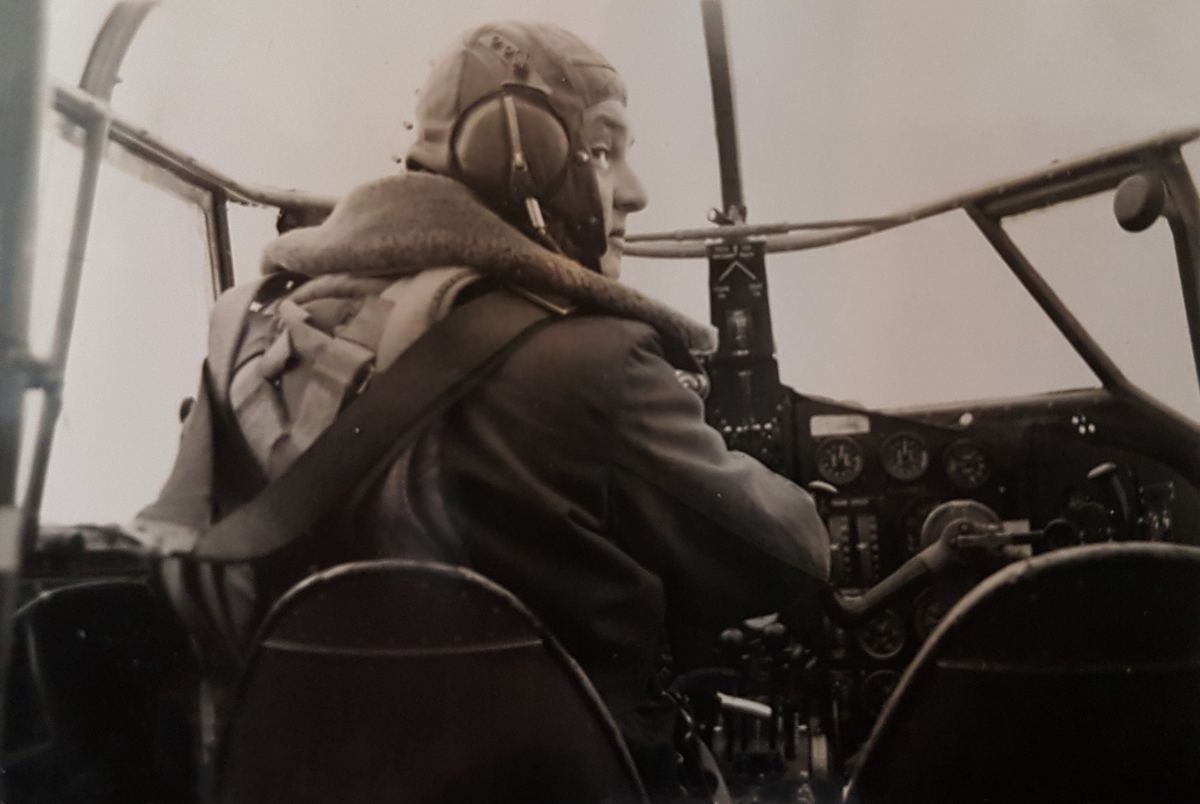
If the verdict is favourable, the candidate is admitted to pilot training proper. Those who drop out usually go on to train as navigators. Ab Roessingh is spared that route. He is one of the lucky ones who can prepare for ‘real’ pilot training.
Training in Canada
This takes place largely in Canada. Because of the precarious war situation, the crowded British airspace and the often poorer weather in England, most RAF flying schools were moved to Canada early in the war. So in June 1942, via a large transit depot in Manchester, Roessingh sails from Greenock in Scotland to North America aboard USAT Thomas H. Barry, an American troopship. After an uneventful voyage the ship docks in New York. There is no time for sightseeing, however: the group goes straight onto a train. After a long journey they end up at a depot in Moncton, in the Canadian province of New Brunswick. “This camp was another sort of waiting room where we spent 14 days,” says one of Roessingh’s fellow travellers, the future Lancaster pilot Jaap ’t Hart.
After another long train journey of four days and three nights, the group reports in mid-July at De Winton airfield near Calgary. This is home to No. 31 Elementary Flying Training School, where the first part of their pilot training will take place. The flying lessons are given in the Boeing Stearman, a sturdy biplane. Basic flying training at De Winton consists – besides the daily dose of theory – initially of learning standard manoeuvres such as take-off and landing, turning, and stalling the aircraft.
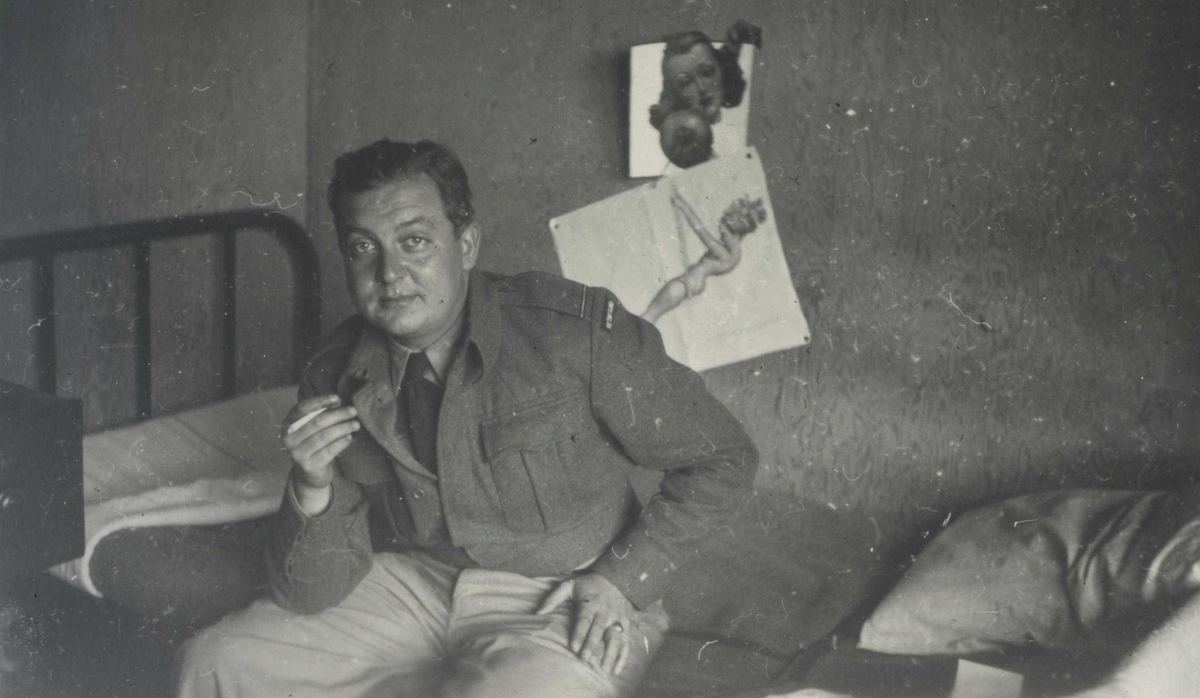
Once the pupil has mastered all this, the level of difficulty is raised. He also flies in darkness and learns to fly his aircraft using instruments alone. The course ends in late September 1942 with a flying test and a written exam. On the advice of the chief flying instructor, the would-be pilot is then posted to advanced training on either single-engine or multi-engine aircraft. Ab Roessingh passes through this stage without difficulty and, with a few others, is selected to fly multi-engine aircraft.
A visit to the United States
Before leaving for Medicine Hat airfield for advanced flying training, Ab Roessingh and five other Dutchmen take the opportunity to pay a short visit to the United States. On arrival in the small town of Butte, Montana, the local press soon gets wind of the Dutchmen’s presence. Jaap ’t Hart, mentioned above, and two others are even asked to give an interview on the local radio station.
’t Hart recalls: “Almost all of them except me [’t Hart was studying in Cambridge when war broke out] were “Engelandvaarders”, and one by one [they] told their stories. At the end they were asked how I had got to England. Without hesitation and with a straight face they declared that I had swum the Channel. And everyone believed it. It even made the paper.” The five need not worry about the journey back, by the way: a State Highway Patrol car drives them all the way back to Canada.
Roessingh and his companions selected for multi-engine training then arrive at Medicine Hat airfield in late September 1942. This is home to No. 34 Service Flying Training School (SFTS). The trainer this school uses is the Airspeed Oxford, a twin-engined wooden aircraft with a top speed of around 300 kilometres an hour. After about a month they move to Moose Jaw.
During advanced flying training at No. 32 SFTS, which takes between twelve and sixteen weeks, they fly a good hundred hours. On 22 January 1943 the day finally comes: Roessingh and his fellow trainees have their wings pinned on. They now officially hold the military pilot’s badge. They return to England by much the same route. After a short stay in Moncton they travel by train to New York, where they board the Queen Elizabeth, a large, fast liner.
Back in England
After a six-day voyage, Roessingh and the other Dutchmen arrive back in Great Britain. Via a ‘waiting room’ in Harrogate, the “Engelandvaarder” reports to No. 3 (P) Advanced Flying Unit (AFU). This unit is based at South Cerney airfield in the Cotswold district.
Here he takes an acclimatisation course to learn to fly in the far less stable European weather and in the blacked-out British airspace. As during advanced flying training in Canada, No. 3 AFU flies the Oxford. Roessingh comes through the course without any problems.
What follows next is combat training proper and conversion to the aircraft flown by the operational unit. Because Roessingh is destined for the Dutch 320 Squadron, he has to retrain on the B-25 Mitchell bomber. For this he is posted to No. 13 Operational Training Unit (OTU) at Bicester airfield. At about the same time the naval squadron is busy converting to the American bomber. The first aircraft are delivered in April. They replace the Lockheed Hudson the squadron had flown since 1940.
After a period of training and working up, the squadron’s first operational sortie follows on 12 June 1943: an air sea rescue mission over the North Sea, searching for shipwrecked sailors and airmen who have come down in the sea. More of these relatively safe missions follow over the next few weeks. They are used to build up further experience with the new aircraft.
With 320 Squadron
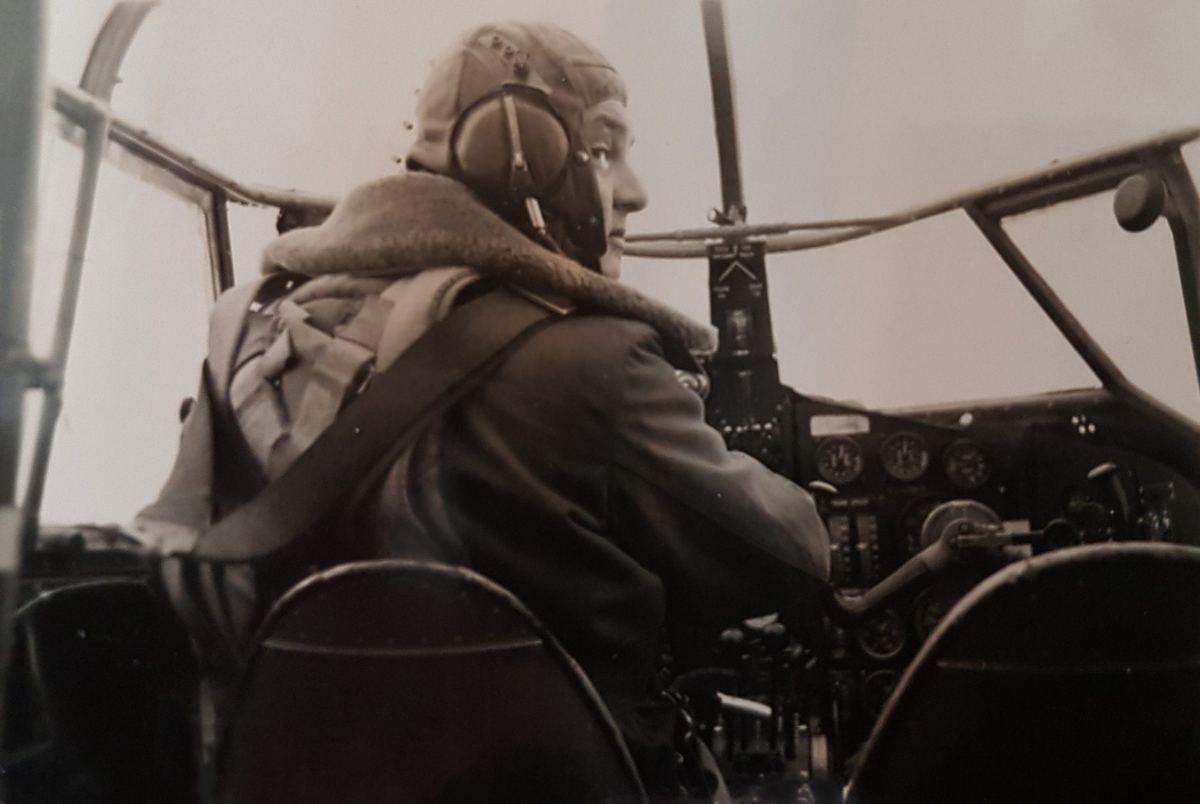
After completing his combat training at Bicester, Ab Roessingh’s secondment to the British air force comes to an end. In the second half of July he takes off his blue RAF uniform and swaps it for Dutch navy blue. He then reports in mid-July to 320 Squadron at Attlebridge airfield. At last he can do what he fled the Netherlands for: take part in the fight against Nazi Germany alongside the Allies. A long career as a wartime pilot, however, is not in store for him. On 28 July reserve first lieutenant pilot Ab Roessingh flies his first combat operation aboard the B-25 Mitchell with serial number FR144: an air sea rescue mission. Some empty lifeboats are spotted at sea, but otherwise the flight passes without notable incident. Two days later, on Friday 30 July 1943, Roessingh is again one of the five crew of the Mitchell with serial number FR144. Also on board are officer pilot second class W.J. Ritte, reserve first lieutenant pilot E. van ’t Eind, corporal wireless operator W.L. Blok and cook second class C.P.J.M. van der Does, who was also an “Engelandvaarder”. Together with five other bombers, the aircraft takes off from Attlebridge in the afternoon for another air sea rescue mission over the North Sea. In a box formation of six aircraft they patrol at low altitude over the sea. When the formation turns at around 15.15, things go horribly wrong. FR144 slips, a wingtip touches the waves and the aircraft plunges into the sea. The crew have no chance at all of getting out and are killed instantly.
The crash makes a deep impression on the other aircrews in the formation. Ab Roessingh’s friend Cees Waardenburg (also an “Engelandvaarder”) can barely grasp that his comrade, with whom he went through the whole of his pilot training, is gone. “One moment they’re flying next to you. Now there’s nothing but wreckage and no sign of the men. Life goes fast and you’re strongly reminded again of how short and relative it is. Ab has gone, suddenly. I can’t believe it. For a year and a half we shared the good times and the bad. (…) We went through everything together, and suddenly someone is gone from your life who, because of circumstances, was so very closely bound up with yours in many ways. There’s an emptiness in you that oppresses you. (…) Ab went before us into death. Who knows how soon I will follow.” Sadly, Waardenburg’s premonitions prove right. The 23-year-old from Schipluiden was killed just over a year later, on 30 August 1944, shortly after taking off in a Mitchell near the English town of Godalming.
The bodies of Ab Roessingh and his comrades were never recovered. They still rest in the North Sea. The crew is commemorated today at the Gedenkteken Luchtvarenden (Aircrew Memorial) in Soesterberg.