On the afternoon of Tuesday 26 March, the Nationaal Archief (Dutch National Archives) hosted the closing event of the “Engelandvaarders” project. In this project, the interrogations of the “Engelandvaarders” in London and countless supporting documents were digitised and made searchable online. As a result, we now know more about what the “Engelandvaarders” experienced on their journeys and which routes they took.
The afternoon opens with a presentation by the project leader, Pepijn Lucker of the Nationaal Archief. He explains that some 70 volunteers spent three years combing through all the interrogation reports and other documents. The project has ended, but the work is not yet finished: of the more than 2,100 “Engelandvaarders” they have identified, 400 now have their routes fully described. For 1,000 others this has been done in part, and the rest will follow.
Next up is Edwin Rutten, known from the legendary TV series de Film van Ome Willem, but also the son of film director and “Engelandvaarder” Gerard Rutten. In an interview with Pepijn Lucker he explains that his father refused to make films for the NSB, the Dutch Nazi party, and chose to escape to England instead. There, like many “Engelandvaarders”, he was interrogated by Oreste Pinto, who noted of Rutten: “a sincere and good Dutchman”.
What Edwin remembers most is that after arriving in London his father was put under psychological pressure to test whether he really was a loyal patriot. On one of his first days, for instance, Rutten heard an escort say: “That’s the gallows field – that’s where you’ll hang.” His son closes by urging everyone to visit Museum Engelandvaarders.
Using information unlocked by the project, WO2.net has created a superb theme page on the Oorlogsbronnen website: De tocht naar Engeland – Netwerk Oorlogsbronnen. Lizzy Jongma and Daan Raven show several handsome route maps on the site that trace the journeys of the “Engelandvaarders”.
After the break, Tim Feliks of the Nationaal Archief presents the teaching programme he has developed about the “Engelandvaarders” for the lower years of secondary school. Through the stories of the “Engelandvaarders” Ellis Brandon and Herman Friedhoff, pupils learn what primary and secondary historical sources are and when a source can be trusted.
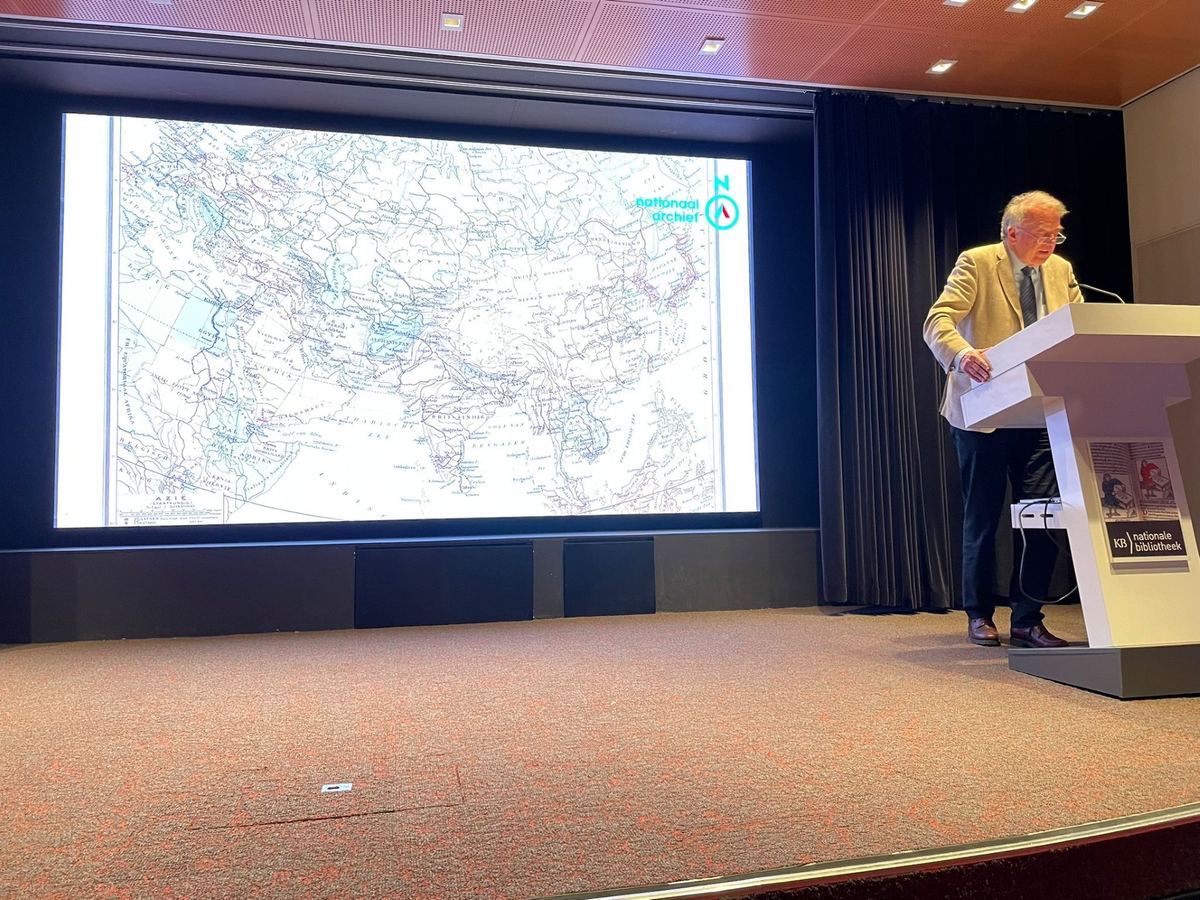
The final speaker is Sierk Plantinga of Museum Engelandvaarders. He takes us along the so-called Moscow route that some “Engelandvaarders” followed. Among other things, he tells the story of Andries Woudhuysen, who travelled via Stockholm, Riga, Moscow, Vladivostok, Tokyo, Honolulu and San Francisco to New York. “And there, after all that effort, he was declared medically unfit for military service.“ In the end Andries was passed fit after all, and he reached England after two and a half years.
Hugo Pos also travelled via Moscow. There he was “taken under the wing of ladies from Bureau Intourist, who showed him several magnificent museums and did not leave his side until they had put him on the train. What he did not know was that Bureau Intourist was an out-and-out KGB operation. For Stalin, the idea of a bunch of foreigners roaming Moscow unsupervised was intolerable – far too dangerous.” The option of reaching England via Moscow ended on 22 June 1941, when Germany invaded the Soviet Union in Operation Barbarossa. Thanks to the Moscow route, some 55 young Dutch people eventually reached their goal.
Sierk’s full lecture will appear in a forthcoming newsletter. Would you like to receive the newsletter? Sign up here.