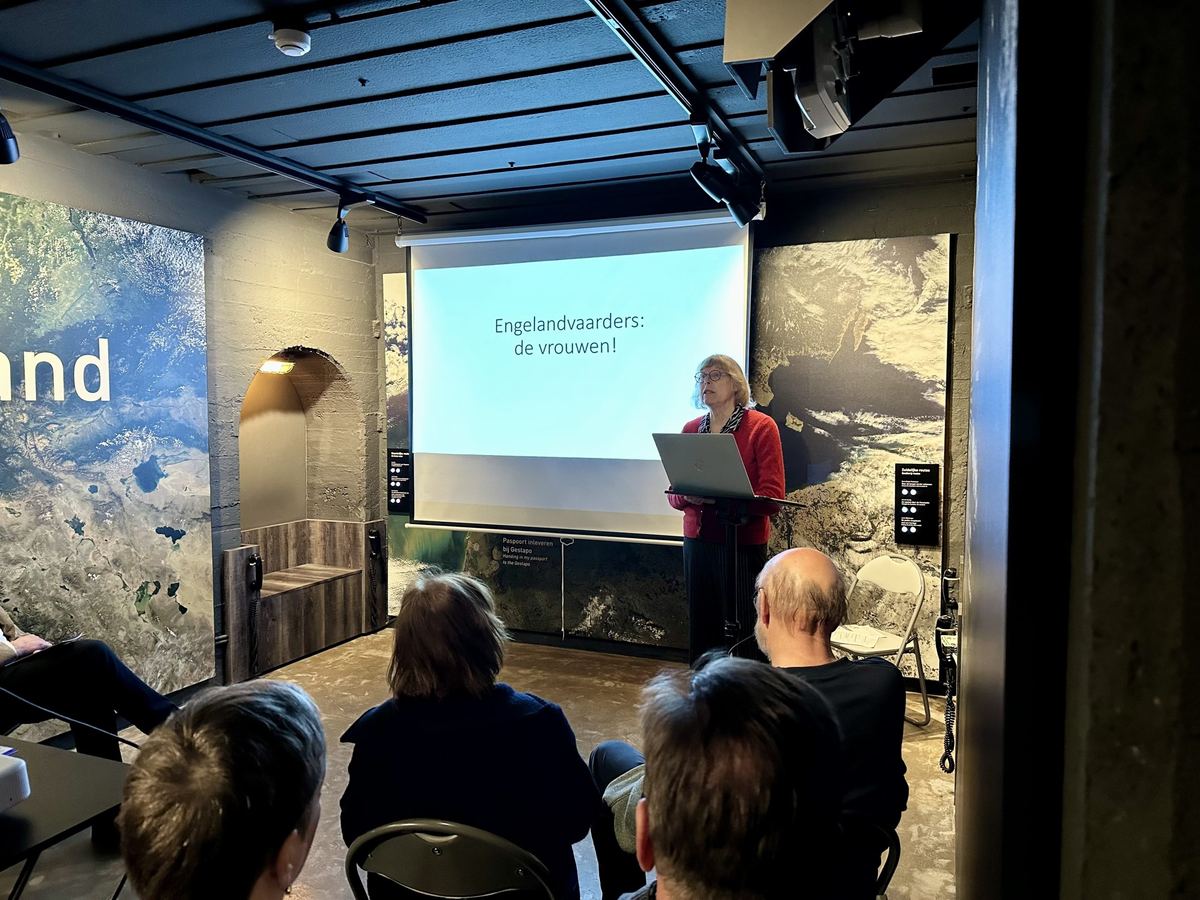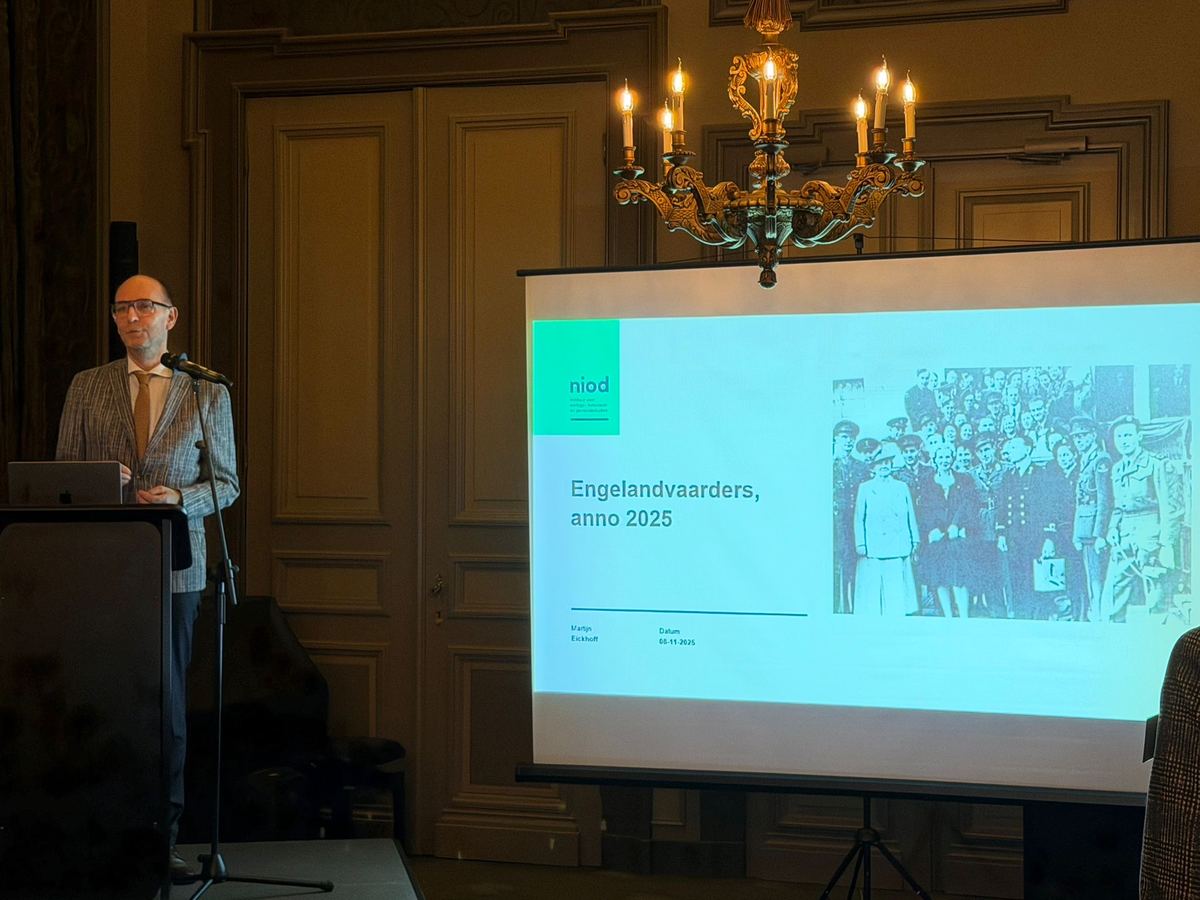
On 8 November, at the celebration of the museum’s tenth anniversary in Sociëteit De Witte, Martijn Eickhoff, director of the NIOD Institute for War, Holocaust and Genocide Studies, gave a talk on “Engelandvaarders” in 2025. In it he addressed the question of how the “Engelandvaarder” can remain within reach as an inspiring role model for today’s Dutch people and for generations to come.
The “Engelandvaarders” continue to fascinate, and every “Engelandvaarder” is unique – I realised that while preparing this talk. I share this with you knowing that there is no clear, delimiting definition, and that the known number of “Engelandvaarders” is still growing. What fascinates me most are the questions of what drove them and what they achieved (or did not), what their relationships with their families were like, what their social position was, how they looked back on their “Engelandvaart” as a group or as individuals, what picture we have of them now, and how that picture has developed over time. The question of what kind of people the “Engelandvaarders” were is therefore directly related to two important issues of today: the future of commemorating the Second World War, and the status of heroism in 2025.
These issues also came up in my preliminary conversation with the board of Museum Engelandvaarders. I was asked to address how the stories of the “Engelandvaarders” can be made a source of inspiration in 2025 – 80 years after the end of the war – and the related question: ‘what would you do?’. That last question is put to visitors explicitly in Museum Engelandvaarders. The board’s request does not stand alone. As director of NIOD I have been asked repeatedly over the past year how we can keep passing on the lessons of the Second World War with real impact, precisely at a time that many people experience as ‘the 1930s’ of the 21st century.
Before I go into that further, I want to share an important insight from research into remembrance – memory studies – with you: the difference between cultural memory and communicative memory. Cultural memory stands for the official story, told in national histories and museums, depicted in documentaries and films, and preserved in archives. Where the “Engelandvaarders” are concerned, the emphasis is on the heroic and on being united in the inspiration of ‘God – Orange – Fatherland’. Alongside this there is communicative memory, as passed on within families and personal relationships. Against that background you are a special audience. I do not want to generalise, but you are certainly familiar with the cultural memory, while you also grew up with stories from your own circle, with taboos and silences, and you have felt the emotions that go with them. That makes you a group that knows better than anyone the dilemmas and complexities of resistance, at second or perhaps third hand.
In 2010 my colleague Remco Ensel and I wrote the article ‘Soldaat van Oranje’ (Soldier of Orange), in which we observed that the biography of Erik Hazelhoff Roelfzema is a prime example of a story that gives meaning to the national wartime past, carried by publications, a film and a musical. We also noted that the term ‘Soldaat van Oranje’ – introduced in 1971 with the reprint of Hazelhoff Roelfzema’s autobiography – is an expression of the democratisation of heroism. This process had already begun in the 19th century, when slowly but surely not only officers but also ordinary soldiers found a place in heroic historiography and commemoration. As ‘Soldiers of Orange’, individual citizens in the Second World War could now also fight the enemy in the name of the Royal House.
The canonised story of Soldaat van Oranje fitted perfectly with the Netherlands’ self-image as a nation of resistance, which was central to historiography and remembrance culture immediately after the war. That made it highly influential, even though it clashed with divergent experiences within the group of “Engelandvaarders”. Were there not other, perhaps more complex, motives for joining the resistance? And could the “Engelandvaarders”, as a tiny minority, really serve as the norm for the rest of the Dutch population?
Loe de Jong, the first director of NIOD – then called RIOD – was one of the main architects of the great meaning-giving story of the Second World War. He wrote a history in which right and wrong (‘goed’ and ‘fout’) were the guiding moral categories of behaviour, and he was also the first to compile an extensive history of the “Engelandvaarders” based on historical research. In volume 9 of Het Koninkrijk der Nederlanden in de Tweede Wereldoorlog (The Kingdom of the Netherlands in the Second World War, 1979), De Jong devotes some 125 pages to their fortunes, while the subject comes up on more than 200 pages across all the volumes. De Jong assumes that all “Engelandvaarders” shared the same mentality. He presents them as a group of enterprising and recalcitrant people who, once they had landed in the complacent Dutch community in London, felt that people there understood little of what life under German occupation meant. It stands to reason that De Jong was not guided solely by objective historical research in his reflections; he lived and worked in London during the war years, was close to the action and will have formed his own judgement of the “Engelandvaarders” and their relationship with the Dutch bureaucracy from his own observation.
De Jong’s fascination with the “Engelandvaarders” comes out most clearly in the film script ‘Geheim agent’ (Secret agent), which he wrote in 1966 while on holiday in the Dordogne. It reconstructed the life and death of the London government’s first secret agent: Lieutenant Lodewijk van Hamel of the Royal Netherlands Navy. A gripping story, according to De Jong himself, but the film producer was hesitant, and in the end it was never filmed. In the script, however, there was no question of resistance bravado: ‘Geheim agent’ centred on the selfless human solidarity of ordinary Dutch people – people who had put their lives on the line for others and in doing so had set an example for the Dutch population.
When in 2015 the initiative to found Museum Engelandvaarders came from within your ranks, the Netherlands’ status as a ‘nation of resistance’ had already been substantially revised. That process had begun in the 1960s, as the involvement of Dutch society in the Holocaust came ever more explicitly into view. That a pro-German group of Dutch people had actively collaborated was never in dispute, but it became increasingly clear that besides collective obstruction or resistance there had also been accommodation, passivity, and even indifference and looking the other way.
Then, at the start of the 21st century, with reference to a so-called ‘Grey Past’ of the occupation years, a debate arose about whether people’s involvement in resistance or collaboration had always been a conscious choice. Had chance and circumstance not been far more important to the relationship between the Dutch and the occupying power? Had most people during the occupation years not simply muddled through, with little room for principles? It led Arnon Grunberg to sigh that if the unmasking of heroism becomes commonplace, that may also mean that looking the other way in the present is ‘morally supported’.
This fragmented picture makes exploring the future of remembrance and commemoration a difficult task. The Second World War is not a ‘closed chapter’; it continues to occupy, unite and divide us. The fear of forgetting – whether suffering, heroism or failure – is not new in the Netherlands: it has been a constant concern since 1945. But now, in 2025, we are also seeing the distance to the Second World War grow: literally in time and because the witnesses are dying out, but also because of genocidal violence and wars in today’s world that demand our attention. At the same time, there is visibly more room in the memory of the Second World War for individual stories, including dissenting voices and the stories of minorities. Current social and political developments are driving this, whether the Black Lives Matter or MeToo movements, rising antisemitism, criticism of the democratic system or the international legal order, or the link between social media and polarisation.
An understanding of all these partly contradictory developments in the cultural memory of the Second World War in the Netherlands made my visit to Museum Engelandvaarders in October 2025 extremely interesting. The bunker is a very effective museum space: it creates a certain sense of oppression and evokes the atmosphere of a time capsule in which the stories of the “Engelandvaarders” come into their own. The museum leaves no room for nostalgia or romanticisation, and so does justice to the danger the individual “Engelandvaarders” faced and the suffering they endured. Nor is there room for a single heroic, nationalist story set in stone. While heroism and patriotism are certainly addressed, no uniform picture of the group is painted. Instead there is room for many voices and for diversity (think of women, Jews and those left behind, and of differing motives, routes and experiences). The presence of personal items – original documents, objects and photographs – is crucial in this context.
In the days when the Netherlands saw itself primarily as a nation of resistance, the “Engelandvaarders” ultimately served above all as a vanguard. After 80 years of historical research, however, it has become clear that German occupation policy was far more effective than people long wanted to see or admit. The harnessing of the Dutch economy to German war aims and the persecution of Jews, and of Roma and Sinti, were a success from the German perspective. The ‘Gleichschaltung’ (forced alignment) of the Netherlands – reorganising society on Nazi principles – also went relatively smoothly. Supported by propaganda and cultural policy, the aryanisation of Dutch society took shape and the leadership principle was introduced, while the civil service and the business world generally carried on working without any significant problems.
This realisation makes the individual stories of the “Engelandvaarders” all the more relevant. Whether it was ‘chance’ or principle, or a mix of the two, their commitment was not the norm for the rest of the Netherlands. The more we know about the human complexity behind the hero status – what risks they took and why they broke away from the structures of their settled social lives – the better we understand why some people, in certain situations, put the well-understood common good above their own interests. The stories may then become less normative, but more compelling, and more powerful too. For by not lumping the “Engelandvaarders” together, not putting them on a pedestal, and so making them more human, the democratisation of heroism continues. Only in this way will the “Engelandvaarder” remain within reach as an inspiring role model for today’s Dutch people and for generations to come.