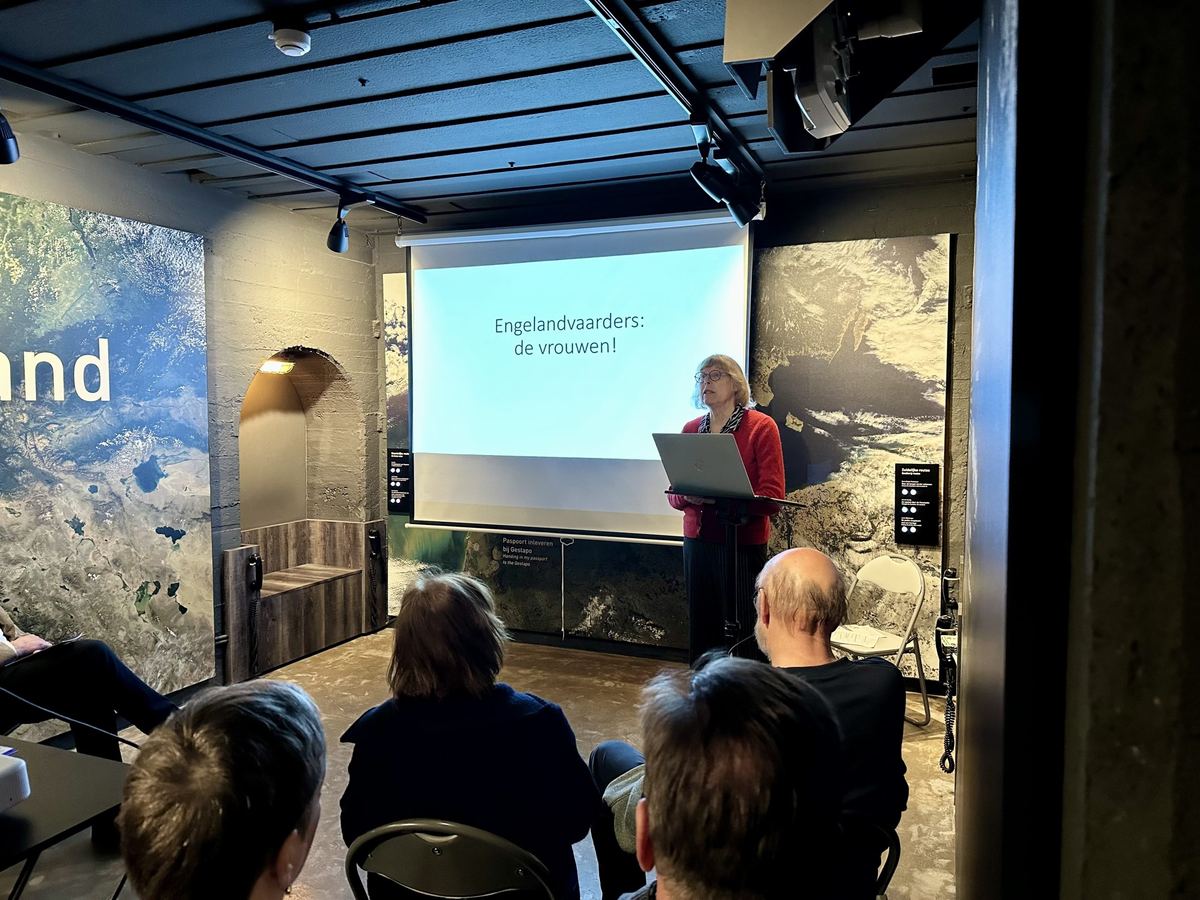
On 17 December Agnes Dessing gave a talk at the museum about women “Engelandvaarders”. Agnes, who completed her doctoral research on “Engelandvaarders” in 2004, gave a witty and revealing account of what women “Engelandvaarders” went through.
Speaking to an attentive audience of almost forty people, Agnes first addressed the question of why there were so few women among the “Engelandvaarders”: in her doctoral research, just 48 out of 1,700. In her view the main reasons were that the German measures (apart from those directed against the Jews) did not apply to women, and that women saw no role for themselves – after all, there was no conscription for women.
For some of the women “Engelandvaarders” we know what drove them to go to England: like the men, they wanted to fight!
One of them was Ida Veldhuyzen van Zanten. Ida made two attempts to cross the North Sea and eventually reached England via Spain and Portugal. There she spent the rest of the war ferrying aircraft from the factories to air force bases. Taking part in the fighting in the air was not allowed; that was reserved for men.
The sisters Carla and Babs Musaph were around twenty when they too travelled to England by the southern route. In their account of the journey they wrote: “We have crossed four borders illegally, we have fought for our ideal, and we hope our reward will be that we can help in the great struggle for final victory. Long live the Queen!” Travelling as a woman alone was not easy, as the two sisters found out when they had to deal with a café owner who could not keep his hands to himself. They wrote matter-of-factly in their account: “Firm action nipped this in the bud”.
Women “Engelandvaarders” suffered just as many hardships and setbacks on the way as their male counterparts. Josepha Mendels, a journalist and writer, was robbed by her “passeur” (guide) in the middle of the Pyrenees of all her money and the manuscript of her first book, and was then abandoned by him. She wandered through the mountains for days without food or water until she finally reached Spain under her own steam.
Once in England, most women “Engelandvaarders” ended up in office jobs, often doing deadly dull work. Ellis Brandon, for example, was put to work at the Ministry of the Interior writing the names of newly arrived Dutch people in a large ledger. To make her life a little less tedious, she was allowed to keep watch on the ministry roof in the evenings to spot enemy aircraft in good time.
Small wonder, then, that the women “Engelandvaarders” looked with envy at the military corps open to British women. At the end of 1941 Britain had introduced conscription for women as well. More and more voices called for conscription for Dutch women too – not only for “Engelandvaarders”, but also for women in the United States, Suriname and the Netherlands Antilles. Yet when the Minister of War, Van Lidth de Jeude, put forward a proposal for female conscription, the Council of Ministers shot it down at once: “This way we’ll lose all our secretaries and typists”.
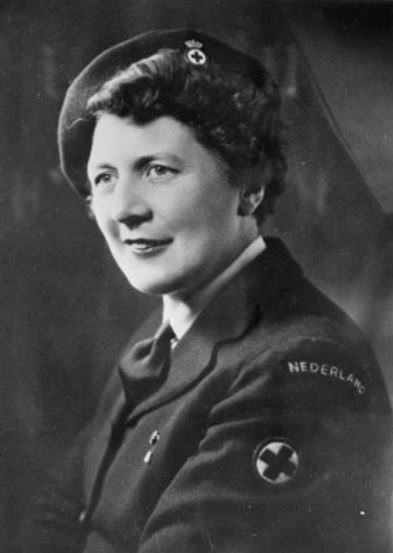
Eventually, at the end of 1943, the Vrijwillig Vrouwen Hulpkorps (Women’s Voluntary Auxiliary Corps, later known as the VHK) was founded to provide humanitarian aid behind the front line. An “Engelandvaarder” such as Rie Stokvis-Knapper was given a staff post in the corps. In that role she went to recruit women for the corps in the Antilles and Suriname, but when she wanted to do the same in the United States, her own minister called her back, declaring “That’s quite enough”. She later became aide-de-camp to Queen Wilhelmina. When she accompanied the Queen to the liberated south of the country, one of her tasks was to find crockery for the royal residence in Breda.
To do so she went to relatives in the area. Nico Knapper, now 91, saw her arrive when he was her ten-year-old nephew. A guest at the talk, he said: “I don’t know if we ever got the crockery back”.
To close her talk, Agnes looked at what women “Engelandvaarders” did after the war. Rie Stokvis-Knapper moved to France, disappointed over the political “renewal” that the Queen too had hoped for. Josepha Mendels carried on writing and in 1985 became the first recipient of the Anna Bijns Prize for women writers. She was also the first “BOM-moeder”: a woman who deliberately chose to be an unmarried mother.
So ended a fascinating talk full of anecdotes, with the conclusion that women “Engelandvaarders” had to overcome many extra hurdles to be of use to the Allied cause.