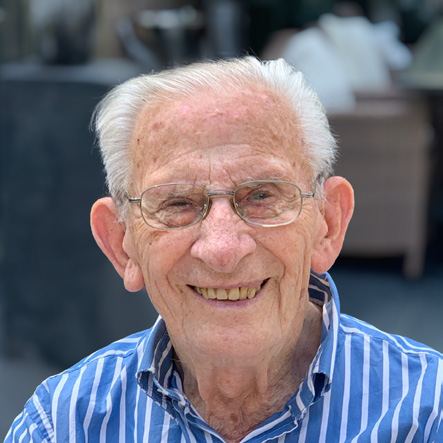
Leendert Koops, born on 9 August 1919 in Groningen into a family of 11 children, was serving as a seaman on the SS Maaskerk in the spring of 1940. On 7 May the ship was in the port of Antwerp. When the German army invaded the Netherlands and the defeat of the Dutch army became inevitable, the crew decided to make for England, intending to carry on the Allied fight from there.
A few days before Leendert was due to join the SS Abbekerk, the ship was hit by bombs during a Luftwaffe raid on London on 8 September 1940. He then volunteered as a reconnaissance soldier with the Dutch army in Congleton, but after a few months he applied for a transfer to the RAF. After training as a navigator, he joined the Dutch No. 320 Squadron of the RAF at the end of 1942, initially flying AVRO ANSON aircraft with the rank of second lieutenant.
In the autumn of 1943, Leendert flew as a navigator in B-25 Mitchell bombers on the operational sorties that “320” carried out for Bomber Command against targets in France.
He flew 72 missions in all, for which he received decorations including the Vliegerkruis (Dutch Flying Cross) and the British Defence Medal.
After demobilisation, Leendert worked for KLM at London’s Heathrow Airport until the 1980s. In 1981, after retiring, he set up an express courier service with his sons Eric and Jan and his daughter Annette.
He died on 27 September 1990. At his funeral, in the presence of former RAF comrades, “the Last Post” was sounded at sunset.
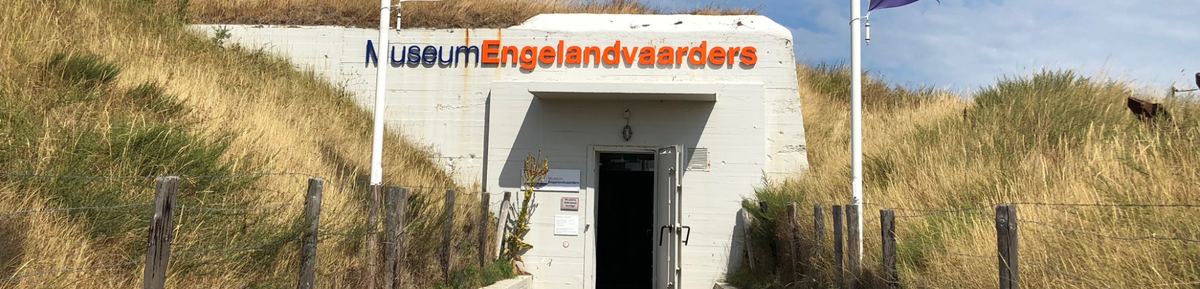
So reads the short biography in the Museum Engelandvaarders database.
I met Leendert Koops in 1984 at a dinner with his “320 mate” Henk Voorspuy in East Sussex. They had little or no wish to share their experiences with No. 320 Squadron with “outsiders”. Although I asked them about that time, they would only tell me, kindly, that I was too young to understand. Of course, I could not have guessed then that this meeting would lead, 38 years later, to my welcoming his children to Museum Engelandvaarders to remember him.
In November 2021, Adrie van der Knaap forwarded me an email from Michael Koops, one of Leendert’s sons, who, after four years of research with his sisters and brothers, had come up with information about his father’s wartime experiences.
At the beginning of June this year the moment came: Leen Koops’s story went into the database with photographs, and I was able to let the Koops family know. They promptly responded by arranging a “family visit”.
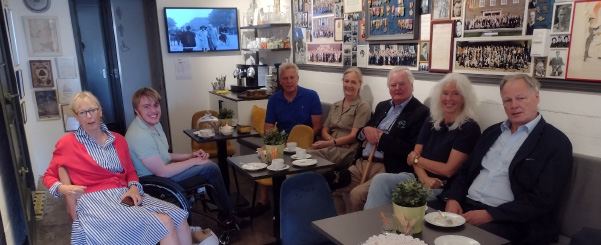
On Saturday 16 July I had the pleasure of welcoming five of Leen Koops’s six children: Eric, Michael, Jan, Annette and Linda.18
With the help of Maurits Huijbrechtse, I told them something over coffee and cake about the “Engelandvaarders” and how the museum came about. Maurits and I gave a short “tandem tour” of sorts: I covered the main thread and he filled in the details, which turned out to be a surprisingly good combination. Our guests grew more and more interested. We then went into the bunker, where we added some explanation here and there and answered their questions. In the last room, opposite the boat, at the database, everyone fell silent. I let them type in their father’s surname, and his story appeared. I waited for them in the coffee corner with “tea and sympathy”, as it was a moving moment for our guests.
The brothers and sisters were impressed by our museum and agreed unanimously that Leendert Koops’s Second World War artefacts would be in good hands with us: his pilot’s logbook, his decorations, photographs and his dog tag, to name just a few.
It is always a special moment, by the way, to hold in your hands these personal items that were carried on missions.
After signing the donation agreement, the Koops family announced that they would be back, possibly as early as September, bringing their spouses, children and grandchildren to “this important museum”.
Now that his “war time history” has come to light after 38 years, I understand how Leen Koops responded to my question in 1984. I am glad that now, at least, I can welcome his children and grandchildren as their host in September.
As long as relatives of “Engelandvaarders” and Engeland-gangers (those who reached England by other means) still find their way to our museum to read about and share in their family members’ experiences, it is not yet history, in my view. It only becomes history when these documented stories no longer strike a chord at all.