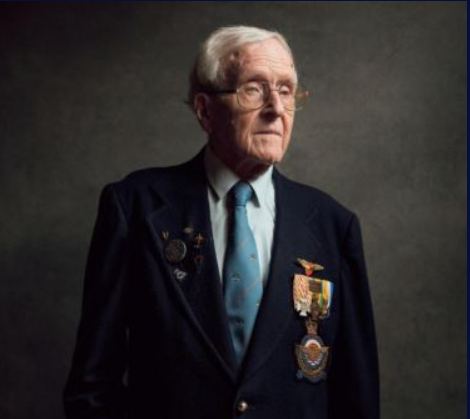
“Engelandvaarder” André Hissink died in Perth, Canada, on 1 January 2024, at the age of 104.
André Louis Armand Hissink was born in Batavia on 26 June 1919. When the Second World War broke out, he was a third-year law student at the University of Utrecht, where he also lived. Because of the mobilisation he had been stationed as a conscript at Soesterberg since October 1939, and later in Rotterdam, where he fought German troops on 10 May 1940. During the bombing of Rotterdam he sheltered, along with many others, in the still unfinished Maas Tunnel. He held the destruction of the city bitterly against the Germans and was determined to make the enemy pay for it.
After the Dutch surrender, he ran, walked and hitchhiked with two friends, Bill Hamilton of Silverton Hill and Jan Wildeman, to Hook of Holland. There they managed to get aboard a British minesweeper, HMS Keith, which was sunk a month later during the evacuation of the British Expeditionary Force from Dunkirk.
On arrival in England he reported to the Marine Luchtvaartdienst (MLD, the Dutch Naval Air Service), which had also moved to England by then. He joined a contingent of trainee aircrew from the army air force (LSK) who were sent via South Africa to the naval air station at Morokrembang, Surabaya (Dutch East Indies). There he trained as an MLD officer pilot/observer.
He flew two operational sorties when Japanese troops invaded the Dutch East Indies in December 1941. During the Japanese invasion of Java in 1942, the MLD flying school was evacuated to Australia and then to the United States, where the Royal Netherlands Military Flying School (RNMFS) was set up in Jackson, Mississippi. There, with other Dutchmen, he completed his training as a pilot/observer.
In early 1943 he was posted to England, where he became a bomb aimer/navigator with the Dutch 320 Squadron of the RAF. During an attack on German troops in the Belgian Ardennes, he and his crew had to bail out by parachute; one of the gunners, Joop Jillings, was killed.
In all, André flew 69 operational sorties: 2 over the Dutch East Indies and 67 over France, Germany and the Netherlands.
After the war he worked for KLM in Switzerland, among other places, as a flight-planning & operations officer, and later in New Zealand as a navigation & mapping officer. Having to give up his Dutch nationality to take a job in New Zealand was a bitter disappointment to him, as he deeply loved his native country. He travelled to the Netherlands as often as he could to spend some time there. He also worked for about four years in Vancouver as an operations officer with Canadian Pacific Airlines (CPA). In Montreal he continued his career at the International Civil Aviation Organization (ICAO), the United Nations agency responsible for the orderly and safe operation and further development of civil aviation.
In August 2016 he was a guest at a reunion of the Dutch 320 Squadron at the former Dunsfold airfield in the United Kingdom, together with Edward Hoenson, Camille Stritzko and Eduard Jacob, where he gave an impressive speech. At the memorial service for Edward Hoenson in Schaarsbergen in May 2018 he also said a few words, urging those present never to forget 320 Squadron’s part in the liberation of the Netherlands.
As one of the few Dutch Second World War veterans to do so, he talked often and generously about this chapter of his life and his part in the Dutch 320 Squadron, always speaking with reverence of his English wife Janet, who from 1941 onwards followed him everywhere at the risk of her own life. He helped many journalists and programme makers by sharing his memories of the Second World War with them.
Living in Perth, he celebrated his 100th birthday in 2019. Earlier that year, on 4 June 2019, he had visited Museum Engelandvaarders. Just a day later he stood on the podium of honour in Portsmouth, United Kingdom, under the motto “a tribute to the heroes”, for the 75th anniversary of D-Day.
In June 2021, shortly after his 102nd birthday, Museum Engelandvaarders and the NIMH (Netherlands Institute for Military History) launched a joint initiative to apply for André’s re-naturalisation. The request was granted on 26 May 2022, when the Dutch Ambassador in Ottawa presented him with a document confirming that he had regained his Dutch nationality – the fulfilment of a long-cherished wish.
He held the War Commemorative Cross with the clasps Oorlogsvluchten 1940-1945 (War Flights), Nederland mei 1940 (Netherlands May 1940) and Javazee 1941-1942 (Java Sea). Because of his large number of operational sorties he was also awarded the Airman’s Cross (Vliegerkruis).
NOS news report “He is Dutch again”
NOS news report on the death of “Engelandvaarder” André Hissink